Relationship Intentionality: What It Means and How to Practice It

Relationship Intentionality: What It Means and How to Practice It
Relationship intentionality means choosing, on purpose, the daily actions that sustain closeness with your partner rather than letting connection happen by accident. Try this within the next 24 hours: put your phone face-down, look your partner in the eye, and ask one genuine question about their day. That 60-second moment is intentionality in action. Mental health organizations, couples therapists, and neuropsychologists all point to the same conclusion: intentional relationships use commitment, deliberate rituals, and conscious conflict engagement to maintain closeness over time.
Key Takeaways
Relationship intentionality works through small, consistent actions repeated daily, not through grand gestures or single conversations.
| Point | Details |
|---|---|
| Definition | Relationship intentionality means choosing deliberate actions to sustain closeness rather than letting connection happen by accident. |
| Micro-rituals over grand gestures | Daily check-ins and specific appreciative messages build more durable emotional safety than infrequent large efforts. |
| Intention needs action | Good intentions without empathy and follow-through commonly fail; pair every intention with a scheduled, specific behavior. |
| Start with one ritual | Pick one micro-ritual, attach it to an existing habit, and review after seven days before adding more. |
| Pingher reduces friction | Pingher’s one-tap messaging and reminders help couples sustain daily appreciation rituals without daily decision-making. |
Table of Contents
- Why intentionality changes the health of your relationship
- What intentionality looks like day-to-day: daily and weekly rituals
- How to start practicing relationship intentionality, step by step
- How to handle conflict with intentionality: a short protocol
- Why good intentions fail and the practical fixes that actually work
- Conversation prompts, short exercises, and a 7-day starter plan
- What experts say, and when to seek professional help
- The gap between knowing and doing
- Pingher helps you keep the small things consistent
- Sources
Why intentionality changes the health of your relationship
Most couples don’t drift apart because they stop loving each other. They drift because life fills the space that connection used to occupy, and nobody made a deliberate choice to protect it.
Practicing relationship intentionality shifts that dynamic. When you act with purpose, you signal safety to your partner’s nervous system. Repeated, predictable acts of care engage the brain’s executive-control systems and strengthen neural pathways linked to trust and reward. The brain registers “this person shows up for me” not from a single grand gesture but from a hundred small, consistent ones.
The practical benefits stack up quickly:
- Increased emotional safety: Your partner learns what to expect from you, which lowers defensiveness.
- Stronger appreciation: Naming what you value about each other regularly prevents resentment from accumulating quietly.
- Faster conflict repair: Couples with established rituals return to baseline faster after disagreements because the relationship already feels secure.
- Reduced reactive escalation: When both partners feel seen day-to-day, minor friction is less likely to trigger a full argument.
A concrete example: couples who use a brief daily check-in, as outlined in effective communication strategies for the workplace, tend to experience fewer cancellations of plans due to airing small grievances before they compound. The importance of intentionality in relationships is also a public-health matter. Mental Health America notes that social connection and relationship health are central to overall mental well-being, not just a nice bonus.
Pro Tip: Daily affection reminders are one of the lowest-effort ways to build this predictability. A scheduled appreciative message costs 30 seconds and lands as a consistent signal of care.

What intentionality looks like day-to-day: daily and weekly rituals
Rituals are predictable signals of care. They don’t need to be elaborate. According to The Couples Center, small, consistent micro-actions outperform grand gestures for building sustained emotional safety. The goal is repetition, not spectacle.
Daily micro-rituals (under 5 minutes each)
- A 60-second non-distracted check-in at the start or end of the day
- One specific appreciative text (“I noticed you handled that call really well today”)
- A non-sexual touch: a hand on the shoulder, a brief hug when you leave or arrive
- Saying your partner’s name when you greet them
- Putting your phone away during one shared meal
- A single “thinking of you” message mid-afternoon
- Asking one open question rather than a yes/no (“What was the hardest part of your day?”)
Weekly rituals (30–60 minutes)
- A 30-minute connection conversation with no agenda except catching up
- A shared activity you both enjoy, even something as simple as a walk
- A weekly planning alignment: five minutes to sync calendars and reduce logistical friction
- A brief appreciation exchange: each partner names one thing they noticed and valued that week
- A relationship check-in question (see Section 7 for prompts)
Micro-example, daily: One partner sends a specific compliment every morning before work. Within two weeks, the other partner starts initiating physical affection more often. No conversation about it. The signal was received. For thoughtful compliments that land with specificity, a few templates go a long way.
Micro-example, weekly: A couple schedules 30 minutes every Sunday evening to talk without phones. After a month, they report that Monday mornings feel noticeably less tense.

How to start practicing relationship intentionality, step by step
Building intentional relationships doesn’t require a personality overhaul. It requires a small, repeatable starting point.
- Assess where you are. Spend five minutes writing down what you currently do, on purpose, to show your partner you care. If the list is short, that’s useful information, not a verdict.
- Pick exactly one ritual. Not three. One. Choose the daily micro-ritual that feels most natural to you from the list above.
- Schedule it. Put it in your calendar or attach it to an existing habit. “After I pour my morning coffee, I send one appreciative message” is more durable than “I’ll do it when I remember.”
- Make it frictionless. Habit stacking works because it removes the decision. If sending a message is the ritual, keep a few affection message templates on hand so you never stare at a blank screen.
- Review after seven days. Ask yourself: did I do it? Did my partner seem to notice? What felt awkward? Adjust one thing and continue.
Two communication scripts to use right now
For a daily check-in: “I have about five minutes. What’s one thing on your mind today that I should know about?”
For a repair after conflict: “I know we left that conversation in a rough place. I’d like to try again when you’re ready. What would help you feel heard right now?”
Both scripts are short enough to remember and specific enough to actually use.
Pro Tip: Reminders improve relationship health precisely because they remove the cognitive load of remembering. Set a recurring phone reminder for your chosen ritual and treat it like any other appointment.
If your partner resists: Don’t frame the ritual as a relationship-improvement project. Frame it as something you want to do for them. “I want to check in with you more. Can I ask you one question at dinner?” is far less threatening than “We need to be more intentional.”
How to handle conflict with intentionality: a short protocol
Conflict handled badly erodes the safety that intentionality builds. A short, repeatable protocol keeps disagreements from becoming relationship debt.
- Pause. Before responding to a charged moment, take one slow breath. This is not avoidance. It’s the difference between reacting and choosing.
- Name the feeling. Say what you’re experiencing, not what your partner did wrong. “I feel dismissed” opens a door. “You never listen” closes one.
- Make a specific request. Not “be more supportive” but “can you put your phone down when I’m telling you something difficult?”
- Repair with a behavior, not just an apology. Follow through on the request within 24 hours.
A 3-step repair script
This script works because it names the emotion, attaches it to a specific event, makes a concrete request, and commits to a visible action. Heartfelt communication that follows this structure reduces the chance that repair attempts get dismissed as hollow.
Couples who maintain consistent micro-rituals find conflict repair easier because the relationship already carries a surplus of positive signals. A single rough evening doesn’t feel catastrophic when the baseline is warm.
Why good intentions fail and the practical fixes that actually work
Wanting to be a better partner is not the same as being one. Psychology Today’s analysis makes this plain: good intentions without empathy and follow-through commonly fail to sustain relationships. Intention must be paired with listening and action.
Here are the most common traps and their direct fixes:
- Intention without empathy. You plan a thoughtful gesture but miss what your partner actually needs right now. Fix: ask before acting. “What would feel most supportive to you this week?” takes 10 seconds.
- Intention without follow-through. You commit to a ritual and abandon it after three days. Fix: make the ritual so small it’s almost impossible to skip. One sentence, not a letter. One minute, not an hour.
- Overcomplicating rituals. You design an elaborate weekly date night that requires coordination and ends up feeling like a chore. Fix: start with something that takes under five minutes and build from there.
- Assuming one size fits all. You copy a ritual from a podcast without checking whether it fits your relationship. Fix: intentionality is customized to your specific dynamic, not borrowed wholesale from someone else’s.
- Treating intention as a one-time decision. You have a big conversation about “being more intentional” and then wait for things to change. Fix: translate the decision into a scheduled, specific micro-action within 48 hours.
The pattern across all these pitfalls is the same: the gap between wanting and doing. Closing that gap requires specificity, scheduling, and empathy, not more motivation.
Conversation prompts, short exercises, and a 7-day starter plan
High-leverage prompts open conversations that surface what your partner actually values, not just what’s logistically happening in their life.
- “What’s something I do that makes you feel most loved?”
- “Is there anything you’ve been wanting to tell me but haven’t found the right moment?”
- “What does a really good week look like for you right now?”
- “What’s one thing we could do differently that would make you feel more connected to me?”
- “What are you most proud of lately that I might not know about?”
These prompts work because they’re curiosity-focused and low-stakes. No partner feels accused or evaluated by them.
7-day starter plan
| Day | Action | Time |
|---|---|---|
| Day 1 | Send one specific appreciative message | 2 minutes |
| Day 2 | 60-second non-distracted check-in at dinner | 1 minute |
| Day 3 | Ask one of the prompts above during a quiet moment | 5 minutes |
| Day 4 | Initiate one non-sexual physical touch with intention | 30 seconds |
| Day 5 | Write down one thing you noticed and valued about your partner | 3 minutes |
| — | Use the daily check-in script from Section 4 | 5 minutes |
| Day 7 | Share what you wrote on Day 5 out loud | 5 minutes |
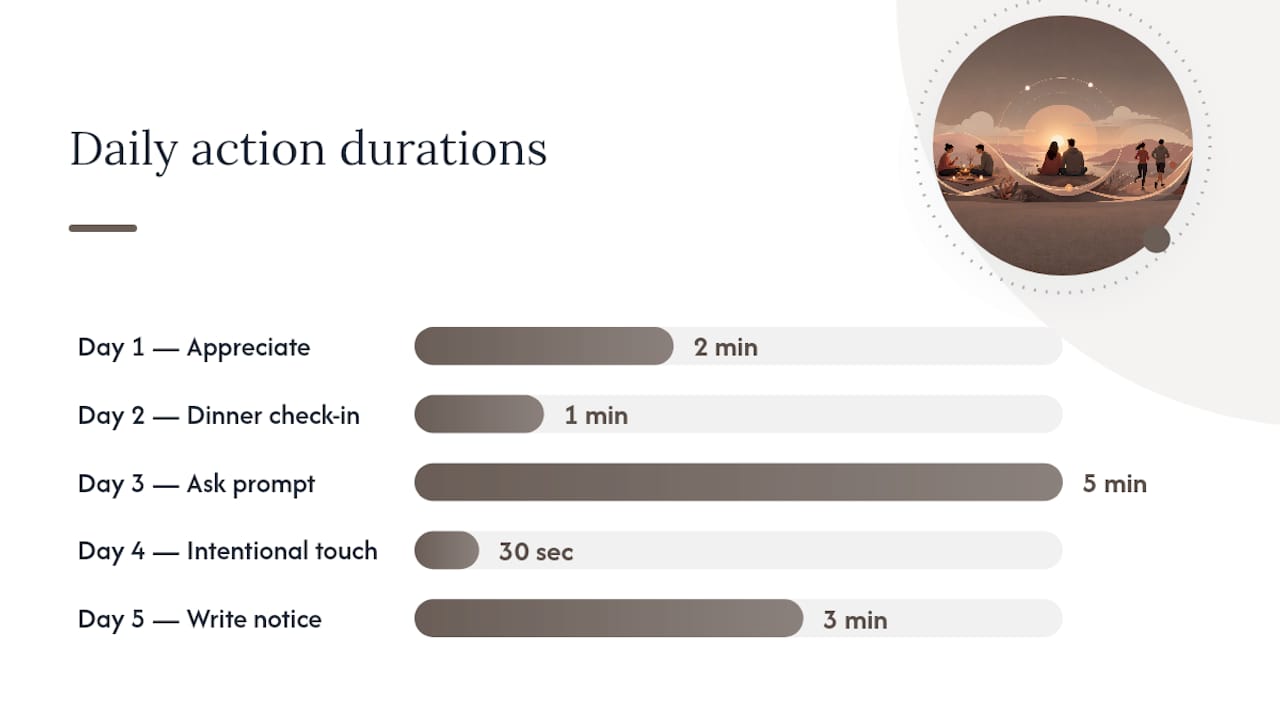
Keep each action under 15 minutes. Measure how you feel after each one, not whether you did it perfectly. Emotional response is the signal that tells you whether a ritual is working.
What experts say, and when to seek professional help
The neuropsychological case for micro-rituals is straightforward. Choosing deliberate behaviors, such as listening without interrupting, expressing gratitude, or initiating repair, engages prefrontal executive functions. When repeated, these behaviors strengthen neural pathways tied to safety and reward. Small acts activate the same bonding systems as larger gestures because the brain responds to pattern and predictability, not scale.
Therapists who work with couples consistently describe intentionality as a practice rather than a personality trait. Better Together Family Therapy frames it as active commitment: choosing rituals of connection and engaging with conflict deliberately rather than avoiding it. Relationship communication health built on these habits tends to be more durable than connection that depends on mood or circumstance.
When to seek professional help
Some patterns signal that self-guided practice isn’t enough:
- Persistent emotional withdrawal that doesn’t respond to repair attempts
- Chronic conflict escalation where arguments regularly become contemptuous or threatening
- A sense that one or both partners have already emotionally disengaged
- Any concern about safety, including emotional, verbal, or physical harm
If any of these apply, a licensed couples therapist is the right next step. The American Association for Marriage and Family Therapy (AAMFT) offers a therapist locator at aamft.org. For immediate safety concerns, the National Domestic Violence Hotline is available at 1-800-799-7233.
The gap between knowing and doing
The most overlooked truth about building intentional relationships is that knowledge doesn’t close the gap. Plenty of couples understand what they should do. They’ve read the books, listened to the podcasts, had the conversations. What they haven’t done is make the behavior small enough and scheduled enough to survive a busy Tuesday.
The rituals that stick aren’t the ones that feel most meaningful in theory. They’re the ones that require the least friction on the worst days. A 90-second appreciative text sent from a parking lot before a stressful meeting does more for a relationship than a beautifully planned date night that gets canceled three times.
There’s also a tendency to treat intentionality as something you practice when the relationship needs repair. That framing gets it backwards. Intentionality is maintenance, not rescue. The couples who handle conflict well aren’t the ones who fight less. They’re the ones who’ve built enough goodwill through consistent small actions that a hard conversation doesn’t feel like a threat to the whole relationship.
Pingher helps you keep the small things consistent
Keeping micro-rituals consistent is where most couples struggle, not because they don’t care, but because daily life competes for attention. Pingher is built for exactly that gap. The app lets you craft and send personalized, loving messages to your partner in one tap, with AI-powered suggestions and templates when you’re not sure what to say. You can schedule messages in advance, set reminders tied to specific times or dates, and build a daily habit of appreciation without it requiring mental effort every single day.
For couples who want the benefits of thoughtful digital communication without the friction of starting from scratch each time, Pingher removes the blank-screen problem entirely. Visit Pingher to explore the free tier and see how one-tap messaging fits into your daily rituals.
Sources
- Why Good Intentions Aren’t Enough for a Good Relationship — Psychology Today
- How Can Couples Be More Intentional About Their Relationship Without Overcomplicating It? - The Couples Center
- The Science of Intentionality in Romance | Opinion | Outlook Newspapers
- The Importance of Intentionality in our Relationships — Better Together Family Therapy
- State of Mental Health America
This article is general information, not a substitute for advice from a qualified doctor. Consult a qualified healthcare professional about your own circumstances before acting on anything here.
Recommended
Built for couples who care.
Pingher helps you send the right words at the right moment.
Get Pingher on Google Play