Thoughtful Digital Communication for Stronger Relationships

Thoughtful Digital Communication for Stronger Relationships
Thoughtful digital communication is the intentional practice of crafting online messages with clear language, respect, and emotional awareness to reduce misunderstandings and build genuine connection. Unlike face-to-face conversation, digital messaging strips away tone of voice, facial expressions, and body language. That loss creates real risk in relationships. A single poorly worded text can spark conflict that takes hours to resolve. Tools like Grammarly help with clarity and tone checking, and platforms like Pingher are built specifically to help couples send messages that feel personal and emotionally resonant. Mindful digital communication is not a luxury. For couples and individuals who rely on screens to stay close, it is a daily necessity.
What is thoughtful digital communication and why does it matter?
Digital communication is more than words. It involves strategic expression, virtual presence, and thoughtful tone to build meaningful connections. That definition matters because most people treat texting as casual and low-stakes. In relationships, it rarely is.
The core challenge is the absence of nonverbal cues. When you speak in person, your partner reads your face, your posture, and your voice. A text gives them none of that. The brain fills the gap by defaulting to the most emotionally charged interpretation, which is often the negative one. Thoughtful online interactions counteract that default by making intent explicit.
Misunderstandings in digital channels escalate faster than in person because there is no immediate feedback loop. You send a message, your partner reads it, and they react before you can clarify. Emotional regulation, which means pausing before you respond rather than firing back instantly, is a core component of effective digital messaging. Without it, small miscommunications compound into real conflict.
Thoughtfulness in digital communication also protects mental health. Good digital habits reduce conflict and mental health strain, making them a wellbeing protective behavior. That is a concrete reason to treat every message as worth a second look before you hit send.

How does digital empathy improve online interactions?
Digital empathy involves recognizing feelings and responding kindly online to compensate for missing nonverbal cues and minimize conflicts. It is not just about being nice. It is an active set of behaviors that replace what tone of voice and eye contact do in person.
The practical behaviors of digital empathy include:
- Pausing before replying. When a message triggers a strong reaction, wait at least a few minutes before responding. Emotional urgency produces reactive messages that almost always make things worse.
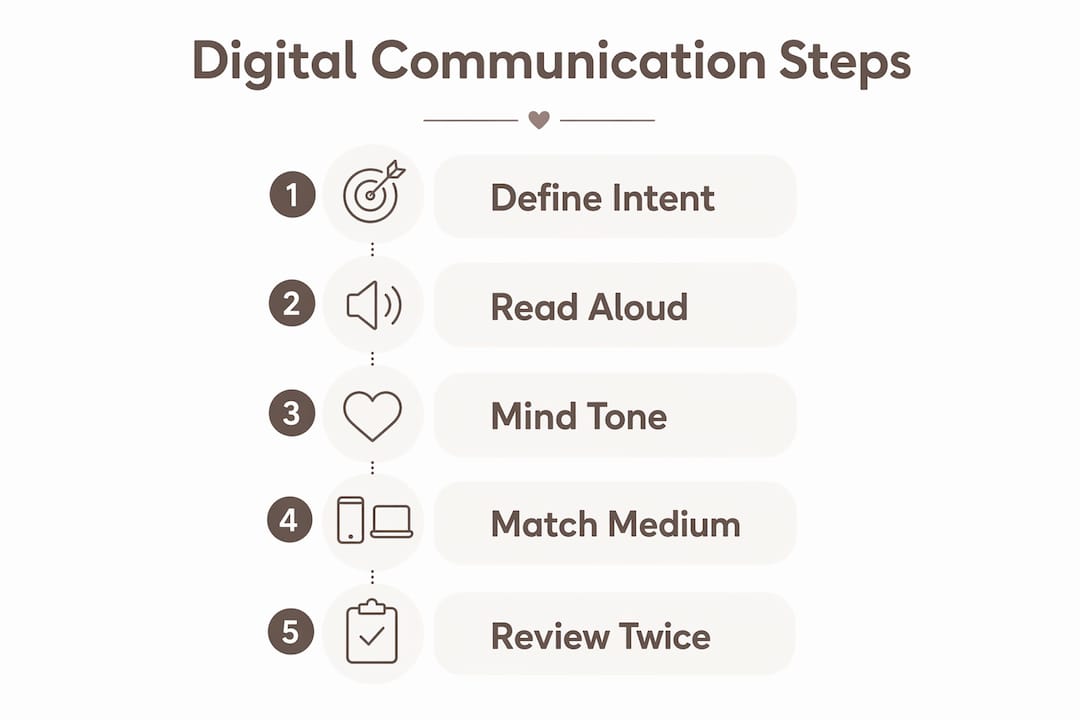
- Rereading for tone. Before sending, read your message as if you are the recipient. Ask whether the words could be read as cold, dismissive, or aggressive.
- Asking clarifying questions. When a message from your partner seems off, ask what they meant before assuming the worst. “Did you mean X?” prevents a spiral.
- Confirming understanding. After a difficult exchange, summarize what you heard. “So you’re saying you felt ignored, not that you were angry at me?” closes the loop and prevents lingering resentment.
Pro Tip: Before sending any message during a conflict, read it aloud quietly. If it sounds harsh out loud, it will read even harsher on a screen.
Digital etiquette builds on empathy by adding structure. Core etiquette principles include respect, clarity, attention to timing, and honoring boundaries. Timing matters more than most couples realize. Sending a heavy emotional message at 11 p.m. when your partner is exhausted is not thoughtful, regardless of how carefully you worded it. Respecting the moment is part of respecting the person.
Why do punctuation and formatting affect how messages feel?
Small textual choices carry emotional weight that most people underestimate. Research on punctuation shows that placing a period after a single word conveys abruptness or frustration, affecting how recipients interpret tone even when no negative intent existed.
That finding has direct implications for couples. A message like “Fine.” reads as cold or dismissive. “Fine!” reads as sarcastic. “Fine, sounds good!” reads as warm and agreeable. The content is identical. The punctuation changes everything. Message formatting cues actively influence recipient interpretation, which is why tone-checking before sending is not optional in close relationships.
The table below shows how small edits shift the emotional register of common messages:
| Original message | How it reads | Revised message | How it reads |
|---|---|---|---|
| “Fine.” | Cold, dismissive | “Sounds good to me!” | Warm, agreeable |
| “Whatever.” | Frustrated, checked out | “I need a little time, then we can talk.” | Honest, respectful |
| “K.” | Annoyed, disengaged | “Got it, thanks.” | Neutral and kind |
| “Why didn’t you tell me.” | Accusatory | “I wish I’d known sooner.” | Vulnerable, not attacking |
The drafting strategy that works best is writing your message twice. Drafting messages twice, first for content and then for tone and formatting, prevents unintentional harshness in couples’ texting. Write what you want to say, then go back and read it purely for how it feels. Those are two separate tasks, and combining them produces worse results than separating them.
How to communicate thoughtfully online: practical strategies for couples
Building better digital communication habits does not require a complete overhaul of how you text. A few consistent practices produce noticeable results.
Use a pre-send mental check. Before sending any message with emotional weight, run through three questions: What is my intent? What emotional state might my partner be in right now? How could this message be misread? A personal pre-send script that checks intent, recipient context, and anticipated interpretation concretely supports thoughtful communication. This takes about ten seconds and prevents a significant share of digital conflicts.
Match the medium to the message. Text is fine for logistics and light affection. For anything emotionally complex, a voice call or video chat restores the nonverbal cues that text removes. Couples who default to text for every conversation, including hard ones, create unnecessary friction. Reserve sensitive topics for richer channels.
Create shared communication signals. Couples who develop their own shorthand, whether that is a specific emoji that means “I need space right now” or a phrase that signals “I’m not upset, just tired,” reduce misinterpretation significantly. These shared codes replace the nonverbal cues that digital channels strip away.
Use clarity tools when stakes are high. Tools like Grammarly support clear, empathetic, and respectful digital messaging. For a difficult message about finances, a disagreement about plans, or an apology, running your draft through a tone checker adds a useful outside perspective.
- Send appreciation messages consistently, not just during conflict repair. Daily affirmation builds a positive baseline that makes hard conversations easier.
- Avoid sending emotionally loaded messages when you are hungry, tired, or stressed. Your judgment about tone degrades under those conditions.
- When you receive a message that upsets you, wait before replying. The goal is a response, not a reaction.
- Ask your partner directly how they prefer to receive difficult news. Some people want a heads-up call first. Others prefer text so they can process privately.
Pro Tip: Schedule one weekly check-in via voice or video call specifically for anything that felt unresolved in your text exchanges that week. It clears the backlog before it becomes resentment.
Building relationships through digital media requires consistency. One thoughtful message does not transform a relationship. A sustained habit of clear, kind, and intentional messaging does.
Key takeaways
Thoughtful digital communication requires clarity, digital empathy, and consistent tone-checking to protect emotional connection in relationships.
| Point | Details |
|---|---|
| Define your intent first | Ask what you want the message to accomplish before you write a single word. |
| Punctuation carries emotion | A period or a missing word can read as cold or hostile even when no harm was intended. |
| Draft twice for sensitive messages | Write for content first, then review separately for tone and formatting. |
| Match medium to message weight | Use voice or video for emotionally complex conversations, not text. |
| Empathy is a daily habit | Consistent small gestures of clarity and kindness build stronger emotional bonds over time. |
What I’ve learned from paying attention to digital tone
The single biggest shift I made in how I communicate digitally was treating every message as a first impression. Not because I am performing for someone, but because the person on the other end cannot see my face or hear my voice. They only have the words and the punctuation. That is a thin signal for something as complex as a relationship.
I used to send short, clipped replies when I was busy. “K.” “Sure.” “Later.” I thought I was being efficient. What I was actually doing was leaving the other person to fill in the emotional blank, and they almost always filled it with something negative. The moment I started adding one extra word or a warmer sign-off, the responses I got back changed noticeably.
The other thing I have come to believe strongly is that digital empathy is not a soft skill. It is a discipline. Pausing before you reply when you are upset is genuinely hard. Rereading a message for tone when you are in a hurry feels like friction. But those two habits alone prevent more relationship damage than any amount of post-conflict repair work.
Couples who treat their text exchanges as an extension of their relationship, rather than a utility for logistics, communicate differently. They check in without a reason. They send a message that says “thinking of you” with no agenda. Those small signals accumulate into something real. The technology is neutral. What you do with it is not.
— Alan
How Pingher helps you send messages that matter
Knowing what thoughtful digital communication looks like is one thing. Building the habit of doing it daily is another.
Pingher is built for exactly that gap. The app helps you craft and send personalized messages to your partner with one tap, so expressing love and appreciation becomes a daily habit rather than an afterthought. Pingher combines the convenience of a quick send with the personal touch that makes a message feel genuinely meant. For couples who want to strengthen their emotional bond through consistent, warm digital communication, Pingher removes the friction that usually gets in the way.
FAQ
What is thoughtful digital communication?
Thoughtful digital communication is the intentional practice of crafting online messages with clear language, respect, and emotional awareness. It compensates for the absence of nonverbal cues by making intent explicit and tone deliberate.
How does digital empathy differ from regular empathy?
Digital empathy applies the same core principle of recognizing and responding to feelings, but adds compensatory behaviors like pausing before replying and confirming understanding to offset what text-only communication removes.
Why does punctuation matter so much in text messages?
Research shows that small formatting details, including periods after single words, significantly influence perceived emotion. A period can read as cold or frustrated even when the sender intended nothing negative.
What is the best strategy for avoiding misunderstandings in couple texting?
Draft your message twice: once for content and once for tone. Then run a quick pre-send check asking about your intent, your partner’s likely emotional state, and how the message could be misread.
When should couples avoid using text for communication?
Text is poorly suited for emotionally complex conversations, conflict resolution, or delivering difficult news. Voice calls and video chats restore the nonverbal cues that make sensitive topics easier to navigate without misinterpretation.
Recommended
Built for couples who care.
Pingher helps you send the right words at the right moment.
Get Pingher on Google Play