Why Communication Tools Support Relationships That Last

Why Communication Tools Support Relationships That Last
Communication tools are methods and technologies that help couples exchange thoughts, feelings, and needs with greater clarity and less friction. Understanding why communication tools support relationships matters because the gap between what you mean and what your partner hears is where most conflict lives. Tools like asynchronous messaging, video calls, shared calendars, and structured frameworks such as Gottman’s Love Maps give couples concrete ways to close that gap. Research from 2026 confirms that intentional tool use reduces impulsive reactions, improves emotional attunement, and builds the kind of trust that sustains long-term relationships.
Why communication tools support relationships at the emotional level
Communication tools improve emotional clarity by slowing down the exchange and creating space for reflection. When a conversation is charged, the brain defaults to defense. A text message or voice note gives your partner time to process before responding, which reduces impulsive reactions during conflict. That pause alone changes the outcome of thousands of small disagreements each year.
Asynchronous messaging is the term for communication that does not require both people to be present at the same time. It is one of the most underused tools in relationships. When one partner is an introvert or processes emotions slowly, asynchronous formats give them room to articulate what they actually feel rather than what they blurt out under pressure.
Video calls serve a different function. A 10 to 20 minute video call is more effective than text for complex emotional topics because it restores nonverbal cues: facial expressions, tone, and eye contact. Those cues carry a large share of emotional meaning. Stripping them out of a difficult conversation increases the chance of misreading intent.
The benefits of multimodal communication, meaning using more than one format depending on the situation, are well supported by therapists and researchers alike. No single mode is consistently superior. The skill is knowing which tool fits the moment.
- Asynchronous messaging (text, voice notes, email): best for processing complex feelings before responding
- Video calls: best for emotional topics where tone and expression matter
- Shared calendars (Google Calendar, Apple Calendar): best for reducing mental load and scheduling conflict
- Structured frameworks (Gottman’s Love Maps): best for building deep knowledge of each other over time
Pro Tip: Reserve video calls for any conversation where you have already sent three or more texts and still feel misunderstood. The format shift alone often resolves the confusion.
What relationship challenges do communication tools help solve?
The demand-withdraw pattern is one of the most damaging cycles in relationships. One partner pushes for connection; the other retreats. Gottman-based frameworks like Love Maps directly address this pattern by giving both partners a structured way to stay curious about each other. Quantitative studies confirm that couples using these frameworks report better marriage quality and higher trust over time.

Mental load is a second major challenge. Mental load refers to the invisible cognitive work of tracking schedules, appointments, and household responsibilities. When one partner carries most of it, resentment builds quietly. Shared digital calendars and reminder apps distribute that load visibly, so neither partner feels like the sole manager of the relationship’s logistics.
Conflict resolution is a third area where tool choice matters enormously. Text is fine for low-stakes disagreements. For anything involving hurt feelings, unmet needs, or recurring patterns, text strips out too much context. Couples who default to text for every conflict tend to escalate faster and resolve slower.
Long-distance couples have adapted these tools most creatively. Many use asynchronous voice notes to maintain emotional presence across time zones, sending short recordings that feel more personal than a typed message and more flexible than a scheduled call.
| Communication mode | Best use case | Risk if misused |
|---|---|---|
| Text messaging | Quick updates, low-stakes check-ins | Misread tone, escalated conflict |
| Voice notes | Emotional updates, nuanced feelings | One-sided if partner rarely responds |
| Video calls | Deep conversations, conflict resolution | Screen fatigue if overused |
| Shared calendars | Scheduling, mental load distribution | Transactional feel without balance |
| Love Maps exercises | Building emotional knowledge | Feels forced without genuine curiosity |
Pro Tip: When a text conversation starts to feel tense, agree in advance on a signal word (like “call?”) that means both of you switch to voice or video immediately. This norm prevents text spirals before they start.
- Agree on response time norms so silence does not read as rejection
- Use message tagging or labels to flag emotional versus logistical messages
- Schedule a weekly video check-in even when you live together, treating it as a dedicated conversation slot
How to balance digital tools and genuine emotional effort
Tools are support systems, not substitutes for presence or vulnerability. This distinction matters more than most couples realize. Expert therapists are clear: tools should aid reflection, not replace the uncomfortable work of showing up honestly. A perfectly worded message drafted with outside help means nothing if the sender is emotionally checked out.
The risk of over-reliance is real. Using technology to polish or fake feelings damages trust over time. Emotional connection depends on honesty and accountability, not optimization. A partner who senses that your warmth is manufactured will eventually stop trusting the warmth at all.
Transparency is the safeguard. Couples who openly discuss how they use communication tools avoid the trust erosion that comes from feeling like a tool is acting as a silent third party in the relationship. If you use an app to draft a difficult message, saying so is almost always the better move.
Four practices keep digital communication grounded in genuine effort:
- Name your tools openly. Tell your partner which apps or frameworks you use and why. Transparency prevents the feeling that communication is being managed rather than shared.
- Protect tech-free time. Ritualized, non-digital connection windows, such as a phone-free dinner or a morning walk without earbuds, prevent the relationship from feeling transactional.
- Use tools to prepare, not perform. Draft a message to clarify your own thinking, then say the thing out loud. The tool serves the conversation; it does not replace it.
- Check in on the tools themselves. Ask your partner periodically whether the communication norms you have set still feel right. Needs change, and the tools should adapt.
What are the best practices for choosing and using relationship communication tools?
The best tool is the one both partners will actually use. WhatsApp and Signal are widely accepted for daily messaging because they are familiar and low-friction. Introducing a new app that one partner finds confusing creates more friction than it removes. Start with what already exists in both of your lives.
Setting norms matters as much as choosing the right app. Agreeing that a message tagged with a specific emoji means “I need a real response, not just a thumbs up” takes thirty seconds to establish and saves hours of misunderstanding. Response time norms are equally useful. Knowing that your partner checks messages at noon and 7 p.m. removes the anxiety of an unanswered text.
Incorporating Love Maps exercises into a weekly routine builds the kind of deep mutual knowledge that makes all other communication easier. Love Maps, developed by the Gottman Institute, are structured questions designed to help partners stay genuinely curious about each other’s inner world. Couples who practice them regularly report fewer assumptions and more accurate empathy.
Prompt-based tools and AI communication coaches are a newer category worth understanding. Practicing precision with these tools builds self-awareness of needs and context, which carries over into real conversations. The skill of articulating what you actually need, rather than what you think your partner wants to hear, improves with practice regardless of the medium.
Pro Tip: Limit your active communication tools to three at most: one for daily messaging, one for scheduling, and one for intentional emotional check-ins. App overload creates the same mental load the tools are meant to reduce.
Key takeaways
Communication tools support relationships most when couples use them intentionally, transparently, and alongside genuine emotional effort rather than as a substitute for it.
| Point | Details |
|---|---|
| Match the tool to the moment | Use video calls for emotional topics and text for low-stakes updates to reduce misreading. |
| Gottman frameworks reduce conflict | Structured exercises like Love Maps decrease the demand-withdraw pattern and build trust. |
| Transparency prevents erosion | Openly discussing tool use stops partners from feeling managed rather than heard. |
| Tech-free time is non-negotiable | Ritualized, non-digital connection prevents the relationship from feeling transactional. |
| Tools build real communication skills | Practicing clarity with digital tools increases self-awareness that improves face-to-face conversations. |
What I have learned about tools and real intimacy
The couples I have seen struggle most with communication are rarely struggling because they lack the right app. They are struggling because one or both partners are afraid to say the true thing. Tools can lower the activation energy for that conversation. They can give you the words, the format, and the timing. What they cannot do is make you brave.
That said, I have watched people genuinely improve as communicators by using structured tools consistently. When you practice articulating a need precisely in a message, you get better at doing it in person. The emotional connection built through that kind of deliberate practice is real, not manufactured.
The caution I carry is this: tools work only when partners engage in the uncomfortable work of intimacy. A shared calendar does not fix a relationship where one partner feels invisible. A perfectly timed reminder does not substitute for actually showing up. The technology is the scaffold. The relationship is the building. You still have to do the construction.
My honest recommendation is to pick one tool, use it consistently for 30 days, and pay attention to whether your real conversations improve. If they do, the tool is earning its place. If they do not, the problem is not the tool.
— Alan
How Pingher fits into a healthy communication practice
Staying emotionally present in a relationship takes more than good intentions. Life gets busy, and the small daily expressions of care are often the first things to slip.
Pingher is built for exactly that gap. With one tap, you can send a personalized message that reminds your partner they matter, without needing to carve out a long block of time. The app is designed to complement the communication practices covered in this article, not replace them. Think of it as the daily reminder layer that keeps affection visible between the deeper conversations. Couples who use Pingher’s messaging tools report feeling more consistently valued, which is the emotional baseline that makes every other conversation easier.
FAQ
Why do communication tools support relationships?
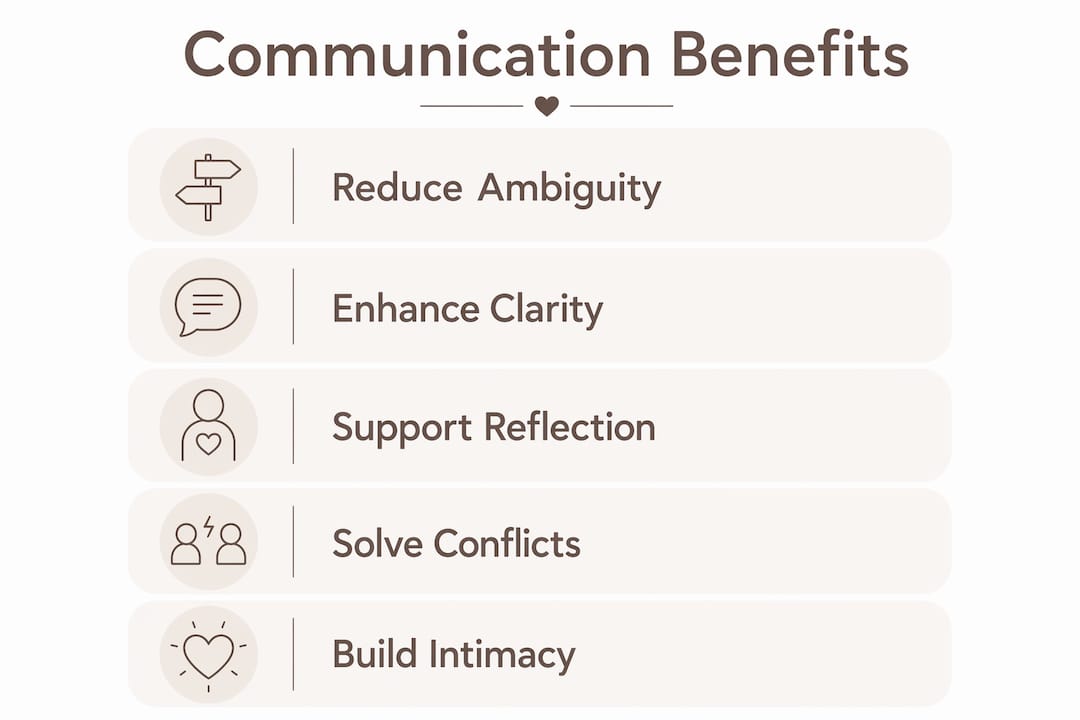
Communication tools reduce ambiguity, slow down reactive exchanges, and give couples structured ways to express needs. They work because clarity and consistency are the foundation of emotional trust.
What is the best communication tool for couples in conflict?
A 10 to 20 minute video call is more effective than text for complex emotional topics because it restores nonverbal cues that text strips away. Reserve text for low-stakes updates.
Can using too many communication tools hurt a relationship?
App overload creates the same mental load the tools are meant to reduce. Limiting active tools to three, one for messaging, one for scheduling, and one for emotional check-ins, keeps communication manageable.
What are Love Maps and how do they help couples?
Love Maps are structured questions developed by the Gottman Institute to help partners stay curious about each other’s inner world. Couples who practice them regularly report fewer assumptions and more accurate empathy.
Do communication tools replace the need for honest conversation?
Tools support honest conversation but do not replace it. Emotional connection depends on accountability and genuine effort. A tool that polishes or fakes feelings damages trust over time.
Recommended
Built for couples who care.
Pingher helps you send the right words at the right moment.
Get Pingher on Google Play