How Thoughtful Compliments Strengthen Your Relationship

How Thoughtful Compliments Strengthen Your Relationship
Thoughtful compliments are expressions of specific, genuine appreciation that build deeper emotional connections between partners. Unlike generic praise, they name a real trait, action, or quality you have observed in the other person. Research on the Gottman 5:1 ratio shows that thriving relationships maintain five positive interactions for every one negative one. Thoughtful compliments strengthen relationship health directly by contributing to that ratio. They also trigger oxytocin and dopamine release, which reduces stress and increases feelings of closeness. The good news is that you do not need to be naturally eloquent. You just need to know what to say and when to say it.
What makes a compliment thoughtful and effective in strengthening relationships?
The most effective compliments focus on character, not appearance. Telling your partner “you look great” is pleasant but forgettable. Telling them “the way you stayed calm during that difficult conversation showed real strength” lands differently. Character-based compliments increase trust and the feeling of being deeply understood, which appearance-based praise rarely achieves.
Effective compliments also use what researchers call “you-type” language. This means naming a specific action and connecting it to its impact on you or others. Compare these two:
- “You’re so thoughtful.”
- “The way you remembered my sister’s birthday without being reminded made her feel so loved.”
The second version is specific, grounded in reality, and shows you were paying attention. That specificity is what makes it feel sincere rather than performative.
Three qualities separate a meaningful compliment from a throwaway one:
- It names something real. You observed it. You are not guessing or flattering.
- It focuses on who they are, not just what they look like. Character, resilience, energy, and effort all count.
- It explains why it matters. The reason is what gives the compliment its weight.
Pro Tip: Use the “Because Formula” when giving a compliment: “Thank you for X because Y.” For example, “Thank you for handling the bills this month because it took real pressure off me.” Adding “no need to respond” at the end reduces pressure to reciprocate and makes the expression feel like a gift, not a transaction.
How to incorporate kind words into daily interactions

Consistency matters more than intensity. Waiting for a birthday or anniversary to express appreciation creates emotional gaps that build up over time. Everyday acknowledgment of routine efforts creates more emotional security than occasional grand gestures. Your partner needs to feel seen on a Tuesday, not just on Valentine’s Day.
Here is a practical framework for building a daily compliment habit:
- Start with one specific observation each morning. Notice something your partner did the day before or is doing right now. Name it out loud.
- Praise invisible labor. Paying bills, scheduling appointments, keeping the household running. These contributions are easy to overlook and deeply meaningful to acknowledge.
- Set a weekly kindness goal. Just one act of kindness per week is linked to reduced loneliness and stronger relationship bonds. A compliment counts.
- Use transitions as triggers. When you greet your partner after work or say goodnight, make one of those moments a consistent space for appreciation.
- Write it down when you cannot say it. A short note, a text, or a message sent through an app like Pingher can carry the same emotional weight as a spoken word.
The goal is not to manufacture five compliments a day on a checklist. The goal is to train your attention toward what your partner does well, so that genuine appreciation becomes your default mode.
Pro Tip: Keep a daily appreciation journal. Each evening, write one specific thing your partner did that you valued. After a week, you will have a list of genuine compliments to share and a clearer sense of how much your partner actually contributes.
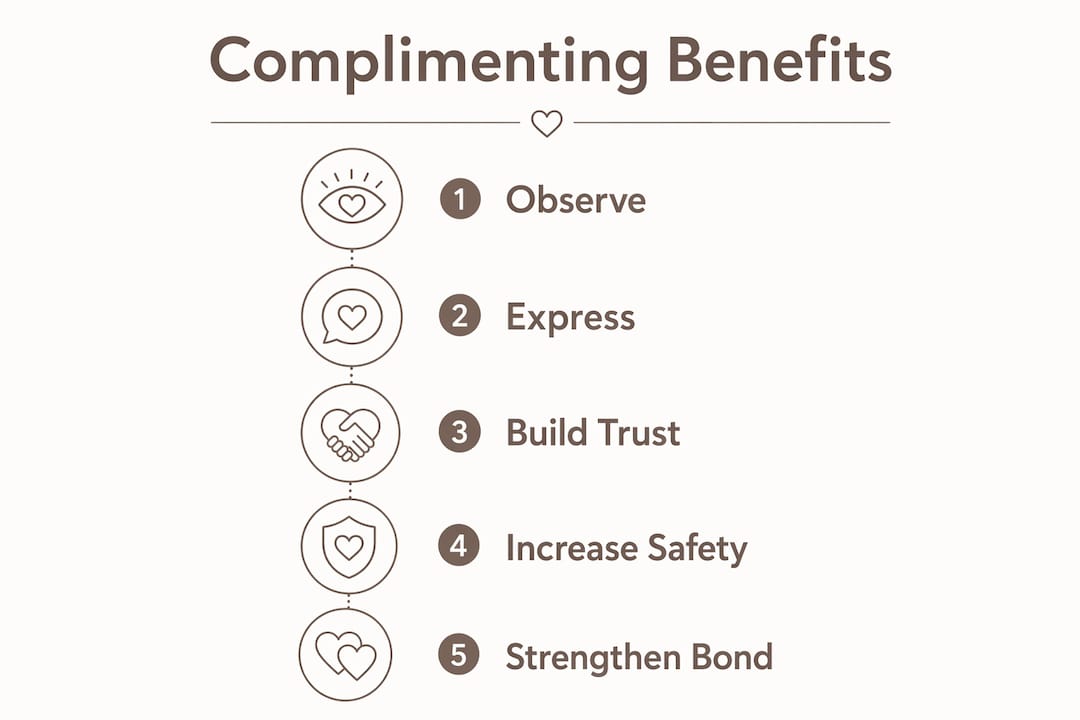
Common mistakes that make compliments feel forced or insincere
The biggest mistake couples make is giving vague compliments out of obligation. “You’re amazing” said without context feels hollow, especially if it follows an argument or comes across as a way to smooth things over. Vague praise does not build connection. It fills silence.
Watch for these patterns that undermine sincerity:
- Appearance-only compliments. Commenting only on how someone looks reduces them to their surface. It also creates pressure around physical changes over time.
- Compliments with a hidden ask. “You’re such a great cook” followed immediately by “can you make dinner tonight?” signals that the praise was instrumental, not genuine.
- Reciprocal pressure. Giving a compliment and then waiting visibly for one in return turns appreciation into a transaction. Offering a no-pressure out breaks that dynamic.
- Timing that feels strategic. Complimenting your partner right before a difficult conversation can read as manipulation, even when it is not intended that way.
The fix for most of these is simple: slow down and observe before you speak. A compliment grounded in a real, recent observation always reads as more genuine than one that sounds rehearsed. If you catch yourself reaching for a cliché, ask instead: “What did I actually notice about this person today?”
How do compliments build emotional safety and long-term trust?
Compliments are not just kind words. They are what relationship researchers call “bids for connection,” small signals that say “I see you and I value you.” When those bids are consistent, they rewire neural pathways toward patience and away from hostility. Over time, a relationship built on regular appreciation feels fundamentally safer than one where praise is rare.
Kindness is a fundamental biological bid for connection. When you express genuine appreciation, you are not just being polite. You are meeting a core human need for recognition, and your brain responds by releasing oxytocin, the bonding hormone that reduces stress and deepens trust.
The psychological benefits run in both directions. Expressing appreciation enhances fondness and admiration for both the person giving the compliment and the person receiving it. The giver shifts their attention toward what is working in the relationship. The receiver feels valued and more emotionally open. Both effects compound over time.
| Effect | Who benefits | Mechanism |
|---|---|---|
| Increased trust | Recipient | Feels seen and understood at a character level |
| Reduced loneliness | Both partners | Oxytocin and dopamine release from kindness |
| Stronger fondness | Giver | Attention shifts to partner’s positive traits |
| Lower hostility | Both partners | Neural pathways rewired toward patience |
| Greater relationship satisfaction | Both partners | Negativity bias offset by consistent appreciation |
Compliments also act as an antidote to contempt, which relationship research identifies as one of the most corrosive forces in long-term partnerships. When you practice appreciation as a habit, you train yourself to see your partner’s strengths first. That shift in perception protects the relationship during conflict, because your baseline view of your partner remains positive.
Key Takeaways
Thoughtful compliments strengthen relationships by building fondness, trust, and emotional safety through consistent, specific, and character-based appreciation.
| Point | Details |
|---|---|
| Specificity drives sincerity | Name a real action or trait you observed rather than offering vague praise. |
| Consistency beats grand gestures | Daily acknowledgment of small efforts builds more security than rare, big compliments. |
| Both partners benefit | Giving appreciation shifts your focus to positives, improving your own relationship satisfaction. |
| The “Because Formula” works | Adding a reason to your compliment makes it feel genuine and reduces pressure to respond. |
| Compliments rewire the brain | Regular kindness builds neural pathways toward patience and away from hostility over time. |
What I have learned from watching compliments change relationships
I have spent years reading relationship research and talking with couples about what actually shifts the emotional temperature in a partnership. The finding that surprises people most is this: the giver benefits as much as the receiver. When you train yourself to notice what your partner does well, you stop taking them for granted. That change in perception is not a side effect. It is the whole point.
Most people treat compliments as something they give when they feel inspired. The couples who thrive treat them as a habit, the way they treat brushing their teeth. Not because it feels romantic to be systematic, but because verbal appreciation in couples does not happen reliably on inspiration alone. Life gets busy. Attention drifts. A habit holds the practice in place when motivation fades.
The other thing I have noticed is that people underestimate the power of specificity. A compliment that names something invisible, something your partner thought no one noticed, lands with a force that “you’re amazing” never will. It says: I am paying attention. I see the real you. That is the message every person in a relationship most needs to hear.
Approach compliments as gifts, not obligations. A gift is given freely, without expectation of return. When you frame appreciation that way, both you and your partner feel the difference immediately.
— Alan
How Pingher helps you stay consistent with meaningful messages
Building a daily appreciation habit is simple in theory and easy to forget in practice. Pingher is built for exactly that gap. It gives couples a way to send personalized, heartfelt messages with one tap, so the intention to express love actually becomes a daily action.
Whether you want to acknowledge your partner’s invisible labor, share a specific compliment about their character, or simply remind them they matter on an ordinary Wednesday, Pingher makes that easy. The platform combines personal touch with real convenience, so thoughtful communication does not require a big time commitment. Couples who use appreciation rituals consistently report feeling more connected and more valued. Pingher is the tool that keeps those rituals alive. Visit Pingher and start sending the messages your partner deserves to hear.
FAQ
What makes a compliment thoughtful rather than generic?
A thoughtful compliment names a specific action, character trait, or contribution you genuinely observed. Generic praise like “you’re great” lacks the specificity that makes a compliment feel sincere and meaningful.
How often should partners give each other compliments?
Relationship research points to a 5:1 ratio of positive to negative interactions as the benchmark for thriving relationships. Aiming for at least one specific compliment daily keeps that ratio healthy.
Why do character-based compliments work better than appearance-based ones?
Character-based compliments increase trust and the feeling of being deeply understood. Appearance-based praise focuses on surface traits that change over time and do not reflect who a person truly is.
Can giving compliments benefit the person giving them?
Yes. Expressing appreciation shifts the giver’s attention toward their partner’s positive traits, which reduces negativity bias and improves the giver’s own relationship satisfaction.
What is the “Because Formula” and how does it help?
The “Because Formula” structures a compliment as “Thank you for X because Y.” Adding a reason makes the compliment feel grounded and genuine, and offering a no-pressure out removes any obligation to respond, making the exchange feel like a gift.
Recommended
Built for couples who care.
Pingher helps you send the right words at the right moment.
Get Pingher on Google Play