What Emotional Presence Means in Relationships

What Emotional Presence Means in Relationships
Emotional presence is the act of being fully attentive to another person’s inner experience, not just their words, but their feelings, body language, and unspoken needs. Cleveland-Innes and Campbell define it formally as the outward expression of emotion by individuals within a community of inquiry. In plain terms: it is what makes someone feel genuinely seen rather than merely heard. When it is missing, even a room full of people can feel lonely. When it is present, a single five-minute conversation can shift everything.
Key Takeaways
Emotional presence is the foundation of genuine connection, and it is built through small, repeatable acts of attention rather than grand gestures or constant availability.
| Point | Details |
|---|---|
| Core definition | Emotional presence is full attentiveness to another’s feelings, body language, and unspoken needs, not just their words. |
| A.R.E. checklist | Use Accessibility, Responsiveness, and Engagement to diagnose and repair moments of disconnection. |
| Two-second pause | Wait two seconds before responding in any important conversation; it signals absorption, not just hearing. |
| Presence vs. fixing | Shift from composing solutions to reflecting back what you heard before offering any response. |
| Try today | Pick one conversation and use one reflective statement: “What I’m hearing is…” and notice the difference. |
Table of Contents
- What does emotional presence look like in real relationships?
- How do you actually practice emotional presence?
- What gets in the way of being emotionally present?
- How does emotional presence differ from related concepts?
- What does the research say about the benefits of emotional presence?
- Why emotional presence is harder than it looks
- Sources
What does emotional presence look like in real relationships?
Emotional presence shows up in behavior, not intention. You can care deeply about someone and still be emotionally absent if your attention is split, your body is turned away, or your first instinct is to solve rather than listen. Psychology Today frames it as being wholly attentive and attuned to another’s words, body language, and feelings, creating safety that allows vulnerability.
Behavioral markers include:
- Attentive body language: facing the person, making natural eye contact, and putting the phone face-down without being asked
- Reflective listening: repeating back what you heard before offering your own thoughts (“It sounds like you’re feeling overwhelmed, not just tired”)
- Gentle check-ins: asking “How are you really doing?” and waiting for the real answer
- Regulated self-awareness: noticing when your own anxiety or impatience is pulling you out of the conversation and consciously returning
Three quick examples show how this plays out across relationship types. A romantic partner who stops scrolling when their partner starts talking about a hard day is practicing presence. A friend who says “I don’t have a fix for this, but I’m here” instead of jumping to advice is practicing presence. A parent who gets down to a child’s eye level and asks “What was the hardest part?” rather than “Did you get in trouble?” is practicing presence.
The clearest way to tell the difference between being present and being problem-focused: if your mind is already composing a solution while the other person is still mid-sentence, you are in fix mode, not presence mode. The A.R.E. framework breaks this down practically: Accessibility (are you reachable?), Responsiveness (do you acknowledge what they feel?), and Engagement (are you genuinely interested?). All three have to be active at once. Missing one collapses the experience of connection for the other person. You can learn more about how feelings of closeness develop through exactly these small, consistent behaviors.
How do you actually practice emotional presence?
The most effective practices are small, repeatable, and built into conversations you are already having. They do not require extra time so much as redirected attention.
Preparation (the self-check before a conversation): Before a difficult or important conversation, take thirty seconds to ask yourself: “What am I carrying right now that might pull me away?” Name it silently. That brief act of self-awareness reduces the chance that your own stress hijacks your attention. Therapists sometimes call this “clearing the channel.”
In the moment (listening moves): The most powerful in-the-moment move is the pause. When someone finishes speaking, wait two full seconds before responding. That gap signals that you absorbed what they said rather than queued up your reply while they were still talking. Pair it with a reflection: “What I’m hearing is…” or “That sounds really hard.” Neither requires you to have an answer.

Follow-up (small rituals): Presence does not end when the conversation does. A short message later that references something specific from the conversation, “Still thinking about what you shared earlier,” signals that the person stayed with you. Thoughtful digital communication like this extends presence across the day without requiring constant availability.
A simple daily practice: pick one conversation each day and commit to the two-second pause plus one reflection statement. That is it. Do it for a week and notice how the other person responds differently.
Pro Tip: Create a predictable window of undivided attention rather than trying to be present all day. Even brief windows without phones materially increase relational security, according to Psychology Today. A consistent daily phone-free check-in each evening does more for connection than scattered, half-attentive hours.
What gets in the way of being emotionally present?
The most common blocks are phone distraction, emotional overwhelm, the impulse to fix, and simple disconnection from your own feelings. Each one has a concrete workaround.
- Phone distraction: Set a brief “arrival ritual” before important conversations. Put the phone in another room, take a breath, and make eye contact first. Six Seconds notes that even small acts of undivided attention measurably strengthen connection.
- The fixing impulse: When you feel the urge to solve, use a validated listening script instead: “I want to make sure I understand before I say anything. Can you tell me more?” This buys time and signals that you are listening, not managing.
- Emotional overwhelm: If someone else’s distress is pulling you under, use the “one foot in, one foot out” anchor. Stay connected to their experience while keeping one foot in your own regulated state. The Secure Relationship describes this as joining without losing yourself.
- Disconnection from your own feelings: You cannot offer presence you do not have. A thirty-second body scan before a conversation, noticing tension, fatigue, or distraction, helps you show up more honestly.
Recurring disconnection often signals a boundary issue rather than a skill gap. Staying present does not mean absorbing another person’s emotions. You can acknowledge their pain without carrying it. “I hear how hard this is” is presence. Feeling responsible for fixing their pain is something else entirely.
How does emotional presence differ from related concepts?
People often conflate emotional presence with emotional availability, attunement, empathy, and self-esteem. They overlap, but they are not the same thing.
Emotional availability is about being open and accessible over time. Presence is the in-the-moment expression of that availability. You can be emotionally available in principle but absent in a specific conversation.
Attunement is the deeper process of sensing and matching another person’s emotional state, often nonverbally. Presence is the precondition for attunement; you cannot attune to someone you are not paying attention to.
Empathy is the capacity to understand and share another’s feelings. Presence is the vehicle through which empathy gets communicated. Empathy without presence stays internal and invisible to the other person.
Self-esteem affects how comfortable you are being seen and seeing others, but it is not the same as presence. Someone with low self-esteem can still be deeply present with another person; someone with high self-esteem can be entirely self-focused in a conversation.
When to prioritize presence over the others: in any moment where someone needs to feel heard, presence comes first. Emotion regulation, attunement, and empathy all build on top of it. If the foundation is shaky, the rest collapses.
What does the research say about the benefits of emotional presence?
Research supports emotional presence as measurable and linked to better relational and learning outcomes, though most studies are still early-stage and sample sizes tend to be small.
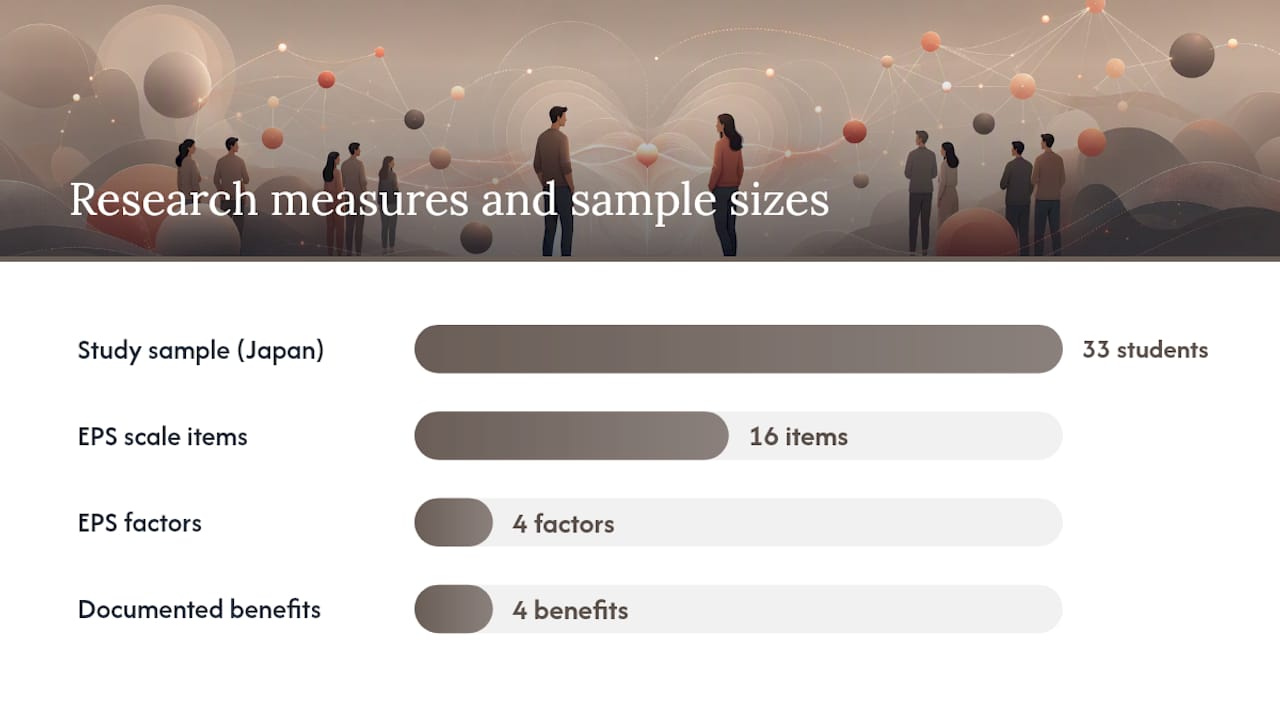
A 2024 Springer review describes a unified Emotional Presence Scale (EPS) with four factors: interest-curiosity, emotional regulation, expression management, and emotional awareness, structured across 16 items. This scale aims to improve measurement reliability across learning and relational contexts. A related small mixed-methods study of 33 Japanese college students found that emotional regulation increased as collaborative tasks grew more complex, suggesting that emotional awareness actively supports cognitive outcomes. The sample is small enough that the finding should be treated as a signal, not a settled conclusion.
On the relational side, clinical and therapeutic writing consistently links presence to safety, vulnerability, and trust. Psychology Today describes compassionate presence as a high-impact relational intervention that supports meaning and trust. The A.R.E. framework operationalizes this for couples: Accessibility, Responsiveness, and Engagement together predict attachment security and repair disconnection.
Documented benefits across the literature include:
- Greater relational security and trust
- Reduced stress for both parties in a conversation
- Improved communication clarity and fewer misunderstandings
- Better learning outcomes in collaborative settings
Why emotional presence is harder than it looks
Most of us were never taught to be present. We were taught to be productive, helpful, and solution-oriented. Those are not bad instincts, but they work against presence in the moments that matter most.
What strikes me about the research is how little presence requires in terms of time and how much it requires in terms of intention. The two-second pause, the reflective statement, the phone put away: none of these are difficult. What is difficult is unlearning the habit of performing helpfulness instead of offering attention.
Presence is also a pattern, not a performance. Showing up fully in one conversation and disappearing for a week does not build connection. What builds it is the small, consistent signal that you are reachable. Tools like Pingher are built around exactly this idea: that a short, personalized message sent at the right moment can carry the weight of presence even when you are not physically together. Sending affection messages between meetings is one practical way to keep that signal alive across a busy day.
Sources
- Emotional presence measurement article — Springer
- IRRODL article (Cleveland-Innes & Campbell) — emotional presence definition
- The Power of Presence: The Heart of Healing and Connection — Psychology Today (SG)
- The Power of Presence: Strengthening relationships with emotional intelligence — Six Seconds
- Emotional Presence (A.R.E.) — HumanTold
Recommended
Built for couples who care.
Pingher helps you send the right words at the right moment.
Get Pingher on Google Play