Ten Second Habit: Send Encouraging Messages That Actually Get Sent

Ten Second Habit: Send Encouraging Messages That Actually Get Sent
This page gives you categorized, ready-to-send encouraging messages for hard days, big wins, and everyday check-ins with partners, friends, family, coworkers, and kids. Copy any line as-is or personalize it in seconds. The one rule behind all of them: validate the feeling first, name the effort or strength you see, then offer your presence. That order matters more than the words themselves.
TL;DR:
- Specific validation of feelings before offering encouragement increases the perceived supportiveness of messages, especially during hard times.
- Short, specific messages led by acknowledgment tend to land better than generic or overly positive statements, especially outside crisis moments.
- Consistent daily messages, even simple one-liners, build stronger emotional connection than occasional grand gestures or infrequent texts.
- Personalizing messages with recent details or specific efforts enhances their impact and avoids sounding recycled or dismissive.
- Leveraging reminder tools and templates simplifies regular sending, making thoughtful encouragement a habit rather than an occasional effort.
Table of Contents
- Short Encouraging Messages for Quick Texts
- Encouraging Messages for Hard Times and Emotional Support
- Encouraging Messages for Friends and Family
- Encouraging Messages for Your Partner
- Encouraging Messages for Work, School, and Professional Stress
- Encouraging Messages for Kids and Teens
- How to Craft Meaningful Encouraging Messages
- When and How to Send an Encouraging Message
- Why Consistency Beats Grand Gestures, According to Pingher
- A Ten Second Habit That Beats the Big Gesture
- Try Pingher for Encouragement That Actually Gets Sent
- Sources
- FAQ
Short Encouraging Messages for Quick Texts
Sometimes you don’t need a paragraph. You need eight words that land at exactly the right moment, between meetings or right before someone walks into a hard conversation. Short lines work because they’re easy to send and easy to receive. No one feels obligated to write back a whole reply. They just feel seen.
The trick with one-liners is specificity dressed up as brevity. “You’ve got this” is fine. “You’ve got this, and I’m proud of how you’ve handled this week” does more work in one extra breath. Below is a bank you can pull from depending on whether someone needs a push, a landing pad, or just proof that you’re thinking of them.
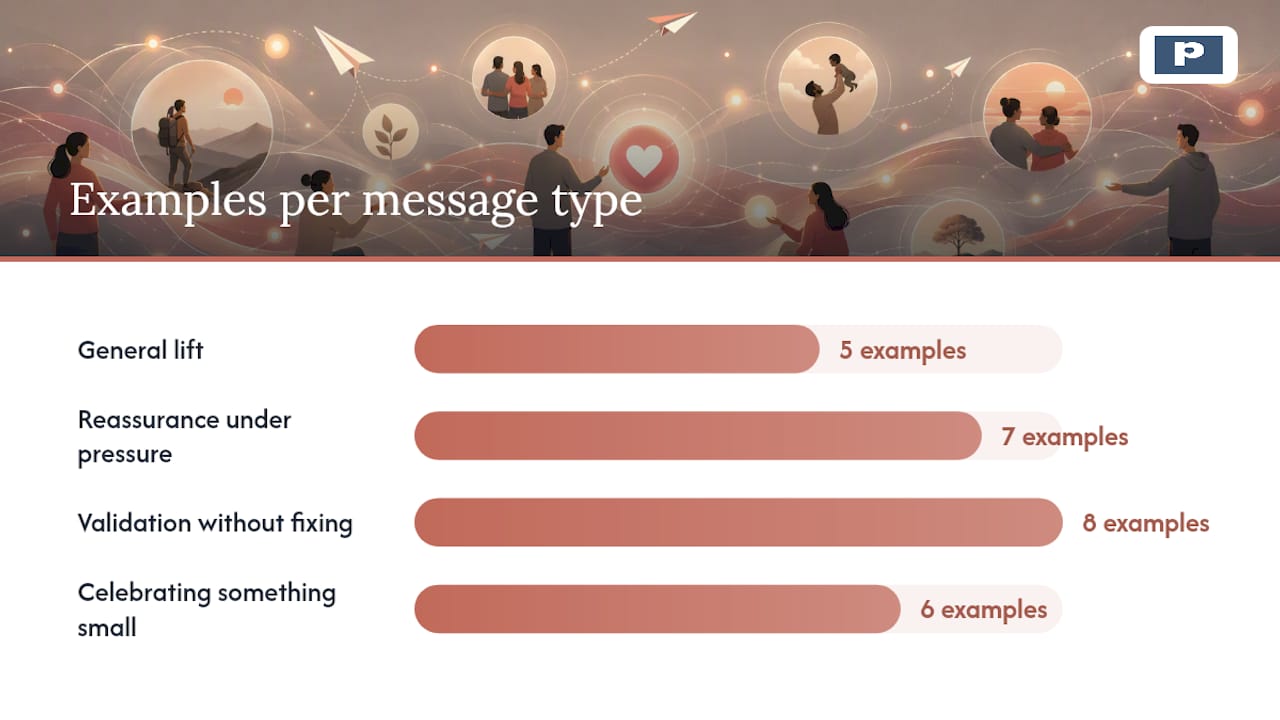
For a general lift:
- You’re handling more than people realize, and you’re doing it well.
- Whatever happens today, I’m on your side.
- You don’t have to feel ready to be capable.
- Small steps still count as progress.
- I believe in you, even on the days you don’t believe in yourself.
For reassurance under pressure:
- Breathe. You’ve prepared for this.
- One thing at a time. You don’t have to solve everything today.
- It’s okay if today is just about getting through it.
- You’re allowed to go slow.
- This feeling is temporary, even when it doesn’t feel that way.
For validation without fixing anything:
- That sounds genuinely hard. I’m glad you told me.
- You’re not overreacting. This is a lot.
- Makes sense you’re exhausted. You’ve been carrying a lot.
- I hear you, and I’m not going anywhere.
- You don’t need to justify how you feel to me.
For celebrating something small:
- You showed up today. That’s not nothing.
- I noticed the effort, even if no one else did.
- That took courage, and you did it anyway.
- Proud of you for trying, regardless of the outcome.
- Look at you, doing the thing you said you couldn’t.
Use a short line when the moment is a check-in, not a crisis, and when you know a longer message might feel like pressure to respond. Save the longer version, discussed below, for situations that need more context or more comfort than eight words can carry.
Encouraging Messages for Hard Times and Emotional Support
Grief, burnout, and setbacks need a different approach than everyday encouragement. Validation improves the effectiveness of supportive messages, according to research out of Penn State, and skipping straight to positivity often backfires. When someone is struggling, “everything happens for a reason” can land as dismissal, not comfort. Acknowledge the weight of what they’re carrying before you say anything hopeful.
Therapist-curated guidance on hard-times messaging warns against language that pressures someone to perform resilience, and instead recommends organizing lines around honest categories like grief, exhaustion, or simply starting over. Here are phrases built on that principle, plus templates that combine validation with a real offer of presence.
Validation-first openings:
- This is genuinely hard, and you don’t have to pretend it isn’t.
- I’m not going to tell you how to feel. I’m just here.
- You’re allowed to fall apart a little. I’ll still be here after.
- What you’re going through would be hard for anyone.
- No timeline on healing. Take what you need.
Comfort without minimizing:
- I don’t have the right words, but I have time, if you want company.
- You don’t need to be strong for me right now.
- I’m not going anywhere, no matter how long this takes.
- It’s okay to not be okay today.
- Whatever you’re feeling right now is valid, full stop.
Templates that pair words with practical help: Pairing encouraging words with concrete offers increases how supportive a message actually feels, according to reporting from The Good Trade. A few examples:
- “This week sounds impossible. Can I bring dinner over Thursday?”
- “You don’t have to ask. I’m picking up groceries, what do you need?”
- “I know you don’t want advice right now. Do you want company or quiet?”
- “I’m free Saturday if you want to talk, or just sit.”
Pro Tip: Skip words like “at least” or “everything will work out.” Both quietly tell the person their pain is smaller than it feels. Try “that makes sense” instead of “look on the bright side.”
Encouraging Messages for Friends and Family
Friends and family relationships run on a different rhythm than romantic ones. You’re not trying to be romantic, you’re trying to show that you noticed, that you remember, and that you care about the specifics of someone’s life, not just the highlights.
Celebrating effort and showing you care:
- I know how much work went into this. It shows.
- You’ve grown so much this year, and I’m not just saying that.
- Watching you figure this out has been genuinely inspiring.
- You handled that with more grace than most people would.
- I don’t say this enough, but I’m lucky to have you.
Check-ins that don’t feel like a task:
- Thinking about you today. No need to reply, just wanted you to know.
- How’s your week actually going, not the polite version?
- Checking in because I care, not because I need anything.
- You’ve been on my mind. Hope today is kind to you.
Congratulations that feel personal, not generic:
- You worked toward this for so long. Watching it pay off is special.
- This is exactly what you deserve after everything you put in.
- I remember when you first talked about this. Look at you now.
- So proud of you I could tell strangers about it.
Comfort for a hard week:
- Rough week, huh? I’m around if you want to vent or distract.
- You don’t have to have it together around me.
- Sending you an easier tomorrow, and I’m here if today’s still hard.
- Whatever you need this week, name it.
Encouraging Messages for Your Partner
Partner messages carry more weight than any other category, mostly because the risk of sounding generic is higher. Your partner has heard “you’ve got this” from coworkers and gym buddies. What they haven’t heard is a line that only makes sense because you know them. Guidance from relationship-focused counseling resources consistently points to the same idea: reference a specific, recent behavior rather than a general trait. “I noticed how patiently you handled that call with your mom” does more than “you’re so patient.”
Consistency also outperforms grand gestures. Therapists at the Bay Area CBT Center note that brief, personal affirmations delivered regularly build more relationship security than an occasional elaborate one. A daily ten-second message beats a once-a-year speech.
For stress or a hard day:
- I saw how much you were carrying today. I’m proud of how you handled it.
- You don’t have to solve everything tonight. I’m here either way.
- Whatever today threw at you, you’re still the calmest person I know.
- You’ve been under a lot lately. I see it, and I see you.
For an achievement, big or small:
- I watched you prepare for this for weeks. This win is earned.
- You did the thing you were scared to do. That’s the whole story right there.
- I’m not surprised you pulled it off. I am proud, though.
- This is what happens when you stop doubting yourself.
For everyday appreciation:
- I don’t tell you enough how steady you make my days feel.
- Something about the way you handled dinner tonight, without even thinking about it, made me love you more.
- You make hard weeks feel survivable. That’s not small.
- I noticed you did that thing again, the one you think I don’t notice. I do.
Longer notes for cards or quiet moments: “I’ve been thinking about how much you’ve grown this year, quietly, without ever asking for credit. I see it. I’m proud of the person you’re becoming, and I’m grateful I get to watch it happen up close.”
For men trying to keep this kind of message fresh across months rather than a single occasion, a rotating source of prompts helps more than memory does. Personalizing a message template with one detail from that day, a comment she made, a look she gave you, a moment from the drive home, turns a good line into one that only fits her.
Pro Tip: Reference something from the last 48 hours, not the last year. Recent detail reads as attentiveness. Old detail can read as recycled.
Encouraging Messages for Work, School, and Professional Stress
Professional encouragement has to stay warm without crossing into territory that feels personal, overly familiar, or like unsolicited advice. The goal is to validate effort and calm nerves while respecting the line between colleague and confidant.
Praising progress:
- Your work on this project has been sharp. It shows.
- You’ve clearly put real thought into this. It’s appreciated.
- The improvement since last quarter is genuinely noticeable.
- You handled that client call better than most people would have.
Calming nerves before something big:
- You’re more prepared for this than you feel right now.
- Take a breath. You know this material better than you think.
- Whatever happens in there, you’ve already done the hard part by preparing.
- You don’t need to be perfect. You need to be yourself.
Validating workload without overpromising fixes:
- This is a heavy stretch. I see how much you’re managing.
- You’re not imagining it, this week has been a lot for everyone.
- Let me know if there’s anything on my end I can shift.
- You’re handling a full plate with more patience than I would.
What to avoid: skip phrases like “just relax” or “it’s not that big a deal,” which can read as dismissive of someone’s professional stress. Also avoid anything that sounds like unsolicited career advice disguised as encouragement. Stick to validating the effort you can actually see.
Encouraging Messages for Kids and Teens
Kids respond to encouragement differently depending on age, but the underlying principle stays the same across both groups: praise effort and process, not fixed traits. Telling a child “you’re so smart” ties their identity to outcomes. Telling them “I saw how hard you worked on that” ties their identity to effort, which is the part they actually control.
For younger children:
- I saw how hard you tried. That’s what matters most.
- Mistakes mean you’re learning something new.
- You figured that out all by yourself. That’s amazing.
- It’s okay to feel frustrated. You can still keep going.
For teens:
- I know this is a lot right now. You’re handling it better than you think.
- You don’t have to have it all figured out yet.
- I’m proud of the effort, not just the grade.
- Whatever happens, you’re not facing it alone.
Caregivers get the most out of these lines by pairing them with specifics: naming the exact thing the child did, rather than a general compliment. “You kept trying even after it got hard” carries more weight over time than “good job.”
How to Craft Meaningful Encouraging Messages
Every message that actually lands follows a simple sequence: validate the feeling, name a specific strength or effort, then offer presence or a next step. Skipping the first step is the most common mistake people make. Jumping straight to positivity, even well-intentioned positivity, can feel like your friend or partner’s feelings were rushed past rather than heard.
Validation, acknowledging someone’s feelings before offering anything else, changes how supportive a message actually feels to the person receiving it. Praising or problem-solving too early risks making someone feel dismissed rather than helped, even when the intent behind the message is entirely good.
That finding, confirmed by researchers at Penn State, reshapes how you should think about encouragement. It’s not about finding the perfect motivational line. It’s about sequencing.
Here’s the formula broken into fill-in-the-blank templates you can use for almost any situation:
- “That sounds really [hard/frustrating/exhausting]. I’m glad you told me.” (Validate)
- “I’ve noticed how [specific quality] you’ve been about this.” (Name the strength)
- “I’m here if you want to [talk/vent/plan next steps].” (Offer presence)
- “You handled [specific situation] with more [quality] than you’re giving yourself credit for.”
- “What you’re feeling makes complete sense given [specific circumstance].”
- “I saw the effort you put into [specific task], even before the result came in.”
- “You don’t have to be okay right now. I’m still here either way.”
- “This is temporary, even though it doesn’t feel that way today.”
- “Can I [specific offer, bring food, help with task, just listen]?”
- “I’m proud of you for [specific action], not just the outcome.”
What to avoid: toxic positivity. Lines like “everything happens for a reason,” “just stay positive,” or “it could be worse” skip validation entirely and can make someone feel like their reaction is the problem, not their circumstance. Verywell Mind’s guidance on encouraging language is consistent on this point: specificity and acknowledgment beat generic cheerfulness every time.
When and How to Send an Encouraging Message
The channel you choose changes how a message feels almost as much as the words do. Text works for quick, frequent touches, the ten-second kind that keeps a relationship warm between bigger moments. A voice note adds warmth that text can’t, useful when someone needs to hear your tone, not just read your words. A physical card or handwritten note carries the most weight of all three, best saved for moments that deserve to be kept.
Frequency matters more than most people assume. A message every single day can start to feel automatic if it’s not backed by real observation. A message once a year, saved for birthdays and anniversaries, can feel like the bare minimum. The middle ground, a few thoughtful check-ins a week, tends to feel sincere without feeling routine.
Quick scripts by channel:
- Text: “Thinking about you. Today’s going to be a good one.” (short, low pressure)
- Voice note: “Hey, just wanted to say I’ve been thinking about how you handled this week. I’m proud of you. Talk soon.” (adds tone and warmth)
- Card inscription: “For the days you doubt yourself, remember I never do. I love you.” (permanent, worth the extra effort)
Sending a message between meetings, on a lunch break, or during a commute doesn’t require a long message. A quick note sent during a busy day can carry just as much weight as a longer one written at home, as long as the detail inside it feels specific rather than automatic.
Pro Tip: If you’re not sure how often to send encouragement, match it to the other person’s stress level, not a fixed schedule. Busy weeks call for more frequent, shorter check-ins. Calm weeks can hold a longer, more thoughtful one.
Why Consistency Beats Grand Gestures, According to Pingher
Most of the messages above only work if they actually get sent, which is where good intentions usually fall apart. Life gets busy, the moment passes, and the message that would have meant something never goes out. That’s the gap Pingher is built to close.
Pingher gives you templates built on the validate-then-encourage formula covered above, so you’re never starting from a blank screen. One-tap sending means a thoughtful message takes seconds, not the ten minutes of drafting and redrafting that usually kills the impulse. Scheduling and reminders help you send thoughtful messages on autopilot, so encouragement becomes a habit tied to your day, not something you remember only when you feel guilty.
Apps built around reminders and structured templates tend to increase how consistently people follow through on habits that otherwise slip. Encouragement is no different. The formula matters, but the sending matters more.
Alan, Author at Pingher
A Ten Second Habit That Beats the Big Gesture
The men who ask me about this usually think they need one perfect message, the anniversary card, the grand speech. I think that instinct is backwards. A single well timed sentence sent on an ordinary Tuesday, when nothing is being celebrated, tends to land harder than a planned one. Try this for a week: send one honest, specific line every day, no occasion required. Watch what happens to how your partner talks to you by day seven.
— Alan
Try Pingher for Encouragement That Actually Gets Sent
Pingher is built for the exact gap this article just walked through: knowing the right words but never quite sending them. It gives you validate-first templates, one-tap sending, and reminders tied to the dates and moments that matter, so encouragement stops depending on whether you remembered or had ten free minutes.
Beyond the daily message templates, Pingher also curates weekend getaways, sorted dinner plans, and gift ideas she’ll actually want, all in one calm, ad-free app built for men who want to be more thoughtful without adding more mental load. If the templates in this article felt useful, try Pingher on Google Play and start sending the version you actually meant to send.
Sources
- Validation may be the best way to support stressed-out friends and family — Penn State News
- Words of Affirmation — Bay Area CBT Center
- Words of encouragement: Examples and what to say — Verywell Mind
- Words Of Encouragement — The Good Trade
FAQ
What are some good encouraging words?
Words like “you’ve got this,” “I’m proud of you,” and “this is temporary” work well, but the most effective ones name a specific effort or strength you’ve actually noticed in that person.
What is an uplifting message?
An uplifting message validates how someone feels, then offers hope, appreciation, or support without minimizing the difficulty they’re facing. The strongest ones feel personal rather than generic.
What is an uplifting supportive quote?
A supportive quote acknowledges a real struggle before offering encouragement, such as “this is hard, and you’re handling it better than you think,” rather than jumping straight to forced positivity.
What is a good short positive message?
Short positive messages like “thinking of you today” or “you’re handling more than people realize” work because they’re easy to send and don’t require a response, making them ideal for quick check-ins. Pingher’s templates are built around this exact kind of short, sincere line.
How do I encourage someone who doesn’t want advice?
Skip the suggestions entirely and lead with validation, something like “I’m not going to tell you what to do, I just want you to know I’m here.” Presence, not solutions, is usually what people want first.
Recommended
Built for couples who care.
Pingher helps you send the right words at the right moment.
Get Pingher on Google Play