Couples: Send One Ten Second Affirmation a Day

Couples: Send One Ten Second Affirmation a Day
Short, sincere affirmations, said or sent daily, help couples feel seen and stay connected. This page gives you categorized lists you can copy right now, plus simple habit tricks like piggybacking affirmations onto routines you already have. Research backs this up: consistent, genuine verbal reinforcement supports emotional safety, but only when the words are real, not recited.
TL;DR:
- Affirmations should be specific and timely to avoid sounding generic or insincere, especially during conflicts or routine interactions.
- Attaching affirmation routines to automatic actions or scheduling simple reminders enhances consistency and prevents forgetting.
- Repetition is more valuable than volume, with a recommended approach being one appreciation, support, or check-in message most days.
- Generic praise lacks impact; personalized, honest compliments rooted in real observations resonate more deeply with partners.
- Using tools like reminder apps can help maintain affirmation habits despite busy schedules or forgetfulness.
Table of Contents
- What Are Couples Affirmations, and Which Ones Should You Use?
- How to Make Affirmations a Daily Habit, Not a Chore
- Why Sincerity Beats Cleverness Every Time
- Copy-and-Paste Scripts for Any Time of Day
- Why This Actually Works, Not Just Sounds Nice
- Send Affirmations Without Relying on Memory Alone
- Sources
What Are Couples Affirmations, and Which Ones Should You Use?
Couples affirmations are short, intentional statements, spoken or texted, that reinforce love, respect, and appreciation between partners. Experts describe them as a way to “train the brain” toward helpful, connecting thoughts instead of the criticism and complaint that couples slide into by default, according to Today’s relationship coverage. The idea isn’t new. It’s the same logic behind gratitude journaling, just pointed at another person instead of yourself.
Below are ready-to-use lines grouped by what they’re actually for. Pick a few that sound like something you’d really say, tweak the wording so it fits your voice, and skip the ones that feel stiff.
Daily appreciation (quick texts):
- “Thank you for handling that thing this morning. It didn’t go unnoticed.”
- “I like who I am when I’m around you.”
- “You make ordinary days better just by being in them.”
Emotional safety and trust:
- “I feel safe telling you the truth, even the messy parts.”
- “You don’t have to perform for me. I like the real version.”
- “I trust you with the stuff I don’t say out loud to anyone else.”
Support and encouragement:
- “You’re carrying a lot right now, and I see how hard you’re working.”
- “Whatever happens with this, I’ve got your back.”
- “I believe in how you handle hard things.”
Repair and reconciliation starters:
- “I don’t want to be on opposite sides of this. Can we start over?”
- “I was short with you earlier, and that’s on me.”
- “I want to understand your side better than I have been.”
Intimacy and romance:
- “I still get a little excited when I see your name pop up.”
- “You’re still the most interesting person in the room to me.”
- “I love the way you laugh at your own jokes before you finish them.”
Self-affirmations (so you show up better):
- “I can be patient here, even when I’m tired.”
- “My job isn’t to fix everything, just to show up.”
- “I’m allowed to have a bad day without taking it out on us.”
For more phrasing built around specific gestures rather than generic praise, appreciation-based affirmations tend to land harder than a blanket “thanks for everything.”
How to Make Affirmations a Daily Habit, Not a Chore
The biggest reason affirmations fizzle out isn’t lack of love. It’s lack of a system. Nobody wakes up thinking “today I will remember to affirm my partner” at 3 p.m. on a Tuesday. Habit-formation research points to piggybacking, attaching a new behavior to one you already do without thinking, as one of the more reliable fixes for this.
- Attach it to something automatic. Say one affirming line while the coffee brews, while you’re both brushing teeth, or right before you fall asleep.
- Keep the format low-effort. A four-word text beats a paragraph you never finish writing. A ten-second voice note works too.
- Use a loose schedule, not a rigid one. You’ll see the 7-7-7 rule (a date night every 7 days, a getaway every 7 weeks, a longer trip every 7 months) and the 2-2-2 rule (date night every 2 weeks, a weekend every 2 months, a longer trip every 2 years) floating around relationship advice. Treat both as compasses, not deadlines. Therapists who reference these frameworks generally agree they’re meant to be adapted, not followed like a legal contract.
A simple weekly rhythm might look like: one appreciation text most mornings, one support line midweek when things get busy, and one longer check-in on a Sunday. That’s it. The goal is repetition, not volume.
Pro Tip: Set one recurring phone reminder labeled “say something real” instead of trying to remember on willpower alone. The friction of remembering is usually the actual problem, not motivation.

Why Sincerity Beats Cleverness Every Time
Generic lines feel like a form letter. “You’re great” says almost nothing. “I noticed you stayed calm with your mom on the phone today, and I know that’s not easy for you” says everything. Specificity is what separates an affirmation that lands from one that gets a polite “thanks.”
- Vague: “You’re a good partner.” Specific: “You remembered I hate small talk and ran interference for me at that party.”
- Vague: “I love you.” Specific: “I love that you still ask how my presentation went, three days later.”
- Timing matters too. A repair-focused affirmation dropped in the middle of an argument reads as deflection, not care.
One caution worth repeating: affirmations paired with honest communication work. Affirmations used to paper over an unresolved issue don’t, according to The Knot’s relationship guidance. If the same argument keeps resurfacing, a kind text isn’t a substitute for actually talking about it.
Copy-and-Paste Scripts for Any Time of Day
- Morning: “Hope today treats you well. I’m thinking about you already.”
- Midday: “No reason, just wanted you to know you crossed my mind.”
- End-of-day: “Glad this day had you in it.”
- Quick repair line: “I don’t like how that landed. Can we try that conversation again?”
For a slightly longer weekly check-in, try something like: “What’s one thing I did this week that felt good to you, and one thing you wish I’d done differently?” It’s short enough for a text thread but honest enough to surface something real. Keep these casual and platform-appropriate, texts should stay under two sentences, while a handwritten note or voice memo can carry more. If you want longer-form options for anniversaries or tougher weeks, these message templates go deeper than a quick text.
Why This Actually Works, Not Just Sounds Nice
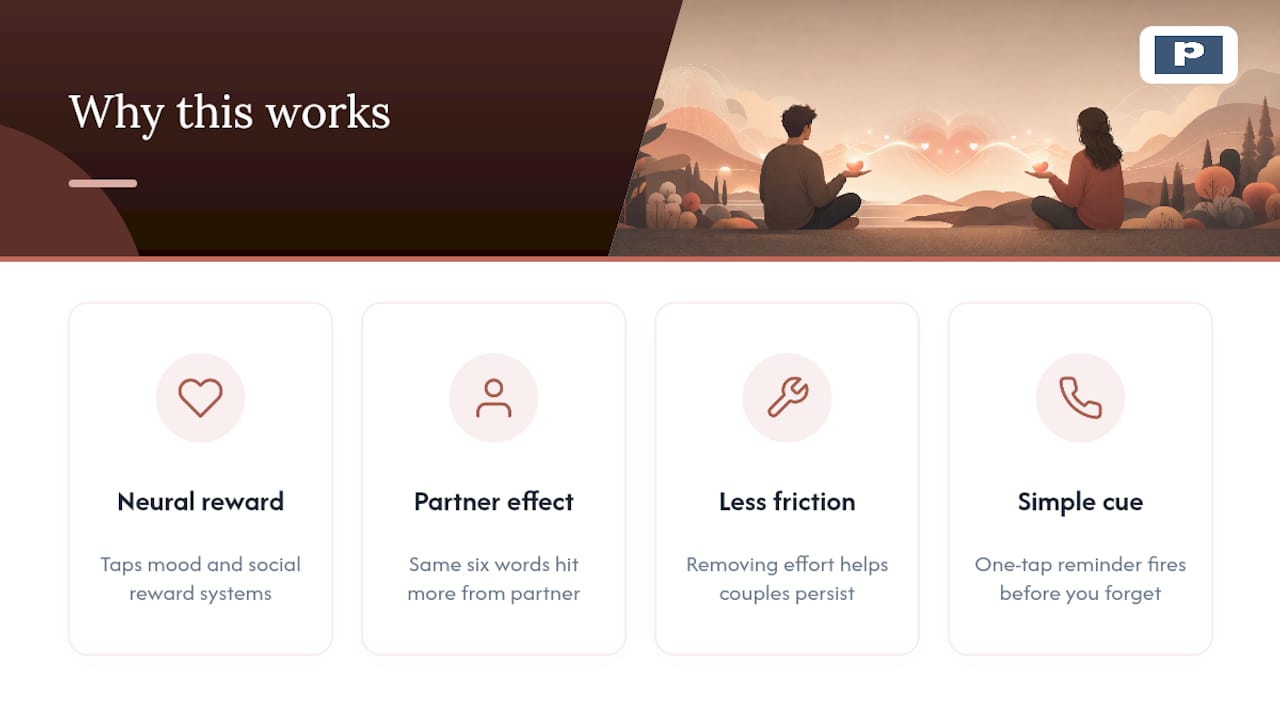
Positive, consistent verbal reinforcement taps into mood and social reward systems, according to peer-reviewed behavioral research. That’s not a soft claim. It’s why the same six words from your partner can hit differently than the same six words from a stranger.
What I keep coming back to is this: the couples who stick with affirmations aren’t more romantic than everyone else. They just removed the friction. A one-tap reminder that fires before you forget beats good intentions every single time.
— Alan
Send Affirmations Without Relying on Memory Alone
Pingher exists for exactly the gap described above: you mean to send something thoughtful, and the day gets away from you. Pingher gives couples curated affirmation templates, scheduling, and one-tap sending, so a short, sincere message goes out even on the days you’re slammed at work or halfway through a business trip.
If you’ve read through the lists here and thought “I’d actually send some of these, if I remembered,” that’s the exact use case. You pick a category, set a reminder or a schedule, and Pingher handles the rest, including important dates you’d otherwise scramble to catch. You can visit the app’s website to learn about available options before committing to anything. Get started at Pingher and turn one good list into a habit that actually holds.
Sources
- 100 Words of Affirmation for You and Your Partner — Today
- NIH/PMC article on social behavior mechanisms
- Words of affirmation examples — The Knot
Recommended
Built for couples who care.
Pingher helps you send the right words at the right moment.
Get Pingher on Google Play