Template Love Messages With a Personal Touch
Template Love Messages With a Personal Touch
Template love messages with a personal touch are customized expressions that use specific memories, nicknames, and genuine emotions to make your partner feel truly seen. A generic “I love you” fades fast. A message that references the way your partner laughs at their own jokes, or the road trip where everything went wrong but you both still talk about it, stays with them. That is the difference between a template and a personalized love note. This article shows you exactly how to use heartfelt message templates as a starting point, then layer in the details that make your words impossible to forget.
What makes template love messages feel personal and heartfelt?
The most effective template love messages carry a personal touch through specificity, not length. A message that mentions “the night we got lost in Nashville and ended up at that tiny diner” lands harder than three paragraphs of poetic language. Specificity signals that you were paying attention. That signal is what your partner actually wants to feel.
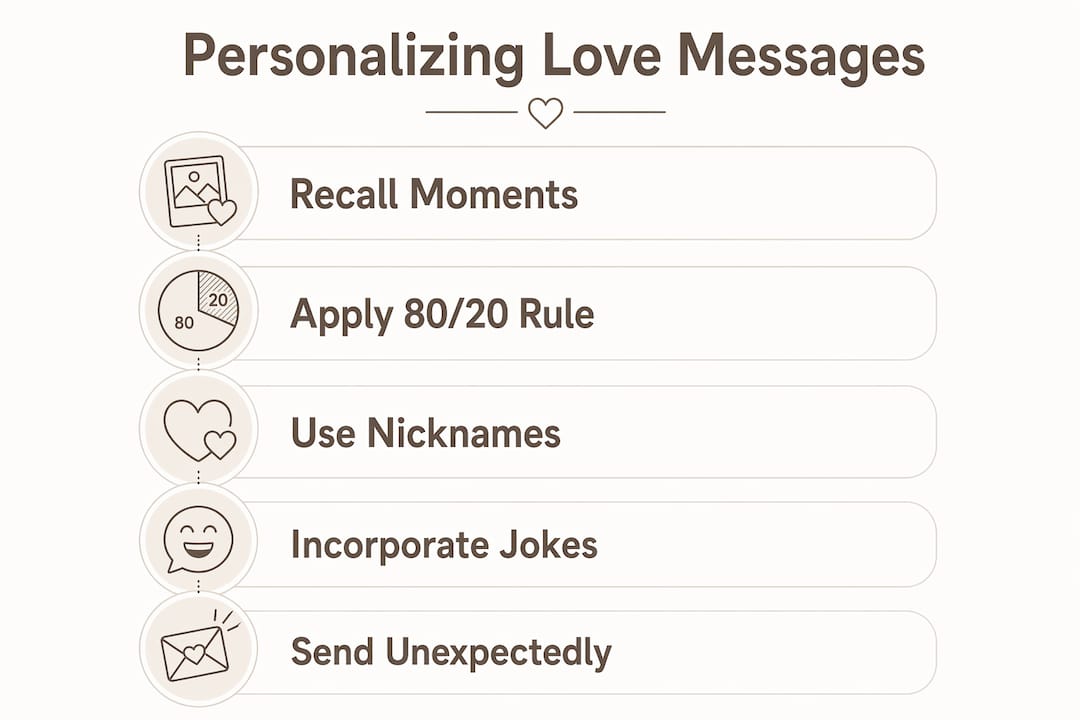
Relationship experts identify several core elements that separate a meaningful message from a forgettable one:
- Shared memories. Reference a moment only the two of you experienced. The more specific and mundane, the better. Anchored nostalgia grounds your message in reality and deepens emotional connection.
- Nicknames and inside language. The private vocabulary you share as a couple belongs in your messages. It signals intimacy that no template can manufacture on its own.
- Specific dates. Mentioning the anniversary of a first date or the day you adopted your dog shows you track what matters.
- Inside jokes. A single line that only your partner will understand can carry more weight than a full paragraph of declarations.
- Genuine emotional tone. Write the way you actually talk. If you are naturally funny, be funny. If you are sincere and direct, be sincere and direct.
The 80/20 personalization rule is the most practical framework for this. Use 80% template structure for flow and clarity, then fill the remaining 20% with unique identifiers like memories and inside jokes. That balance prevents your message from sounding robotic while still giving you a reliable framework to work from.
Pro Tip: Write down three specific moments from your relationship before you open any template. Those moments are your raw material. The template is just the frame.
Jen Glantz, bestselling author and founder of Bridesmaid for Hire, advocates for template use as a way to overcome the fear of cliché, not to replace authentic voice. Templates give you structure so your real feelings have somewhere to land.
What digital tools help you craft personalized love messages?
The category of AI-powered love message tools has grown significantly by 2026. These tools function as scaffolds. They generate a working draft based on your inputs, and you refine it with personal details. No tool replaces your voice, but the right one removes the blank-page paralysis that stops most people from writing anything at all.

AI-powered message generators typically offer 4–6 emotional tone options, including romantic, playful, sincere, and nostalgic. Most allow you to input names, keywords, and relationship details. Many provide up to 3 variations without requiring a signup.
Premium services go further. Expert-led generators combine AI drafting with human editing and deliver a polished letter within 24 hours, with unlimited revisions included. That level of service suits milestone occasions like anniversaries or proposals.
Template categories generally fall into three groups:
| Category | Best for | Typical length |
|---|---|---|
| Romantic and sincere | Anniversaries, deep declarations | 80–150 words |
| Playful and funny | Everyday texts, lighthearted moments | 30–60 words |
| Heartfelt and brief | Good morning messages, daily check-ins | 20–40 words |
The heartfelt and brief category is the most underused. Short love messages under 100 words are more often kept and revisited by partners because they are easy to absorb and emotionally direct. A long message demands time. A short one gets read twice.
Pingher sits in a category of its own. Its one-tap functionality lets you send a personalized message without composing from scratch every time. For couples who want daily connection without daily effort, that design solves a real problem.
How do you personalize a love message template step by step?
Personalizing a template is a five-step process. Each step builds on the last, and skipping any one of them produces a message that still feels generic.
-
Choose the right template for the moment. A playful template does not fit a serious anniversary. Match the tone of the template to the emotional register of the occasion. If you are texting on a random Tuesday, pick something warm and brief. If you are marking a milestone, choose something with more depth.
-
List three specific memories before you edit anything. Pull out moments that are unique to your relationship. The more ordinary the better. Referencing daily shared habits resonates more deeply than grand declarations because it shows you notice the small things.
-
Swap generic phrases for your personal details. Replace “I love spending time with you” with “I love our Sunday mornings when you make coffee and pretend you are not going to share it.” That one swap transforms a template line into something your partner will screenshot and save.
-
Adjust the language to match your natural voice. Read the message out loud. If it does not sound like you, rewrite the parts that feel stiff. Your partner knows how you talk. A message that sounds like a stranger wrote it loses its emotional power immediately.
-
Edit for length and clarity. Cut anything that does not add feeling or specificity. Saved and revisited messages provide lasting emotional anchors for partners, and concise messages get revisited far more often than long ones.
Pro Tip: Send the message at an unexpected time. A heartfelt note on a Wednesday afternoon hits differently than one sent on Valentine’s Day when it is expected. Surprise amplifies emotional impact.
For couples who want creative digital love notes that are easy to revisit, the format matters as much as the content. A saved digital message becomes a keepsake. A text that scrolls off the screen disappears.
What mistakes should you avoid when personalizing love templates?
Most personalization mistakes come from one of two directions: trying too hard or not trying hard enough. Both produce messages that miss the mark.
-
Overloading with clichés. Phrases like “you complete me” or “my heart skips a beat” have been used so often they carry almost no emotional weight. If a phrase could appear in any love song from the last 30 years, cut it or make it specific to your relationship.
-
Writing too long. Length is not depth. A 400-word message does not feel four times more loving than a 100-word one. Short, distilled messages have higher impact because they are easier to absorb and more likely to be read again.
-
Prioritizing poetry over honesty. Reaching for beautiful language at the expense of genuine feeling produces messages that sound impressive but feel hollow. Your partner wants to feel known, not impressed.
-
Ignoring your partner’s preferences. Some people love long, expressive messages. Others feel overwhelmed by them and prefer something brief and direct. Know which type your partner is and write accordingly.
-
Skipping the edit. A first draft is rarely the best version. Read it once for feeling and once for clarity. If a sentence makes you cringe, your partner will feel that too.
-
Forgetting voice consistency. If you use formal language in the opening and casual language by the end, the message feels disjointed. Pick a register and stay in it. Thoughtful message ideas work best when the tone stays consistent from the first word to the last.
The single biggest mistake is treating the template as the finished product. A template is a starting point. The personal details you add are what make it yours.
Key Takeaways
Personalized love messages work because specificity creates emotional connection. Generic phrases fade; shared memories and personal details stay with your partner long after the message is sent.
| Point | Details |
|---|---|
| Use the 80/20 rule | Keep 80% template structure and fill 20% with unique memories and inside jokes. |
| Specificity beats length | One specific shared memory outperforms three paragraphs of general declarations. |
| Short messages get revisited | Messages under 100 words are more likely to be saved and reread by partners. |
| Match tone to the moment | Choose a playful, sincere, or heartfelt template based on the occasion and your natural voice. |
| Edit before you send | Cut clichés, check voice consistency, and read the message aloud before hitting send. |
Why I think most people underestimate the small message
I have spent years watching couples pour energy into grand gestures while their daily communication stays on autopilot. The anniversary dinner gets planned for weeks. The Tuesday afternoon text gets zero thought. That imbalance is where most relationships quietly lose ground.
What I have found is that the small, specific message sent on an ordinary day does more for a relationship than the elaborate gesture on a special one. When you text your partner “I was just thinking about the way you always burn the toast and then act surprised,” you are telling them something more powerful than “I love you.” You are telling them you notice. You are telling them the ordinary moments of your life together are worth remembering.
Templates made this easier for me to practice consistently. I stopped staring at a blank screen trying to find the perfect words. I started with a structure, added the specific detail that was true for us that week, and sent it. The response was always warmer than I expected.
The couples I have seen maintain the strongest connections are not the ones who write the most beautiful messages. They are the ones who send something regularly. Consistency beats perfection every time. Find a template that fits your voice, personalize it with one real detail, and send it. Do that enough times and it becomes the foundation your relationship stands on.
— Alan
How Pingher makes personalized messaging part of your daily routine
Knowing what makes a great love message and actually sending one regularly are two different problems. Pingher solves the second one.
Pingher is built for couples who want to stay emotionally connected without spending 20 minutes composing the perfect message every day. Its one-tap functionality means you can send a warm, personalized note in seconds. The platform is designed around the idea that consistent daily messages build stronger bonds than occasional grand gestures. You get the personal touch without the friction. For couples who want to make thoughtful communication a habit rather than a special occasion, Pingher is the most direct path to that goal.
FAQ
What is a template love message with a personal touch?
A template love message with a personal touch is a pre-structured romantic message customized with specific details like shared memories, nicknames, and inside jokes. The template provides the framework; your personal details make it feel genuine and unique.
How long should a personalized love message be?
Short messages under 100 words are more often saved and revisited by partners because they are easy to absorb. Aim for brevity and specificity rather than length.
What details make a love message feel personal?
Specific shared memories, nicknames, inside jokes, and references to daily habits are the details that make a message feel personal. Generic phrases like “you mean everything to me” carry far less weight than a reference to a moment only the two of you share.
How do I avoid clichés in a love message template?
Replace any phrase that could appear in a generic greeting card with something specific to your relationship. If the line could apply to any couple, rewrite it with a detail that applies only to yours.
Can I use AI tools to write personalized love messages?
AI tools work well as a starting point. Most platforms offer tone options and accept personal keywords to generate a draft. The key is to treat the output as a scaffold and add your own specific memories and voice before sending.
Recommended
Built for couples who care.
Pingher helps you send the right words at the right moment.
Get Pingher on Google Play