Best Bremma.io Alternatives for Busy Couples (2026)

Best Bremma.io Alternatives for Busy Couples (2026)
Pingher is the top pick for busy couples who want one-tap, personalized loving messages without the setup overhead. If you’ve been using Bremma.io’s structured weekly-meeting system and want something lighter, or you’re just starting to explore relationship apps, the right alternative depends on one thing: how much friction you can tolerate daily.
Here’s a fast breakdown of the four approaches worth knowing:
- One-tap message apps (Pingher): Send AI-assisted, personalized messages in seconds. Best for couples who want daily emotional connection without scheduling anything. Freemium entry; premium monthly or annual plans typically in the $3–$15 monthly range.
- Structured weekly-meeting systems (Bremma-style): Guided weekly check-ins where both partners collect topics throughout the week and discuss them together. Best for couples who want a shared relationship operating system. Subscription-based, one plan per couple.
- Coaching apps (Relish-style): Personalized relationship coaching with certified coaches, goal-setting, and quizzes. Best for couples who want guided growth with human accountability. Monthly or annual tiers.
- Therapy-backed digital tools (Gottman-style, Lasting): Clinically grounded content, assessments, and exercises. Best for therapy-adjacent couples or those wanting research-credentialed guidance. Annual plans common; some offer therapist discounts.
Habit-building cadence predicts real-world effectiveness more than feature count. Pick the approach that fits your actual daily rhythm, not the one with the longest feature list.
Table of Contents
- What are the best Bremma.io alternatives for couples?
- How do these alternatives actually differ in daily use?
- How do you choose the right app for your relationship?
- Which app fits your specific situation?
- Key Takeaways
- Why low-friction tools win for most couples
- Pingher makes daily connection effortless for busy couples
- Useful sources and further reading
What are the best Bremma.io alternatives for couples?
The table below maps each category across the dimensions that matter most when you’re choosing a relationship app.
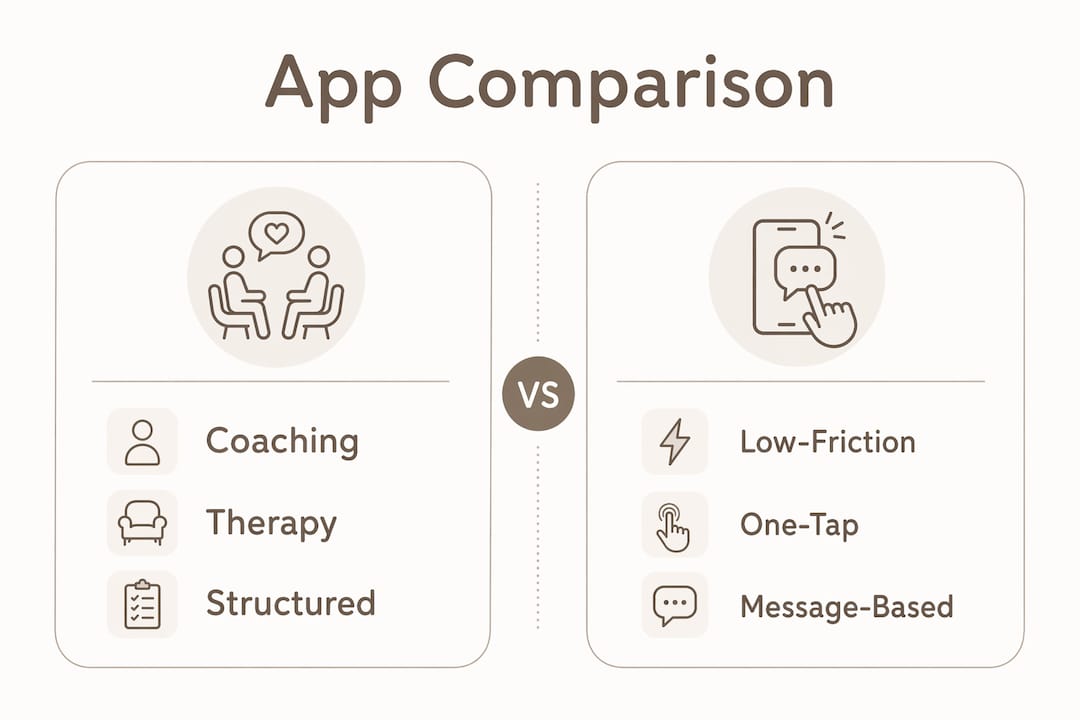
| Category | Core methodology | Key features | Habit cadence | Platforms / US available | Typical pricing | Best for | Privacy notes |
|---|---|---|---|---|---|---|---|
| One-tap message apps (Pingher) | AI-assisted personalized messaging; reminders and date tracking | Message scheduling, AI templates, one-tap send, reminders, anniversary tracking | Daily | iOS, Android, web / Yes | Freemium; monthly or annual premium | Busy couples wanting low-friction daily messages | Paired accounts; private message history |
| Structured weekly-meeting systems | Shared agenda built throughout the week; guided weekly discussion | Weekly check-in framework, daily individual logs, shared goals, to-do lists, couple calendar | Weekly (daily log feeds in) | iOS, Android / Yes | Single couple subscription | Couples wanting a full relationship operating system | Paired shared space; individual accounts |
| Coaching apps | Certified coach guidance; personalized plans and quizzes | Coach messaging, relationship quizzes, goal tracking, daily prompts | Daily to weekly | iOS, Android / Yes | Monthly or annual tiers | Couples wanting human-guided growth | Coach-mediated; review privacy policy for data sharing |
| Therapy-backed digital tools | Clinically validated content; research-based exercises and assessments | Assessments, guided exercises, session-bridging tools, therapist referrals | Weekly or as-needed | iOS, Android / Yes | Annual plans common; therapist discounts available | Therapy-adjacent couples; those wanting clinical credibility | Clinical-grade; often HIPAA-adjacent; check data retention |
| Memory/messaging apps (Between-style) | Private shared space for photos, notes, and messages | Shared photo albums, private chat, anniversary reminders, memory timeline | Daily or as-needed | iOS, Android / Yes | Freemium to low monthly | Long-distance or memory-focused couples | Private paired space; end-to-end encryption varies by app |
Pros and cons by category:
- One-tap message apps: Low friction, fast to build a habit, AI suggestions reduce blank-page anxiety. Limited structured relationship-health tracking.
- Structured weekly-meeting systems: Thorough and organized; nothing falls through the cracks. Requires both partners to commit to a weekly session.
- Coaching apps: Human accountability and personalized feedback. Higher cost; quality varies by coach.
- Therapy-backed tools: Strong clinical credibility; Gottman Institute-style tools carry therapist trust. Often positioned as adjuncts to therapy, not standalone solutions.
- Memory/messaging apps: Warm, low-pressure, great for long-distance. Lighter on structured growth or check-ins.
Pro Tip: Before downloading anything, ask yourself: “Will I actually open this app tomorrow morning?” If the honest answer is “probably not,” pick the simplest option, not the most feature-rich one. Habit formation beats feature breadth every time.
How do these alternatives actually differ in daily use?
The methodology gap between these categories is bigger than it looks on a feature list.
Structured weekly-meeting systems ask both partners to log topics, appreciations, and updates throughout the week, then sit down together once to work through them. The weekly meeting cadence is predictable and thorough, but it requires coordination. If one partner travels or works irregular hours, that weekly session can slip.

Coaching apps feel more like having a relationship mentor on call. You get quizzes, personalized plans, and the option to message a certified coach. The cadence is flexible, but the accountability comes from the coaching relationship itself. Without that, it’s easy to drift.
Therapy-backed tools work best as session-bridging tools for couples already seeing a therapist. They extend the work between appointments rather than replacing clinical care. Gottman-style digital products typically include card decks, assessments, and guided exercises rooted in decades of research.
One-tap message apps like Pingher operate on a completely different premise: reduce friction so far that sending a loving message takes less effort than scrolling social media. AI suggestions and templates mean you’re never staring at a blank text box. The daily communication habit builds naturally because the action is tiny.
Memory/messaging apps sit closest to a private social network for two. The focus is on shared photos, notes, and milestones rather than structured growth.
What a week looks like by approach:
- Pingher: Open app, tap a suggested message, send. Thirty seconds. Repeat daily.
- Structured weekly system: Log a topic Monday, add an appreciation Thursday, sit down Sunday for a 20-minute guided meeting.
- Coaching app: Complete a daily prompt, message your coach twice a week, review a personalized goal.
- Therapy-backed tool: Complete an exercise your therapist assigned; review session notes before your next appointment.
- Memory app: Share a photo from lunch, add a note to your anniversary countdown, browse last summer’s memories together.
On privacy: dedicated relationship apps with paired-account architecture keep your relationship data separate from general productivity notifications. Generic apps like shared calendars or group chats lack this. Always check whether the app stores conversation data on its servers, who owns that data, and whether deleting your account actually removes it.
How do you choose the right app for your relationship?
Start here: if your primary goal is daily emotional connection with minimal effort, pick a habit-first, low-friction tool. Everything else is secondary.
Questions to ask before committing:
- Does the app use a paired-account model, or is it a single account you share?
- What does the privacy policy say about storing relationship data and who can access it?
- Is there a free tier or trial long enough to test the habit (at least 7–14 days)?
- What is the refund policy if you upgrade and it doesn’t stick?
- Does it integrate with a therapist or coach if you want that layer later?
- Can you control notification frequency so it nudges without nagging?
- How responsive is customer support if something breaks or you have billing questions?
Pricing expectations: Most relationship apps fall in the $3–$15 monthly range, with annual bundles commonly running $30–$120 depending on coaching add-ons. Therapy-backed tools sometimes offer therapist or clinic discounts worth asking about directly.
Red flags to watch for:
- High manual input required before you see any value (a sign the habit won’t form)
- No paired-account privacy, meaning your data lives in a shared general account
- So many optional features that the core action gets buried under menus
- Weak or slow customer support, especially for billing issues
- No clear data-deletion path when you want to leave
Your 30-day trial plan: Week one, use only the core feature once a day. Week two, add one secondary feature. Week three, check whether both partners are still opening the app. Week four, decide whether to upgrade or try a different category. Success markers: both partners open the app at least five days a week by day 21, and at least one of you mentions something from the app in a real conversation.
Which app fits your specific situation?
- You’re both slammed with work and want something that takes under a minute: One-tap message apps like Pingher. Personalized daily messages with AI suggestions; annual plan preferred for savings.
- You want a shared system to stay aligned on goals and household tasks: Structured weekly-meeting systems. Weekly cadence with daily log feeds; single couple subscription.
- You want guided growth with a real human in the loop: Coaching apps. Certified coach access; monthly or annual tiers.
- You’re already in couples therapy and want to extend the work between sessions: Therapy-backed digital tools. Clinical exercises and session-bridging content; annual plans with therapist discounts.
- You’re long-distance and want a private shared memory space: Memory/messaging apps. Private photo albums and anniversary reminders; freemium entry.
Key Takeaways
Habit-building cadence matters more than feature count: the app you’ll actually open every day beats the one with the longest list of tools.
| Point | Details |
|---|---|
| Habit cadence wins | Pick the approach that fits your daily rhythm; daily rituals outperform weekly ones for most busy couples. |
| Pricing range | Most relationship apps have pricing ranging from low to moderate monthly or annual fees; annual plans often offer better value. |
| Privacy first | Always confirm paired-account architecture and a clear data-deletion policy before upgrading. |
| Match method to need | Therapy-adjacent couples benefit most from clinically backed tools; busy couples benefit most from low-friction daily messaging. |
| Pingher for daily connection | Pingher’s one-tap messaging and AI suggestions make it the lowest-friction option for couples who want personalized daily messages. |
Why low-friction tools win for most couples
Most relationship apps fail not because they lack features, but because they ask too much of people who are already tired. A structured weekly meeting is genuinely valuable, but it requires both partners to be present, focused, and unhurried at the same time. That’s a high bar on a Tuesday night after a long commute.
The apps that actually stick are the ones that shrink the action to almost nothing. One tap. One message. One small moment that says “I was thinking about you.” Over weeks, those moments compound into something real. That’s not a marketing claim; it’s how habit formation works in any domain: tiny consistent actions beat occasional big efforts.
The Gottman research tradition and coaching-based tools are genuinely valuable, especially for couples navigating real friction or working with a therapist. But for the majority of couples who just want to feel more connected on an ordinary Wednesday, the clinical depth is overkill. What they need is a nudge, a template, and a frictionless send button.
Pingher was built around exactly that insight. The one-tap design isn’t a simplification; it’s the point.
Pingher makes daily connection effortless for busy couples
Staying emotionally connected shouldn’t require a calendar invite. Pingher gives you AI-powered message suggestions, ready-made templates, and one-tap sending so you can reach your partner with something personal in under a minute, every day.
Available on iOS, Android, and web, Pingher works wherever you are. The free tier lets you test the core habit before committing. Pingher+ unlocks full AI suggestions, message scheduling, anniversary and date reminders, and premium templates, available monthly or annually (annual saves you the most). Clinic and therapist partnership tiers are available for professionals who want to recommend Pingher to clients.
Start your free trial and send your first personalized message today. For more ideas on what to say, browse message prompts for partners that actually land.
Useful sources and further reading
- Beatable — Bremma and category alternatives analysis: Comparative breakdown of relationship app categories, habit-building insight, pricing ranges, and trust signals by category. Start here for a category-level overview.
- Bremma (bremma.io): The weekly meeting system for couples. Useful for understanding the structured-meeting category and therapist-network integration.
- Bremma on PeerPush: Independent product summary covering Bremma’s feature set, founding story, and clinical co-founder background.
- BetaList — Bremma startup listing: Early-stage positioning and user segment notes; useful for understanding who the structured-meeting category targets.
- Pingher — Why communication tools support lasting relationships: Evidence-based case for dedicated relationship communication tools over generic messaging apps.
This article is general information, not professional relationship or clinical advice. For serious relationship concerns, consult a licensed therapist or counselor.
Recommended
Built for couples who care.
Pingher helps you send the right words at the right moment.
Get Pingher on Google Play