Why Spontaneous Messages Feel Meaningful in Relationships

Why Spontaneous Messages Feel Meaningful in Relationships
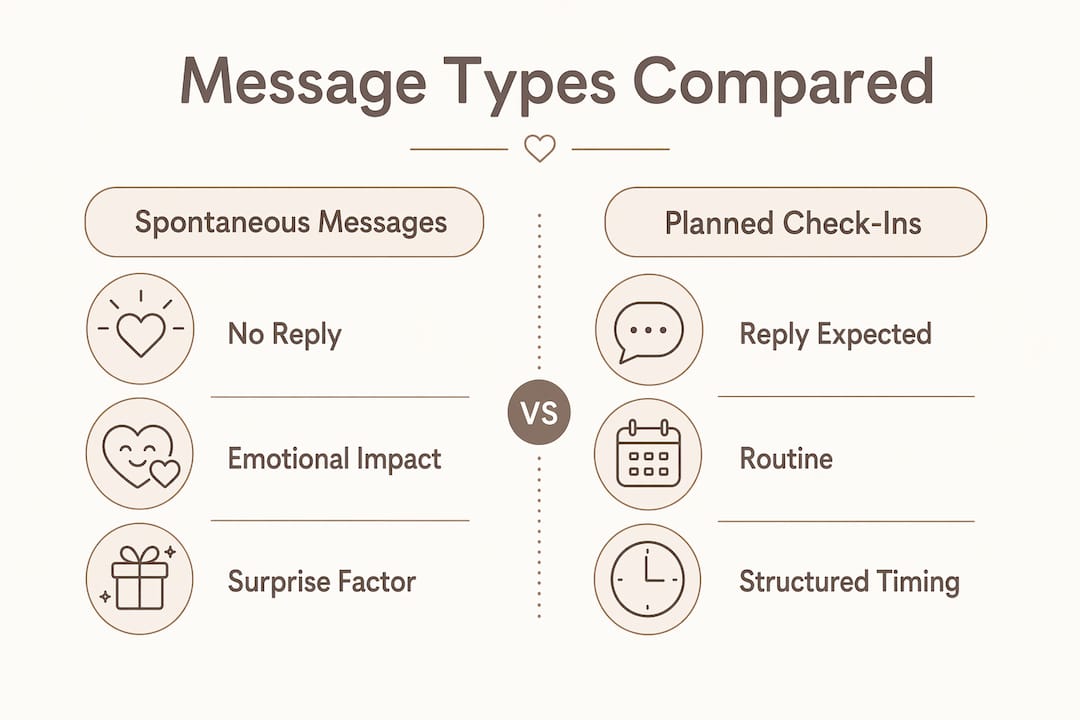
Spontaneous messages are defined as unexpected, low-demand communications sent with no expectation of a reply, and they signal genuine care more powerfully than planned contact. Research confirms that surprise amplifies positive reception in a study of over 5,900 participants, making the unasked-for message one of the most emotionally effective gestures in a relationship. The reason why spontaneous messages feel meaningful is simple: they cost the sender nothing except attention, and they give the recipient proof that someone thought of them unprompted. That proof is rare, and rarity creates emotional weight.
Why spontaneous messages feel meaningful: what research reveals
Spontaneous messages carry emotional weight because they ask nothing in return. Low-demand messages make recipients feel remembered without placing any task-related burden on them. That distinction matters enormously. Most digital communication is transactional: “Can you pick up groceries?” or “Did you see my email?” A spontaneous “thinking of you” text sits outside that category entirely. It signals presence, not need.
The surprise factor compounds the effect. People consistently underestimate how much their partners appreciate unexpected outreach. The 5,900-participant study found that surprise is a primary driver of positive reception, not the content of the message itself. This means a three-word text sent out of nowhere often lands harder than a carefully written paragraph sent on a birthday.

Emotional clarity through cues like emojis also strengthens the impact. A study of 155 respondents found a strong positive association between emotional clarity and perceived social support (p < 0.001). Adding a single emoji to a spontaneous message removes ambiguity and increases warmth. The recipient reads the message as unambiguously kind rather than neutral or obligatory.
| Feature | Spontaneous messages | Planned check-ins |
|---|---|---|
| Expectation of reply | None | Often implied |
| Emotional trigger | Surprise and delight | Routine or obligation |
| Perceived authenticity | High | Moderate |
| Cognitive load on recipient | Very low | Moderate to high |
| Signal of care | Unprompted, genuine | Scheduled, expected |
Pro Tip: Add one emoji to your next spontaneous message. It removes tonal ambiguity and makes warmth unmistakable, even in a two-word text.
How small, everyday messages build intimacy over time
Relationship researchers use the term “bids” to describe small attempts at connection. A bid is any signal that says, “I want to share this moment with you.” Spontaneous messages are bids in digital form, and sharing trivial daily details signals “you are part of my day” in a way that accumulates into genuine closeness over time.
The content of these messages is almost irrelevant. A photo of a strange cloud, a note about a great sandwich, or a random observation about a parking lot carries hidden emotional weight. None of those things matter on their own. Together, they create a shared life experience. The partner receiving them feels carried along through the sender’s day, which is one of the most intimate feelings a relationship can produce.
Texting your partner about nothing, a parking spot, a strange cloud, a good sandwich, may not be saying very much. But it might be saying everything that matters.
Functional communication does the opposite. “I’ll be home at 7” or “Don’t forget the dentist” keeps logistics running but does nothing for closeness. The role of spontaneity in communication is to fill the space between logistics with proof of affection. Without that, relationships can feel efficient but emotionally thin.
Spontaneous messages take many forms, and none require effort or eloquence:
- A photo of something that reminded you of your partner
- A meme or article that fits their sense of humor
- A single emoji sent with no context
- A voice note of a song you heard on the radio
- A “just because” text with no question attached
- A screenshot of something funny or beautiful
Sharing media like memes or articles creates shared experiences without requiring a full conversation. That is the point. The significance of unexpected messages lies not in their depth but in their frequency and sincerity.
Why the brain produces the most heartfelt messages spontaneously
The most authentic messages come from a specific brain state. When the mind is at rest or lightly occupied, the default mode network activates. This is the neural system responsible for self-reflection, empathy, and emotional processing. During these moments, feelings about a partner surface clearly and without the interference of stress or distraction.
Emotional impulses during these states fade within 10 seconds if not immediately captured. That is why the best messages often disappear before they are sent. You think of something genuine, feel the urge to say it, and then a notification arrives or a thought interrupts, and the feeling dissolves. The message that would have meant everything never gets written.
The working memory is fragile. Delays in writing dilute authenticity because the original feeling gets filtered through second-guessing, editing, and self-consciousness. The message that arrives after five minutes of revision often reads as less genuine than the one sent in 30 seconds. This is the cognitive science behind why we cherish spontaneous communication: it bypasses the internal editor and delivers raw feeling.
A two-stage method helps preserve spontaneity without losing the message:
- The moment a feeling arises, open your messaging app immediately. Do not wait.
- Type the first words that come to mind, even if they are imperfect. Send before you revise.
- If the moment passes before you can send, keep a running note in your phone titled “Things I want to say.” Return to it when the feeling resurfaces.
- Review the note once a day and send one item, unedited.
Projection bias is the other major barrier. Senders fear they will intrude or seem needy. Recipients, study after study confirms, feel gratitude instead. The fear of sending is almost always a cognitive distortion, not an accurate read of how the message will land.
Pro Tip: Set your phone screen to open directly to your messaging app. Reducing the steps between feeling and sending increases the chance the message actually goes.
Practical ways to keep spontaneous messages alive in your relationship
The most common reason couples stop sending spontaneous messages is not lack of affection. It is habit erosion. Life gets busy, communication becomes functional, and the small gestures fade. Rebuilding the habit requires removing friction, not adding effort.
Start by removing reply expectations. When you send a spontaneous message, frame it as zero-demand by not asking a question. “Saw this and thought of you” requires nothing back. “Saw this and thought of you, what do you think?” turns a gift into a task. The difference is one sentence, but the emotional effect is completely different.
One low-pressure connection per week is enough to stabilize emotional well-being and reduce loneliness, according to 2026 research. That is a low bar. One spontaneous message every seven days, sent with genuine feeling and no expectation of reply, is enough to maintain the emotional fabric of a relationship. Most couples can do far more than that.
Use everyday moments as prompts. You do not need inspiration to send a meaningful message. You need a trigger. These work reliably:
- Passing a restaurant you both love
- Hearing a song that reminds you of your partner
- Seeing something funny or absurd on your commute
- Finishing a task and having a free moment
- Waking up before your partner and feeling grateful
| Do | Don’t |
|---|---|
| Send without expecting a reply | Ask a question that demands an answer |
| Use an emoji to add warmth | Over-explain or over-edit the message |
| Share trivial observations freely | Wait for a “good enough” reason to reach out |
| Act on the impulse within 10 seconds | Revise until the feeling is gone |
| Treat it as a gift, not a conversation starter | Send only on special occasions |
Thoughtful digital communication does not require long messages or perfect timing. It requires consistency and sincerity. Those two qualities, practiced regularly, build the kind of emotional closeness that sustains a relationship through difficult periods.
Key Takeaways
Spontaneous messages feel meaningful because they signal genuine, unprompted care with no expectation of reply, and that combination of surprise and low demand creates emotional impact that planned communication rarely achieves.
| Point | Details |
|---|---|
| Surprise drives emotional impact | Messages sent unexpectedly are received as more caring than planned contact, regardless of content. |
| Zero-demand framing matters | Removing reply expectations turns a message into a gift rather than a task. |
| Trivial content carries real weight | Sharing small daily observations signals inclusion in your partner’s life and builds intimacy over time. |
| Act within 10 seconds | Authentic emotional impulses fade fast; sending immediately preserves genuine feeling. |
| One message per week is enough | A single low-pressure spontaneous message weekly sustains emotional connection and reduces loneliness. |
What I’ve learned about the messages that actually land
I’ve watched couples describe the texts that stayed with them for years. Almost none of them were long. Almost none arrived on anniversaries or birthdays. The ones that mattered were the ones sent on a random Tuesday afternoon with no occasion and no agenda.
What strikes me most is how rarely people send those messages, not because they don’t feel them, but because they talk themselves out of it. They worry about seeming clingy, or they wait for a better version of the thought, or they assume their partner already knows. None of those reasons hold up. The recipient doesn’t know unless you say it. The better version never comes. And no one has ever felt burdened by a message that simply said, “I thought of you today.”
The imperfect message sent is worth more than the perfect message drafted and deleted. Authenticity is not about eloquence. It is about the willingness to be seen feeling something, without needing anything back. That willingness is what builds emotional connection in relationships more than any grand gesture ever could.
My advice is direct: stop waiting for the right moment. The right moment is the one where you feel something. Send it then.
— Alan
How Pingher makes spontaneous connection effortless
Keeping spontaneous messages alive in a relationship is easier when the process itself takes almost no time.
Pingher is built for exactly this. With one-tap functionality, it lets you send a personalized, heartfelt message to your partner without drafting, editing, or second-guessing. The platform is designed around the idea that messages reminding her she matters should be simple to send and genuinely felt on the other end. Whether you want to share a quick “thinking of you” or a more personal note, Pingher removes the friction between feeling and sending. For couples who want to stay emotionally close without turning every message into a production, Pingher is the most direct path there.
FAQ
Why do spontaneous messages feel more meaningful than planned ones?
Spontaneous messages bypass expectation, which makes them feel like genuine proof of care rather than obligation. Research with over 5,900 participants confirms that surprise is the primary driver of positive emotional reception.
What counts as a spontaneous message in a relationship?
Any unprompted communication sent with no expectation of a reply counts, including a meme, a photo, a single emoji, or a short “thinking of you” text. Content matters far less than the act of reaching out without a reason.
How often should couples send spontaneous messages?
One low-pressure spontaneous message per week is enough to maintain emotional well-being and reduce loneliness, according to 2026 research. More is better, but consistency matters more than frequency.
Does the length of a spontaneous message affect its impact?
Length does not determine impact. Brief messages sent quickly and sincerely land harder than long messages that have been revised until the original feeling is gone.
Why do people hesitate to send spontaneous messages?
Projection bias causes senders to fear they will intrude or seem needy. Recipients consistently report feeling gratitude rather than burden, making the hesitation a cognitive distortion rather than an accurate social read.
Recommended
Built for couples who care.
Pingher helps you send the right words at the right moment.
Get Pingher on Google Play