Why Love Gestures Need Low Barriers to Work

Why Love Gestures Need Low Barriers to Work
Low-barrier love gestures strengthen connection because they invite frequent, low-risk “turning toward” that accumulates safety over time. The logic is simple: a gesture you can do every day beats one you do twice a year, no matter how grand the latter feels in the moment.
Here is what that looks like in practice:
- A text that says “thinking of you” sent mid-afternoon
- A hand squeeze when you pass each other in the kitchen
- A specific, out-loud appreciation before bed: “I noticed you handled that call today. That took patience.”
Each of these takes under ten seconds. Each one registers in the nervous system as a small deposit of safety. The cumulative effect of those deposits, made consistently, is what therapists mean when they talk about a relationship that feels secure.
Pro Tip: Pick one micro-gesture tonight and anchor it to something you already do, like making coffee or brushing your teeth. Do it for two weeks before adding a second one. Tiny and consistent beats ambitious and sporadic.
Table of Contents
- Why low-barrier gestures work: the psychology and physiology
- Everyday low-barrier gestures you can actually use
- Why grand gestures can fall flat
- How to build low-barrier gestures into your daily routine
- What the research and therapists actually say
- Key Takeaways
- What I keep coming back to
- Pingher makes the daily habit easier to keep
- Useful sources to read next
Why low-barrier gestures work: the psychology and physiology
The mechanism is frequency, not magnitude. Small, genuine moments of connection trigger oxytocin and bonding responses in the brain much the same way larger gestures do, because what the brain responds to is presence and safety, not scale. Barbara Fredrickson’s research on “micro-moments of positivity resonance” shows that brief, authentic exchanges activate the same bonding chemistry as more elaborate acts of love.

From a habit standpoint, repeated small acts move relational behavior out of the prefrontal cortex (deliberate, effortful) and into the basal ganglia (automatic, low-effort). Once a gesture becomes habitual, it no longer competes with stress, fatigue, or distraction. It just happens.
There is also a cortisol angle. Physical touch and kind words lower cortisol, the body’s primary stress hormone. A hand on the shoulder after a hard day does not need to be accompanied by a speech. The body registers it before the mind does.
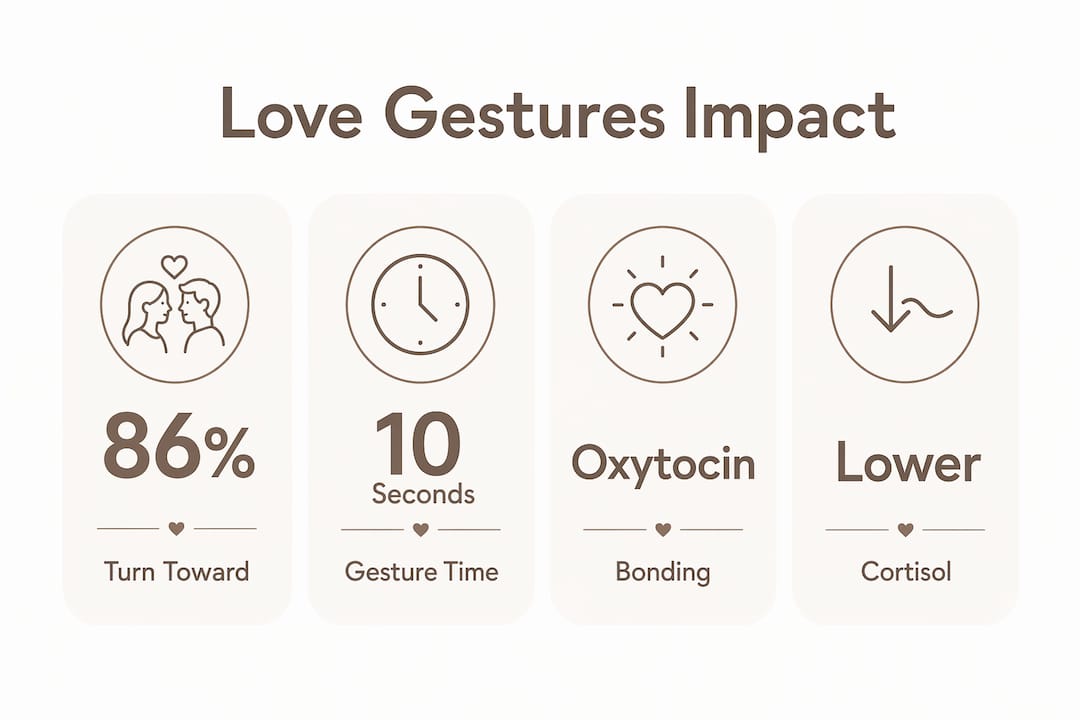
The attachment piece is where the numbers get striking. John Gottman’s longitudinal research found that couples who eventually divorced turned toward bids for connection only about 33% of the time, while stable couples turned toward those same bids roughly 86% of the time. A “bid” can be as small as pointing out something interesting, reaching for a hand, or sending a quick message. The gesture does not have to be large. It has to be frequent.
Low-barrier gestures also reduce what clinicians call defensive activation. When a gesture costs little emotionally, the nervous system does not brace for impact. The recipient does not have to decide whether they are ready to receive something big. That calibrated vulnerability is especially important for avoidant partners or anyone with a trauma history, where high-stakes gestures can trigger withdrawal rather than warmth.
The core mechanisms at a glance:
- Frequency of small acts rewires nervous-system expectations toward safety
- Oxytocin responses do not require grand gestures, only genuine presence
- Cortisol drops with consistent physical and verbal affection
- Turning toward bids at high rates predicts relationship stability
- Low emotional cost removes the defensive barrier to receiving love
Gottman research finding: Stable couples turned toward bids for connection approximately 86% of the time. Couples who later divorced turned toward those same bids only about 33% of the time. The difference was not the size of the gesture. It was how often they showed up.
Everyday low-barrier gestures you can actually use
The goal is variety across categories so you are not relying on one mode of connection. Different partners respond to different channels, and rotating keeps gestures from feeling rote.
Micro-presence Put the phone face-down and hold eye contact for five seconds when your partner walks in. That is it. Therapists describe this kind of presence and attunement as “felt love,” the kind that lands deeper than gifts or grand plans because it signals: you have my full attention right now.
Micro-kindness
- Make their coffee without being asked
- Move their water bottle to where they will find it
- Handle one small task they mentioned dreading
Micro-verbal (copy-ready scripts)
- “I was thinking about you earlier. Hope your afternoon got easier.”
- “I really liked how you handled that.”
- “You looked good today. I noticed.”
- “Thanks for [specific thing]. It made a difference.”
These work as texts or spoken words. For partners who process better asynchronously, a short written message often lands more cleanly than an in-person comment they feel pressure to respond to immediately.
Micro-touch
- A hand squeeze when you pass in the hallway
- A forehead kiss before leaving
- A hand on the back while they are talking
For neurodiverse partners or those with sensory sensitivities, always establish explicit consent around touch. Asynchronous signals like a text or a note carry the same relational weight without the sensory load.
Micro-rituals A one-minute nightly appreciation: each partner names one specific thing the other did that day. Not “you were great.” Something concrete: “You remembered to call my mom. That meant a lot.” Specificity is what makes appreciation feel genuine rather than obligatory.
Why grand gestures can fall flat
Grand gestures can backfire when the partner’s nervous system is not ready, or when the gesture carries a hidden agenda. That is not cynicism. It is how emotional timing works.
The common failure modes:
- Timing mismatch. A grand romantic dinner lands differently when your partner is in the middle of a stressful week and feels like they have to perform gratitude they do not have the bandwidth for.
- Perceived pressure. A large gesture can feel like a demand: now you have to match this energy, or feel guilty that you cannot.
- The invisible bill. When gestures carry implicit expectations, recipients often sense it. High-cost acts that feel conditional create a perceived debt rather than a gift. Unconditional small acts avoid this entirely.
- Love language mismatch. A partner who values quality time over gifts may feel unmoved by an expensive present, no matter how thoughtful the giver believes it to be.
- Stress reactivity. During periods of high conflict or disconnection, a grand gesture can read as an attempt to skip the repair work rather than do it.
None of this means grand gestures are wrong. It means they work best when the relational ground is already warm, which is exactly what consistent low-barrier practice builds.
Pro Tip: If you are planning something big, make five small deposits first. A week of daily check-in texts, a few specific appreciations, a couple of small physical touches. By the time the grand gesture arrives, your partner’s nervous system is already open.
How to build low-barrier gestures into your daily routine
The simplest habit design: pick one tiny ritual, anchor it to something you already do, and repeat it daily for two weeks before adding another.
- Choose one gesture. Start with the category that feels most natural to you, verbal, physical, or written. Do not try to cover all five categories at once.
- Anchor it. Attach it to an existing routine. Morning coffee becomes the moment you send a “good morning” text. Brushing your teeth becomes the trigger for a one-sentence appreciation.
- Make it tiny. The gesture should take under 30 seconds. If it feels like effort, it is too big for a daily habit.
- Commit for 14 days. Two weeks is enough to feel the shift without requiring long-term willpower. Track it simply: a checkmark on your phone’s notes app works fine.
- Layer a second ritual. After two weeks, add one gesture from a different category. This is habit stacking, and it is more reliable than motivation.
Sample 14-day micro-goal timeline:
- Days 1–3: Morning text only. One sentence, specific to that day.
- Days 4–7: Add one physical gesture daily (hand squeeze, forehead kiss).
- Days 8–11: Add a nightly one-sentence appreciation spoken aloud.
- Days 12–14: Reflect. Which gesture got the warmest response? Which felt most natural to you?
Timing guidance: Transitions are the highest-yield moments. Hellos, goodbyes, and the first ten minutes after reuniting are when the nervous system is most receptive. A warm greeting at the door costs nothing and signals: you matter to me, even after an ordinary day.
For avoidant attachment styles, start with asynchronous gestures (texts, notes) before moving to in-person ones. For anxious attachment styles, consistency matters more than variety. Show up the same way, at roughly the same time, and the predictability itself becomes the reassurance.
What the research and therapists actually say
The evidence for small, consistent gestures is not soft or anecdotal. Daily experiences of felt love correlate with measurable improvements in self-esteem, optimism, and overall well-being, not just relationship satisfaction.
Gottman’s turning-toward data, cited above, is the most replicated finding in this space. The 86% vs. 33% gap between stable and divorcing couples is not about who planned better dates. It is about who responded to small, everyday bids.
Fredrickson’s work on micro-moments adds the physiological layer: genuine brief exchanges activate oxytocin-linked bonding pathways. The brain does not require a grand occasion to release the chemistry of connection.
One important limit: low-barrier gestures are a first step, not a substitute for repair. If a relationship involves patterns of withdrawal, chronic disconnection, or unresolved trauma, small gestures help but are not sufficient. A licensed couples therapist, such as one trained in Emotionally Focused Therapy (EFT) or the Gottman Method, can address the deeper architecture that small acts alone cannot reach.
Key Takeaways
Consistent, low-barrier love gestures build relationship security more reliably than occasional grand gestures because frequency of connection, not magnitude, is what the nervous system tracks.
| Point | Details |
|---|---|
| Frequency beats magnitude | Stable couples turn toward bids roughly 86% of the time; the gesture size matters far less than how often you show up. |
| Lower cost, higher receptivity | Small gestures bypass defensive activation, making it easier for partners to receive affection without bracing for pressure. |
| Anchor one ritual first | Attach a single 30-second gesture to an existing routine and repeat it for 14 days before adding a second. |
| Adapt to your partner | Use asynchronous texts for avoidant styles, consistent timing for anxious styles, and explicit consent for touch with neurodiverse partners. |
| Pingher reduces the friction | Pingher’s one-tap messaging and daily reminders make it easy to send a specific, personal note without breaking your routine. |
What I keep coming back to
The conventional wisdom on love gestures tends to celebrate the dramatic: the surprise trip, the anniversary dinner, the public declaration. Those moments are real and they matter. But they are not what builds the felt sense of security that holds a relationship together through an ordinary Tuesday.
What actually works is closer to what Figs O’Sullivan calls “Fiat Love” in reverse: instead of temporary emotional inflation from a single large act, you are making hundreds of small, unconditional deposits. The account grows quietly. Your partner stops bracing for distance and starts expecting warmth. That shift in expectation is the whole game.
The part most people underestimate is how low the bar actually needs to be. A text. A look. A specific thank-you. The gesture does not need to be impressive. It needs to be real, and it needs to happen again tomorrow.
If patterns of withdrawal or emotional distance persist despite consistent effort, please consider working with a licensed therapist. Small gestures are a starting point, not a ceiling.
Pingher makes the daily habit easier to keep
Knowing what to do and actually doing it every day are two different problems. Pingher is built for the second one.
The app’s one-tap functionality means you can send a specific, personal message to your partner in under ten seconds, no drafting, no second-guessing. That frictionless design is exactly what daily affection signals need to survive a busy week. Pingher also includes scheduled reminders so the habit does not depend on you remembering, and short message templates you can personalize without starting from scratch.
- One-tap sending for quick, genuine check-ins
- Daily reminder prompts anchored to your schedule
- Personalized message templates for specific appreciations
- Low-effort design that fits into transitions (morning, commute, evening)
The app is built around consent and privacy: messages go only to the partner you choose, and the tone stays warm rather than transactional. If you want a tool that makes the 14-day habit plan above easier to stick to, try Pingher and send your first message today.
Useful sources to read next
- Micro-moments of positivity resonance (Fredrickson research) — The primary source for oxytocin-linked bonding effects from brief, genuine connection moments.
- The science behind small gestures in relationships — Summarizes Gottman’s turning-toward data and the frequency-over-magnitude principle in accessible terms.
- How to create rituals of connection — Practical guidance on habit stacking and anchoring rituals to existing routines.
- 4 Easy Ways to Show Your Love — Psychology Today piece on daily expressions of love and their measurable impact on relationship health.
- The little things in relationships that matter the most — Verywell Mind summary of research linking daily felt love to self-esteem, optimism, and well-being.
- Pingher — A low-friction tool for sending daily personalized messages; a practical starting point for the habits described in this guide.
Recommended
Built for couples who care.
Pingher helps you send the right words at the right moment.
Get Pingher on Google Play