Why Partners Need Daily Affection Signals

Why Partners Need Daily Affection Signals
Daily affection signals are deliberate, consistent actions that communicate love and safety to your partner, forming the foundation of lasting emotional intimacy. Psychologists and relationship researchers use the term “bids for connection” to describe these micro-moments, a concept developed through John Gottman’s longitudinal research. Whether it’s a morning text, a hand squeeze, or a genuine compliment, these small acts build what Gottman calls an “emotional bank account.” Expressing love daily creates a positive feedback loop that deepens how loved both partners feel over time. Understanding why partners need daily affection signals is the first step toward building a relationship that stays close through ordinary life, not just special occasions.
Why partners need daily affection signals: the science of small moments
Daily affection signals fall into two broad categories: verbal and nonverbal. Verbal signals include compliments, words of affirmation, and spoken appreciation. Nonverbal signals include eye contact, physical touch, a smile across the room, or even turning your body toward your partner when they speak.

Bids for connection are often subtle. A partner who says “look at that sunset” is not just commenting on the weather. They are reaching out for shared attention and emotional contact. Gottman’s research shows that couples who turn toward bids 86% of the time thrive, while couples who turn toward bids only 33% of the time often divorce. That gap is not about love. It is about daily responsiveness.
Micro-gestures carry real biological weight. A 20-second hug, a hand on the shoulder, or a sincere “I appreciate you” each trigger oxytocin release in the brain. These moments signal safety to the nervous system in ways that a single grand romantic gesture simply cannot replicate across 365 days.
- Verbal signals: compliments, daily check-ins, words of affirmation, verbal appreciation, and expressions of gratitude
- Nonverbal signals: eye contact, physical touch outside of sexual contexts, turning your body toward your partner, and attentive listening
- Digital signals: a thoughtful morning message, a brief “thinking of you” text, or a voice note sent during the day
Pro Tip: Watch for the bids you almost miss. A partner who sighs loudly, mentions a stressful day in passing, or lingers near you without speaking is often reaching out. Noticing and responding to these quiet bids builds more trust than any single grand gesture.
How affection rewires the brain and body
The neuroscience behind daily affection is concrete and well-documented. Oxytocin, often called the bonding hormone, is released through small affectionate gestures and signals safety and trust to the nervous system. Affectionate touch outside sexual contexts correlates with lower cortisol levels and greater relationship satisfaction, acting as a pre-verbal safety signal the body registers before the mind catches up.
“Love is proof of work. Daily affectionate micro-moments signal to the nervous system ‘I am here for you,’ fostering secure attachment that words alone cannot build.”
Attachment theory explains why this matters so deeply. Humans are wired to seek proximity and reassurance from their primary attachment figures. When a partner responds consistently to bids for connection, the nervous system learns to predict safety. That prediction reduces defensive behavior, lowers anxiety, and makes genuine intimacy possible.
A study of 842 participants found a positive association between affectionate touch and perceived partner responsiveness, with affectionate touch on one day predicting how responsive a partner felt the next day. That is a direct biological link between daily behavior and emotional intimacy.
The concept of “Fiat Love” captures what happens when words replace action. Behavioral consistency outweighs declarations because the nervous system keeps a biological ledger of turned-toward bids. Saying “I love you” once a week while consistently ignoring bids does not register as love in the body. Daily signals do.
What happens when affection signals go missing?
Missed bids are not neutral events. When a partner reaches out and receives no response, or a dismissive one, the nervous system registers a small threat. Over time, repeated missed bids accumulate into attachment wounds, feelings of being unseen, unwanted, or unimportant.
Missed bids often trigger attachment wounds that lead to negative interpretations and further withdrawal. A partner who stops reaching out is not becoming independent. They are protecting themselves from repeated rejection. That withdrawal then reads as coldness to the other partner, who pulls back in turn. The cycle feeds itself.
The nervous system’s response to being turned away is not subtle. Cortisol rises. Vigilance increases. The brain begins scanning for more evidence of disconnection. What started as a missed text or a distracted response can, over months, erode the felt sense of safety that holds a relationship together.
Repair is possible, but it requires awareness. Three practical steps help couples interrupt the cycle:
- Name the pattern without blame. Say “I notice I’ve been feeling disconnected lately” rather than “you never pay attention to me.”
- Return to small bids deliberately. Restart the habit of reaching out in low-stakes ways, a comment about your day, a shared laugh, a brief touch.
- Respond to bids you would normally miss. Phones act as attention absorbers that create unintentional turn-away responses. Putting the phone down during shared time is a bid response in itself.
Pro Tip: When you realize you missed a bid, name it out loud. “I was distracted earlier when you mentioned that. Tell me again.” That single repair move deposits more into the emotional bank account than pretending the miss did not happen.
How to build daily rituals of affection that actually stick
Consistency matters more than intensity. A two-minute morning check-in practiced every day builds more emotional security than a weekend getaway that happens twice a year. Rituals of connection become automatic over time, shifting from conscious effort to a natural part of how partners relate.
Effective rituals share three qualities: they are brief, they are repeatable, and they feel genuine to both partners. A ritual that feels forced will not survive the first stressful week. The goal is to find small moments that already exist in your day and fill them with intention.
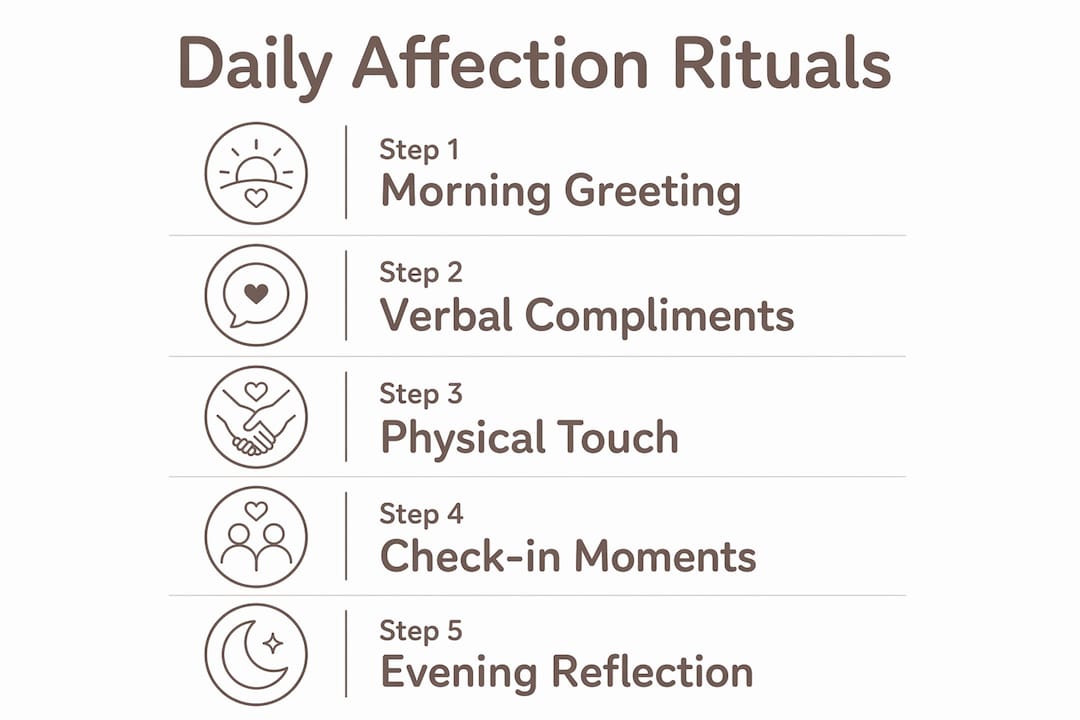
Here are five rituals backed by relationship research:
- Morning greeting with eye contact. Before phones, before coffee, make brief eye contact and say something warm. This sets the nervous system’s tone for the day.
- Appreciation exchange at dinner. Each partner names one specific thing they appreciated about the other that day. Specificity matters more than length.
- Non-sexual touch moments. A hand on the back while passing in the kitchen, a shoulder rub while watching TV. Affectionate touch frequency directly predicts how responsive partners feel to each other.
- A midday message. A brief, genuine text during the workday signals “you are on my mind.” It does not need to be long. It needs to be real. Tools like Pingher make this effortless with one-tap personalized messages that feel thoughtful, not automated.
- A departure and return ritual. A real goodbye kiss and a genuine “how was your day” upon return. Gottman’s research identifies these two moments as disproportionately important for daily connection.
| Ritual | Time required | Primary benefit |
|---|---|---|
| Morning eye contact greeting | Under 1 minute | Sets nervous system safety for the day |
| Specific daily appreciation | 2–3 minutes | Builds emotional bank account deposits |
| Non-sexual touch moments | Ongoing, passive | Lowers cortisol, signals care |
| Midday message | Under 1 minute | Maintains presence across distance |
| Departure and return ritual | 2–3 minutes | Anchors daily connection at key transitions |
The importance of daily affection is not about performing love. It is about making love visible in the small, ordinary moments that fill most of a relationship’s actual life.
Key Takeaways
Daily affection signals work because they give the nervous system consistent, behavioral proof of love, and no amount of words alone can substitute for that evidence.
| Point | Details |
|---|---|
| Small signals outperform grand gestures | Daily micro-moments build more emotional security than occasional large romantic acts. |
| Bids for connection predict outcomes | Couples who respond to bids 86% of the time thrive; those who respond 33% of the time often do not. |
| Missed bids accumulate into wounds | Repeated unacknowledged bids trigger withdrawal cycles that erode trust over time. |
| Rituals create automatic safety | Consistent daily rituals shift from conscious effort to biological safety signals the body expects. |
| Affectionate touch has measurable impact | Touch frequency predicts perceived partner responsiveness the following day, linking behavior to felt intimacy. |
The quiet truth about daily affection I’ve learned over time
Most couples I’ve observed do not fail because of dramatic betrayals. They drift because of accumulated silence. The missed “how are you,” the distracted nod, the evening spent side by side on separate screens. None of those moments feel significant in isolation. Together, they hollow out a relationship from the inside.
What I find genuinely surprising is how little time genuine connection requires. Two minutes of real eye contact and a specific compliment does more for a relationship than a weekend trip planned out of guilt. The nervous system does not care about the size of the gesture. It cares about the frequency and the sincerity.
The couples who maintain strong bonds over decades are not the ones who never get distracted or stressed. They are the ones who have built small, reliable rituals that keep reaching toward each other even on ordinary Tuesdays. That consistency is what emotional connection is actually made of.
The hardest part is not knowing what to do. The hardest part is remembering to do it when life gets loud. That is where intentional systems, whether a habit, a ritual, or a well-timed reminder, become the difference between a relationship that drifts and one that deepens.
— Alan
Pingher makes daily affection easier to practice
Knowing the importance of daily affection signals is one thing. Remembering to act on that knowledge every single day is another. Pingher is built for exactly that gap.

Pingher lets you craft and send personalized messages to your partner with a single tap, making it easy to show up consistently even on your busiest days. The platform is designed for couples who want their daily love expressions to feel genuine, not generic. Whether you want to send a morning appreciation note, a midday check-in, or a specific compliment that lands with real weight, Pingher gives you the words and the reminder to send them. Consistency is the whole point, and Pingher is built around that.
FAQ
What are daily affection signals in a relationship?
Daily affection signals are small, consistent actions that communicate love, care, and responsiveness to a partner. They include verbal expressions, physical touch, eye contact, and digital messages sent throughout the day.
Why do daily affection signals matter more than grand gestures?
The nervous system tracks behavioral consistency, not event size. Research shows that frequent small moments of connection build more emotional safety than rare large gestures because they create predictable, reliable proof of care.
What happens when partners stop giving affection signals?
Repeated missed bids for connection trigger attachment wounds, increase cortisol, and start withdrawal cycles that erode trust. Over time, the absence of daily signals registers as emotional disconnection, even when love is still present.
How long does it take to build a daily affection ritual?
Most relationship researchers suggest that brief, consistent rituals become automatic within a few weeks of daily practice. The key is choosing rituals that feel natural and require minimal time, under three minutes each.
Can a short message count as a meaningful affection signal?
A brief, genuine message sent during the day signals presence and care across distance. Written affection messages build trust through consistency, and their impact compounds over time when sent regularly.
Recommended
Built for couples who care.
Pingher helps you send the right words at the right moment.
Get Pingher on Google Play