Sustainable Affection Habits: Simple Daily Rituals for Couples

Sustainable Affection Habits: Simple Daily Rituals for Couples
A sustainable affection habit is one small, repeatable act of care — done consistently enough that your partner feels genuinely thought of, day after day. Success looks like this: multiple tiny deposits each week, each taking under two minutes, with both of you noticing a warmer baseline connection within a few weeks. No grand gestures required.
Key Takeaways
A sustainable affection habit works because consistency — not intensity — is what builds lasting felt connection between partners.
| Point | Details |
|---|---|
| Frequency over intensity | Five to seven small acts a week outperform occasional grand gestures for long-term connection. |
| Two-minute rule | Keep each habit under two minutes so it survives high-stress days without breaking the streak. |
| Cue-based design | Attach the habit to an existing daily transition — goodbye, bedtime, morning coffee — so memory isn’t required. |
| Preferences matter | Ask your partner what lands best; the form is flexible, the consistency is what counts. |
| Pingher reduces friction | One-tap templates and scheduled reminders help the habit form in weeks one and two, when forgetting is most likely. |
Table of Contents
- What is a sustainable affection habit, and why does it work?
- Why small, frequent acts of affection matter more than you think
- The core ingredients that make affection habits last
- Concrete micro-affections busy couples can start today
- How to build the habit in two to four weeks
- Navigating differences in preferences and comfort
- Why affection habits fade and how to fix them
- How reminders and apps can help (and when to step back)
- Why the smallest acts carry the most weight
- Pingher makes the two-week experiment effortless
- Sources
What is a sustainable affection habit, and why does it work?
The phrase “sustainable affection habit” isn’t clinical jargon. Think of it as the relationship equivalent of drinking water every day rather than bingeing on one enormous meal once a month. The Gottman Institute’s research on rituals of connection describes these small bids as predictable deposits into an Emotional Bank Account — reliable signals that say “you matter to me” without requiring a special occasion.
What makes the habit sustainable is the word “repeatable.” A single loving gesture is a gift. The same gesture, offered at the same moment every day, becomes a ritual — and rituals change how secure your partner feels at a neurological level, not just an emotional one.
Why small, frequent acts of affection matter more than you think
Frequency beats intensity. Relationship expert Bianca Mendez makes this case directly: for busy partners, consistent small acts build a more resilient relational baseline than occasional grand gestures ever could.
The research backs her up across several angles:
- Affectionate touch — kissing, hugging, holding hands — links to improved mood and psychological well-being, with MIDUS findings showing these effects tend to be broadly beneficial, though they vary by baseline relationship satisfaction.
- Smartphone-prompted micro-affections produced significantly higher momentary intimacy in an experimental group versus a control group in a two-week ecological study — meaning brief, prompted acts can causally increase closeness in daily life.
- Daily small acts reduce uncertainty. Verywell Mind’s synthesis of the evidence shows that consistent signals of being “thought of” build the security partners need to weather stressful or busy periods.
💡 Couples who frequently engage in varied affectionate behaviors report higher relationship satisfaction than those who rely on infrequent, high-effort gestures.
The core ingredients that make affection habits last
A habit that fades after ten days wasn’t really a habit — it was a resolution. The minimal recipe for one that sticks has five parts:
- Consistency over creativity. The same small act at the same moment each day is more powerful than a different elaborate act each week.
- Tiny effort. If it takes more than two minutes, it won’t survive a hard Tuesday. Keep the commitment small enough that you’d do it even when tired.
- Shared meaning. A gesture lands differently when both partners understand why it matters. A quick forehead kiss at the door means more when you’ve both agreed it signals “I see you.”
- A predictable cue. Attach the habit to something that already happens — morning coffee, leaving for work, locking the front door. The cue does the remembering for you.
- Consent and comfort. Your partner’s preferences shape what works. A habit that makes one person feel crowded isn’t sustainable for either of you.
Pro Tip: Start with frequency, not intensity. Commit to one 30-second act every day for two weeks before adding anything new. Keeping the bar low is what makes the habit stick.
Concrete micro-affections busy couples can start today
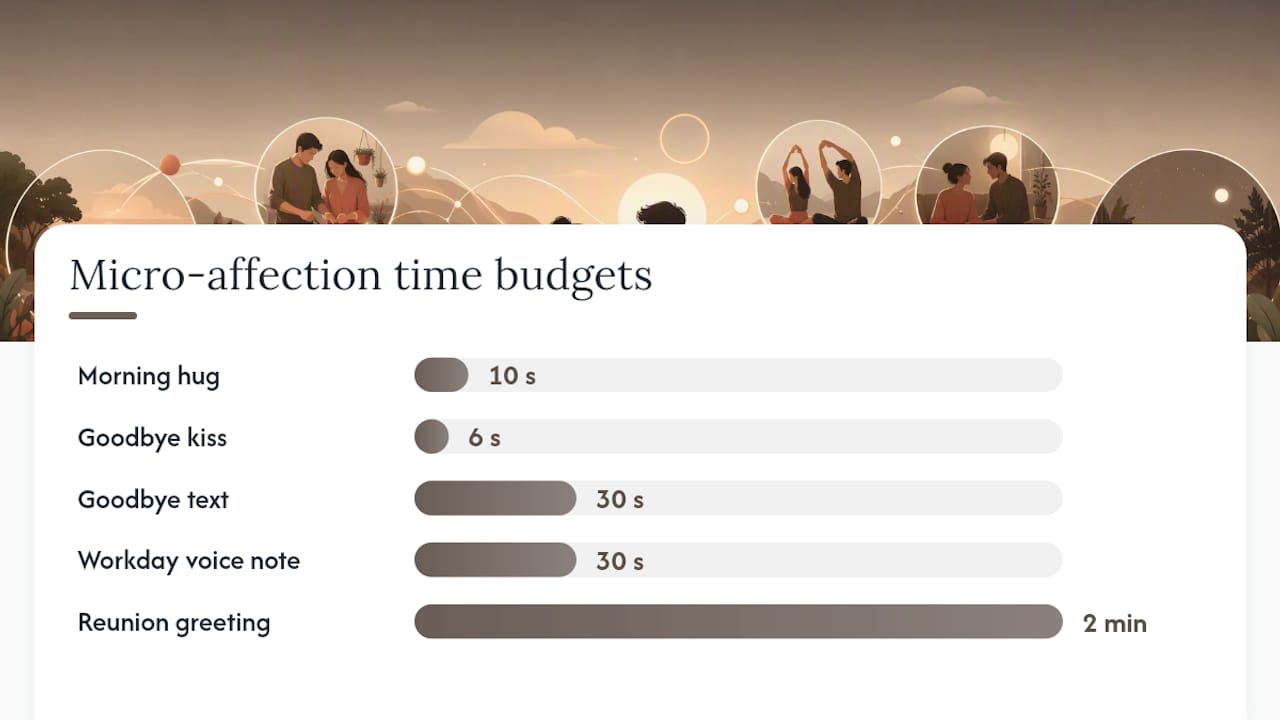
These are categorized by the natural transitions in your day — the moments that already exist and cost nothing to use. Each one includes a time budget and a sample phrase or action.
Morning ☀️
- 10-second hug before phones: Hold for a slow count of ten. No words needed.
- One specific compliment: “You look calm this morning” lands better than “you look nice.”
Goodbye 👋
- Six-second kiss: The Gottman Institute recommends a kiss long enough to actually feel present, suggesting around six seconds as a guideline.
- One-line text as you leave: “Thinking of you today.” Thirty seconds, sent before you start the car.
During the workday 💬
- A mid-day check-in text: “How’s your afternoon going?” — no agenda, just curiosity. You can send affection messages between meetings in under a minute.
- A voice note: Thirty seconds of your actual voice beats a typed emoji on a hard day.
Reunion 🏠
- Two-minute decompression greeting: Put phones down, make eye contact, say one thing about your day before asking about theirs.
Bedtime 🌙
- Appreciation ritual: Name one specific thing your partner did today that you noticed. Keep it concrete: “I noticed you made coffee before I asked.”
- Physical close: A hand on the shoulder or a brief back rub — no pressure, just presence.
High-stress day version: Drop everything to a single text: “Rooting for you today.” That’s it. It counts.
How to build the habit in two to four weeks
This is a simple, ordered experiment — not a permanent overhaul.
- Week 1 — Choose one cue and one tiny action. Pick a transition you already have (morning goodbye, bedtime). Commit to one act lasting under 60 seconds. Write it down: “When I leave for work, I will send one text.”
- Week 2 — Pair it with a daily routine. Stack the habit onto something automatic — your morning coffee, locking the door, plugging in your phone at night. Stacking removes the decision.
- Week 3 — Add a second micro-affection. Only add one. Keep both acts under two minutes combined.
- Week 4 — Review and adjust. Ask yourself three questions each week:
- Did I complete the habit most days? ✓ / ✗
- Did my partner seem to notice or respond? ✓ / ✗
- What one small tweak would make next week easier?
Using daily affection reminders during weeks one and two reduces the cognitive load while the habit is still forming.
Navigating differences in preferences and comfort
Not every partner wants the same kind of affection. That’s normal, and it doesn’t mean the habit won’t work — it means you need a brief, honest conversation first.
Try these curiosity-first prompts:
- “What’s one small thing I do that makes you feel genuinely cared for?”
- “Is there anything I do that feels like too much, or not quite right?”
- “Would you rather I text during the day or save it for when we’re together?”
If your partner dislikes frequent texts, shift to a physical ritual — the morning hug, the bedtime appreciation. If touch feels like pressure on hard days, a handwritten sticky note on the coffee maker works just as well. The form is flexible. The consistency is what matters.
A clear consent reminder: always check in if a habit starts to feel one-sided or if your partner’s response changes. Micro-affections only sustain connection when both people feel comfortable with them.
Why affection habits fade and how to fix them
The four most common failure modes, and a direct fix for each:
- Time scarcity: The habit was too big. Shrink it to 30 seconds and restart.
- One-sided effort: One partner is carrying the habit alone. Name it gently: “I’ve been trying to do X every day — I’d love it if we could do it together.”
- Forgetting: The cue isn’t strong enough. Set a phone reminder or attach the habit to a more reliable trigger.
- Habituation: The act has become invisible. Swap the form — same timing, different gesture — to refresh its signal value.
Short repair script for a missed week: “I’ve been off lately and I know it. I’m sorry. Can we start fresh tonight with [one small thing]?” One sincere acknowledgment plus one tiny reconnection is enough to reset.
If the habit consistently feels one-sided, or if affection has dropped alongside other signs of disconnection — less talking, more irritability, emotional distance — that’s a signal worth taking to a couples therapist rather than a habit tracker.
How reminders and apps can help (and when to step back)
A smartphone-prompted affection intervention showed that brief prompts can causally increase momentary intimacy. That’s the case for using technology as a cue — not as a replacement for meaning, but as a reliable trigger when memory fails.
When choosing a tool or app to support the habit, look for:
- Scheduled nudges at times you actually control (not mid-meeting)
- One-tap message templates so a thoughtful message takes seconds, not minutes
- Privacy controls — your relationship isn’t public content
- Adjustable frequency so reminders don’t become noise
The honest limit of tech: a reminder that sends a pre-written message your partner has seen twelve times stops feeling personal. Use tools to automate the cue, then write the message yourself — or use a template as a starting point and add one specific detail. That combination keeps the habit low-effort and still genuine. For a broader look at relationship bonding tools, the feature checklist above is a good filter.
Why the smallest acts carry the most weight
Here’s the thing most relationship advice gets wrong: it treats affection like a performance. Something you do when you have time, energy, or inspiration. The research points in a different direction entirely.
Rituals of connection work precisely because they’re unremarkable. A six-second kiss at the door isn’t romantic in the cinematic sense. But repeated every morning for six months, it becomes one of the most reliable signals of safety your partner’s nervous system receives. The Gottman Institute calls this “turning toward” — and it’s the behavior that most consistently separates couples who stay close from those who drift.
What I find most overlooked in conversations about sustainable love practices is the role of validation over problem-solving in daily check-ins. When your partner shares something hard, the instinct is to fix it. The more connecting response is to stay curious: “That sounds exhausting — tell me more.” That shift costs nothing and changes everything.

Pingher makes the two-week experiment effortless
Daily affection habits are simple in theory and easy to forget in practice. Pingher is built for exactly that gap. It’s a calm, private app that helps you write, schedule, and send personalized messages to your partner — with one-tap templates, AI-assisted suggestions, and gentle reminders timed to your day.
For a two-week experiment: set one morning reminder, choose a message template, and add one specific detail before sending. Track whether your partner responds differently by the end of week two. Start with one message a day — that’s the only rule. Pingher keeps the friction low so the habit has a real chance to form.
Try Pingher on Google Play and see what two weeks of consistent, thoughtful messages actually feels like.
Sources
- The Little Things That Keep Love Strong
- Can we use smart-phones to increase physical affection, intimacy and security in couples? Preliminary support from an attachment perspective
- What Are “Micromances” and Are They Important for Your Relationship?
- The little things in relationships that matter the most
- Affectionate touch and relationship outcomes (MIDUS findings PDF 2500)
Recommended
Built for couples who care.
Pingher helps you send the right words at the right moment.
Get Pingher on Google Play