Appreciation in Relationships: Why It Changes Everything

Appreciation in Relationships: Why It Changes Everything
Appreciation in relationships is the deliberate, specific act of recognizing your partner’s value — not just what they do, but who they are. It goes well beyond a polite “thanks for dinner.” Real appreciation names the quality behind the action: “You stayed calm when I was overwhelmed, and that steadied me.” That specificity is what separates appreciation from generic politeness, and it’s what makes a partner feel genuinely seen rather than merely acknowledged.
Appreciation shows up in several forms, and the most effective couples tend to use all of them:
- Verbal affirmations: Naming a specific trait or effort out loud (“I noticed how patient you were today”)
- Attentive listening: Putting the phone down and giving full presence during a conversation
- Physical touch: A hand on the shoulder, a longer hug, a squeeze that says “I see you”
- Thoughtful gestures: A coffee made exactly how they like it, a note left somewhere unexpected
- Written messages: A text in the middle of the day that has nothing to do with logistics
The distinction between grand gestures and daily acknowledgments matters more than most couples realize. A birthday speech is meaningful, but it’s the Tuesday morning “I love how you handle hard things” that builds the emotional foundation a relationship actually rests on.
Why appreciation is essential to a healthy relationship
Appreciation does something specific inside a relationship: it makes both partners feel visible. When your partner notices what you bring to the relationship and says so, it confirms that your efforts are real and that you matter to this person. That feeling of being seen is one of the strongest drivers of relationship satisfaction.

Research on relationship maintenance shows that people who feel appreciated by their partners become more appreciative in return, and that cycle of mutual recognition keeps couples invested and responsive to each other’s needs. Appreciation isn’t just a nice emotional bonus — it actively shapes whether people stay committed over time. Partners who felt more appreciative were significantly more likely to still be in their relationships at a nine-month follow-up in that same study.
Appreciation also works as a buffer. When couples disagree about who does more around the house, or when one partner feels the division of responsibilities is unfair, felt appreciation can absorb much of that tension. The resentment that builds from unequal workloads shrinks considerably when both partners feel genuinely valued for what they contribute.
Perhaps most critically, appreciation is the direct antidote to contempt. Dr. John Gottman’s research identifies contempt as the single strongest predictor of relationship dissolution — and the way to prevent it is to keep a living, active sense of fondness and admiration for your partner. Appreciation doesn’t just feel good; it keeps the corrosive patterns at bay.
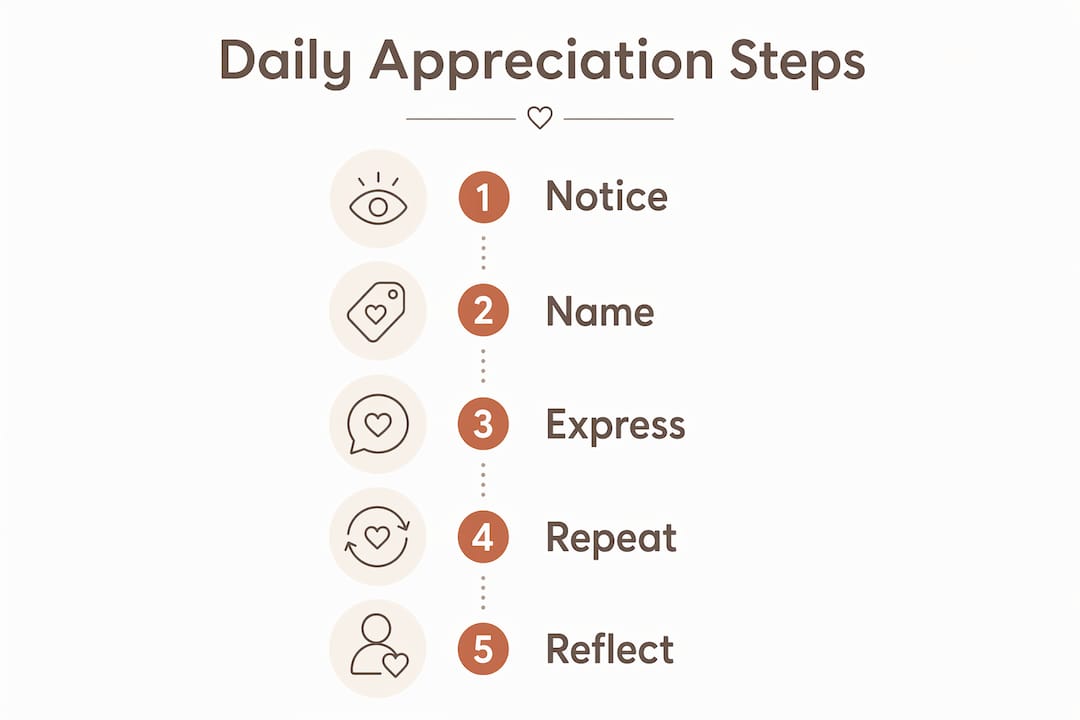
Pro Tip: Each morning, pick one specific thing you genuinely admire about your partner and find a way to name it before the day ends. You don’t need a big moment — a single sentence at the right time does more than a speech delivered once a year.
What research and experts say about appreciation’s effects on couples
Dr. John Gottman’s “Fondness and Admiration System” is one of the most well-documented frameworks in relationship psychology. The core idea is that couples who regularly name what they love about each other build a reservoir of goodwill that cushions them during conflict. When that reservoir runs dry, criticism slides into contempt. When it’s full, the same argument lands differently — partners give each other the benefit of the doubt instead of assuming the worst.
The Gottman approach emphasizes daily specific appreciation as the mechanism: recalling moments when your partner came through for you, naming qualities you admire, and making those private thoughts visible. This isn’t about manufactured positivity. It’s about training your attention toward what’s actually there and saying it out loud.
Sincerity is where this gets complicated. Research published in Personality and Social Psychology Bulletin found that perceived insincerity in gratitude expressions undermines relationship satisfaction even when appreciation is expressed frequently. Going through the motions — saying “thank you” because it’s expected rather than because you mean it — can actually erode trust over time. Authenticity isn’t optional; it’s the mechanism through which appreciation works.
Feeling appreciated and feeling understood are related but distinct experiences. A University of Michigan study found that feeling understood and appreciated creates an upward cycle: partners who feel valued engage in more prosocial behaviors, which prompts more appreciation in return, which deepens connection further. The cycle feeds itself — but it has to start somewhere, and usually it starts with one person deciding to pay attention.
How to express appreciation in ways that actually land
Consistency and specificity are the two qualities that separate appreciation that builds a relationship from appreciation that fades into background noise. A vague “you’re great” registers differently than “the way you handled that situation with my family last week meant a lot to me.” The more specific the observation, the more it signals that you were actually paying attention.
Here are concrete ways to make appreciation a daily practice rather than an occasional event:
- Name the quality, not just the action. Instead of “thanks for cooking,” try “I love that you take care of us like that.” One thanks an act; the other honors a person.
- Use physical touch intentionally. Couples who express appreciation through body language — handholding, a hand on the back, a longer-than-usual hug — report higher relationship satisfaction. Touch communicates what words sometimes can’t.
- Write it down. A short note, a text, a message sent mid-afternoon carries weight precisely because it required a moment of deliberate thought. Learning how to communicate appreciation in writing is a skill worth building.
- Listen without an agenda. Full attention during a conversation is one of the most underused forms of appreciation. No phone, no half-listening — just presence.
- Recall a specific memory. “Remember when you drove three hours to be with me? I think about that more than you know.” Revisiting moments of support reminds both partners of the relationship’s real history.
- Create a daily ritual. Some couples share one thing they appreciated about each other before bed. It takes two minutes and resets the lens through which they see each other.
- Send an unexpected message. Not a logistics text. An actual “I was thinking about you and wanted you to know” message, sent for no reason other than that it’s true.
The role of verbal appreciation in building intimacy is well-documented — but the key is that it has to feel real. Forced or formulaic expressions tend to land flat. The goal is to say what you actually notice, not to perform gratitude on a schedule.
What appreciation looks like in everyday relationship life
Appreciation doesn’t require grand settings or carefully chosen words. Some of the most powerful expressions happen in the middle of ordinary days.
- Telling your partner “you’re such a good problem-solver” after they figure out a logistical headache, not because you needed to say it, but because you noticed it
- Thanking them specifically for handling a task you both dislike — “I know you hate doing that, and you did it anyway”
- Acknowledging their emotional labor: “You always know when I need space and when I need you close. That’s not a small thing”
- Sending a thoughtful compliment during a workday that has nothing to do with anything they did — just who they are
- Noticing when they’ve been patient with you during a hard week and naming it: “You’ve been really steady lately. I see that”
- Recognizing effort that didn’t work out: “I know that didn’t go the way you hoped. I’m proud of you for trying”
- Expressing appreciation for personality traits, not just actions: “Your optimism genuinely makes my life better”
These examples share a common thread: they’re specific, they’re honest, and they’re about the person rather than the transaction. That’s what creates emotional safety over time. When a partner knows their qualities are seen and named, they’re more likely to bring their full self to the relationship rather than retreating into self-protection.
Couples with very different communication styles can still find their own version of this. One partner might express appreciation through acts of service; another through words. What matters is that the expression is genuine and that the receiving partner actually feels it. A wedding photography guide makes a similar point about specific acknowledgment — the most meaningful recognition names what made a moment unique, not just that it was “nice.”
How to build and sustain a daily appreciation habit
The biggest barrier to consistent appreciation isn’t a lack of love — it’s the drift that happens when life gets busy and couples stop scanning for the good in each other. Gottman’s research describes this as losing the habit of making private positive observations visible. You notice your partner did something kind, you feel it briefly, and then the moment passes without being spoken. Over time, those unspoken moments accumulate into a kind of emotional distance.
The fix is structural, not motivational. Waiting until you “feel like” expressing appreciation means it happens sporadically. Building it into a routine means it happens reliably.
Practical supports that couples actually use:
- A shared appreciation journal: Each partner writes one specific observation per day. Reading them together weekly builds a record of being seen.
- Morning or evening rituals: A two-minute check-in where each person names one thing they noticed. Low-effort, high-return.
- Intentional messaging: A short, personal message sent during the day — not a reminder or a question, just a moment of connection.
- Pingher: The app is built specifically for this. Its one-tap functionality lets you send a personalized, affectionate message to your partner without the friction of composing something from scratch. For couples who want to maintain daily appreciation but struggle to find the time or words, Pingher removes both obstacles.
Pro Tip: Set a daily reminder on your phone — not to send a generic message, but to pause and ask yourself: “What did I notice about my partner today that I haven’t said out loud?” That question alone tends to surface something worth saying.
Psychological resilience in couples improves when appreciation is habitual rather than episodic. Daily specific gratitude gradually rewires attention away from fault-finding and toward what’s genuinely good about the person you chose. That shift doesn’t happen in a single conversation — it builds across hundreds of small moments, most of them unremarkable on their own.
What happens when appreciation disappears from a relationship
The absence of appreciation doesn’t feel neutral. It tends to feel like rejection, invisibility, or being taken for granted — and those feelings erode a relationship from the inside out.
When partners stop expressing genuine appreciation, a predictable pattern follows. One or both partners begin to feel that their efforts go unnoticed. That feeling breeds resentment. Resentment, left unaddressed, curdles into contempt — the dismissive eye-roll, the sarcastic comment, the sense that your partner is beneath your respect. Gottman’s research is unambiguous: contempt is the most reliable predictor of relationship breakdown, and it almost always grows from a deficit of appreciation.
The find-remind-and-bind theory of gratitude explains why appreciation is so structurally important. Gratitude helps partners find responsive people worth keeping close, reminds them of that value during hard moments, and binds them together through mutual care. Strip that out, and the binding mechanism weakens. Partners begin to question whether the relationship is worth the investment.
Lack of appreciation also affects how partners handle conflict. When people feel valued, they give their partner the benefit of the doubt during disagreements. When they feel invisible, they interpret ambiguous behavior negatively and respond defensively. The same argument lands completely differently depending on whether appreciation has been present in the days leading up to it.
The good news is that the cycle is reversible. Appreciation that returns after a dry spell carries real weight — partners notice the shift, and the upward cycle of responsiveness can restart. It doesn’t require a dramatic gesture. It requires one honest, specific acknowledgment, and then another the next day.
Key Takeaways
Appreciation in relationships is a daily practice of specific, sincere recognition that builds emotional safety, counters contempt, and keeps couples genuinely invested in each other over time.
| Point | Details |
|---|---|
| Specificity drives impact | Naming a quality or moment (“you stayed calm when I wasn’t”) lands far deeper than a generic “thank you.” |
| Appreciation counters contempt | Dr. John Gottman identifies contempt as the top predictor of relationship breakdown; daily fondness and admiration prevent it. |
| Sincerity is non-optional | Perceived insincerity in appreciation expressions undermines relationship satisfaction even when gratitude is expressed often. |
| Consistency beats grand gestures | Daily small acknowledgments build the emotional foundation that occasional big moments cannot replace on their own. |
| The cycle is self-reinforcing | Partners who feel appreciated become more appreciative in return, which deepens commitment and responsiveness over time. |
Pingher makes daily appreciation effortless
Knowing appreciation matters and actually doing it every day are two different things. Life gets full, and the intention to send a meaningful message gets pushed to “later” until it disappears entirely. Pingher is built for exactly that gap.
With one tap, you can send your partner a personalized, affectionate message that says what you actually mean — without the friction of starting from a blank screen. Pingher helps couples maintain emotional connection through daily reminders and thoughtful communication, so appreciation becomes a habit rather than an afterthought. If you want your partner to feel genuinely valued on an ordinary Tuesday, Pingher makes that easy.
Recommended
Built for couples who care.
Pingher helps you send the right words at the right moment.
Get Pingher on Google Play