How to Communicate Appreciation Simply in Relationships

How to Communicate Appreciation Simply in Relationships
Simple appreciation is defined as brief, sincere, specific gratitude expressed in a way your partner can actually feel. Knowing how to communicate appreciation simply is one of the most direct ways to strengthen emotional connection without adding complexity to your day. People who feel genuinely recognized are 2.5 times more likely to feel satisfied in their relationships. That number tells you everything: appreciation is not a nice extra. It is a core relationship skill. And the best part is that effective appreciation takes less than 30 seconds to deliver and costs nothing.
How to communicate appreciation simply and effectively
Expressing gratitude easily starts with understanding the three forms it can take: verbal, written, and behavioral. Each one works differently, and using all three gives your partner multiple ways to feel seen.
Verbal appreciation is the most immediate. A sincere compliment or a direct “thank you” said out loud lands in real time. The key is to make it specific to your partner’s preferences. Some people love being praised openly. Others prefer a quiet, private moment. Tailoring appreciation to what the recipient actually values makes it far more effective than a generic compliment.

Acts of service communicate appreciation without a single word. Making coffee before your partner wakes up, handling a task they dread, or simply showing up on time sends a clear message: I see what you do, and I value it. Quality time works the same way. Putting your phone down and being fully present tells your partner they matter more than whatever else is competing for your attention.
Written and digital messages fill the gaps that verbal moments miss. A short text in the middle of the day, a note left on the counter, or a brief message with real impact can carry more weight than a long conversation. Written words stick. Your partner can read them again when they need a lift.
Here are simple ways to show appreciation starting today:
- Say “thank you” and name the specific thing you are grateful for
- Send a short text that references something your partner did that day
- Leave a handwritten note somewhere they will find it unexpectedly
- Do one task your partner usually handles without being asked
- Give your full attention during a conversation, no phone, no distraction
- Tell your partner one thing you admire about them before bed
- Acknowledge their effort out loud, even when the result was not perfect
Pro Tip: Pick one method from this list and use it every day for one week. Consistency builds the habit faster than trying all seven at once.
Why does timing matter in appreciation messages?
Timing is not a soft preference. It is a neurological fact. Appreciation delivered within 48 hours of a specific action produces the strongest neural reinforcement and social bonding. The brain connects the positive feeling to the behavior that caused it. Wait too long, and that connection weakens.
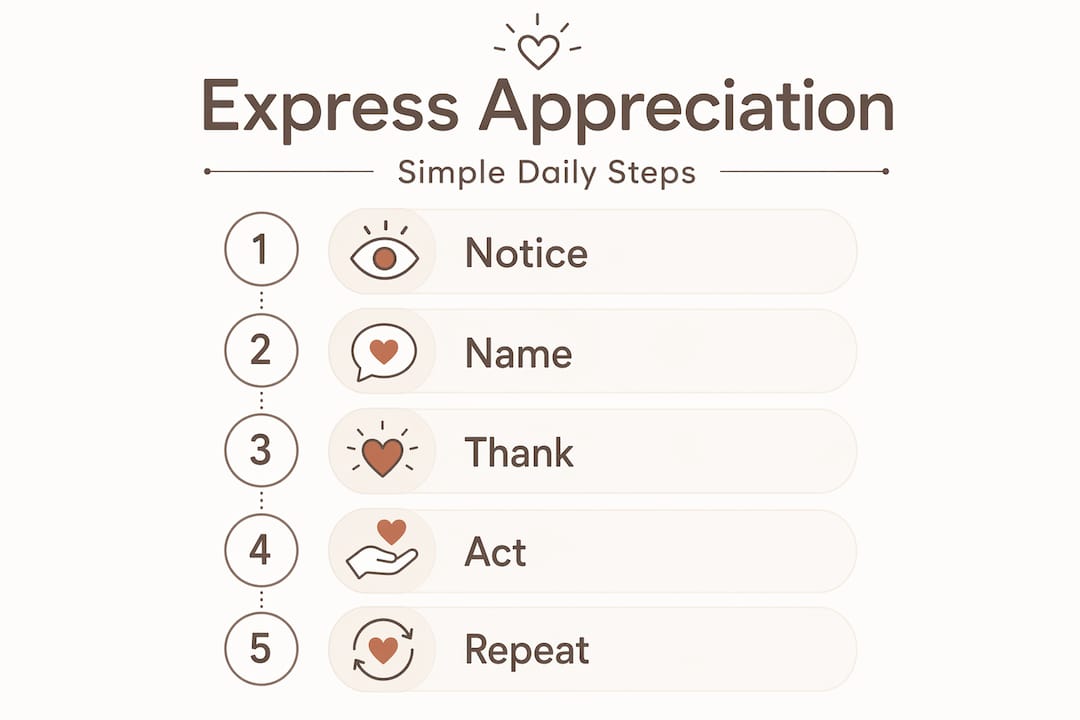
Specificity works the same way. Naming the exact action your partner took, and the real impact it had on you, triggers oxytocin release. Oxytocin is the bonding hormone. Generic praise does not produce the same effect. “You’re great” lands flat. “You handled that situation with so much patience, and it made me feel safe” lands deep.
The table below shows the difference in effect between generic and specific appreciation:
| Appreciation type | Example phrase | Effect on recipient |
|---|---|---|
| Generic | “You’re so helpful.” | Feels polite but forgettable |
| Specific action | “You picked up groceries without me asking.” | Feels noticed and valued |
| Specific + impact | “You picked up groceries. That saved me an hour and I felt so supported.” | Builds trust and emotional safety |
| Timed within 48 hours | Said the same day the action happened | Reinforces the behavior neurologically |
| Delayed or vague | “You’ve been good lately.” | Feels hollow and disconnected |
Brief, frequent appreciation builds trust faster than grand, infrequent gestures. The brain’s dopamine system responds to consistent small rewards more reliably than to rare big ones. This means a short daily text outperforms a monthly grand gesture every time.
Pro Tip: Set a phone reminder for 6 p.m. each day. Ask yourself: “What did my partner do today that I can name and thank them for?” One sentence is enough.
What mistakes should you avoid when expressing appreciation?
The most common mistake is generic, repetitive praise. Saying “you’re amazing” every day without specifics stops registering. Your partner’s brain learns to tune it out. Specific, descriptive thanks beats vague praise for lasting impact every time.
The second mistake is waiting for the perfect moment. Appreciation does not need a ceremony. It needs sincerity and speed. The longer you wait, the more the moment fades.
Here is a numbered framework for structuring any appreciation message so it always lands:
- Direct thanks. Start with a clear “thank you” or “I really appreciate.” No buildup, no preamble.
- Name the specific action. Say exactly what your partner did. “You stayed up to help me finish that project” is specific. “You’re always there for me” is not.
- State the personal impact. Tell them how it affected you. “It meant I could sleep without worrying” gives your partner a real picture of their contribution.
This Direct Thanks + Specific Action + Impact framework for appreciation messages makes recipients feel genuinely seen rather than just politely acknowledged. It takes about 15 seconds to use.
A third mistake is ignoring your partner’s preferred style. Some people feel most appreciated through words. Others need physical presence or acts of service to feel it. Matching your expression to their preference is not complicated. Ask them directly, or pay attention to what they do for you. People tend to give appreciation in the style they most want to receive it.
Feelings of awkwardness when expressing frequent appreciation are completely normal and fade with practice. Recipients almost always appreciate sincere kindness regardless of how smoothly it is delivered. Imperfect appreciation beats silent appreciation every time.
How do you make appreciation a daily habit?
Appreciation becomes a habit when it is attached to something you already do. Psychologists call this a “routine trigger.” You link a new behavior to an existing one, and the existing behavior reminds you to do the new one.
Practical triggers that work well for couples:
- Morning coffee: say one thing you appreciate about your partner before you both start your day
- Commute: send a short text on your way to work referencing something from the night before
- Lunch break: take 60 seconds to write a note or message
- Evening wind-down: share one moment from the day where your partner made a difference
- Journaling: write down one specific thing your partner did that week before you close your journal
Balancing verbal and non-verbal appreciation keeps things from feeling scripted. If you only ever say “thank you,” it can start to sound automatic. Mix in a gesture, a look, or a small act of service to keep the expression feeling genuine.
Responsiveness matters too. When your partner expresses appreciation back, receive it fully. Do not deflect with “oh, it was nothing.” Deflecting teaches them that their gratitude does not land. Say “thank you, that means a lot” and let it sit. That exchange reinforces the cycle for both of you.
Appreciation signals what healthy behavior looks like and encourages positive cycles in relationships. When both partners practice it consistently, the relationship builds a kind of emotional momentum. Small moments compound into deep trust over time.
Pro Tip: Pair appreciation with a thoughtful gesture once a week. The combination of words and action creates a stronger impression than either one alone.
Key Takeaways
Simple, specific, and timely appreciation is the most effective way to build emotional connection in a relationship, requiring less than 30 seconds and zero cost.
| Point | Details |
|---|---|
| Specificity beats generic praise | Name the exact action and its personal impact to make appreciation feel real. |
| Timing is neurological | Appreciation delivered within 48 hours produces the strongest bonding effect. |
| Use the three-part framework | Direct Thanks + Specific Action + Impact makes every message land with clarity. |
| Frequency outperforms grand gestures | Short, daily expressions build trust faster than rare, elaborate ones. |
| Match your partner’s style | Tailor appreciation to how your partner prefers to receive it for maximum effect. |
Why I think most people overcomplicate this
Most relationship advice treats appreciation like a project. There are worksheets, love language quizzes, and communication courses. I understand why those exist. But in my experience, the couples who feel most connected are not the ones who completed a course. They are the ones who got into the habit of saying small, true things out loud.
The awkwardness is real at first. I have felt it. You go to say something genuine and it comes out stilted. That is fine. The research backs this up: awkwardness fades with practice, and your partner appreciates the attempt far more than the polish. Waiting until you can say it perfectly means you often never say it at all.
What I have found is that starting small removes the pressure entirely. One sentence. One specific thing. Said within the same day. That is the whole practice. You do not need to be eloquent. You need to be honest and timely.
The couples I have seen struggle most with appreciation are not unloving. They are just quiet about what they notice. They feel it internally but assume their partner knows. Partners rarely know unless you say it. Saying it, even clumsily, changes the emotional temperature of a relationship faster than almost anything else I have seen.
Start with one moment today. Name it. Say it out loud or send it in a text. See what happens.
— Alan
How Pingher makes daily appreciation effortless
Knowing what to say is one thing. Actually sending it when life is busy is another. Pingher is built for exactly that gap.
Pingher lets you craft and send personalized appreciation messages to your partner with a single tap. You do not need to find the right words from scratch every time. The app supports the kind of brief, specific, timely messages that research shows actually build connection. Whether you are between meetings or winding down at night, sending a meaningful message takes seconds. Couples who use Pingher report feeling more valued and more emotionally present with each other. If you want appreciation to become a daily habit without the mental load, Pingher is the place to start.
FAQ
What is the simplest way to express appreciation to a partner?
The simplest method is a direct “thank you” followed by one specific action your partner took. Keeping it brief and naming the exact behavior makes it feel genuine rather than automatic.
How long should an appreciation message be?
Effective appreciation takes less than 30 seconds to deliver. One to three sentences using the Direct Thanks + Specific Action + Impact structure is enough.
How often should you express appreciation in a relationship?
Short, frequent messages build trust faster than occasional grand gestures. Daily or near-daily appreciation, even in small doses, produces stronger emotional bonding over time.
Does it matter when you say thank you?
Yes. Appreciation delivered within 48 hours of a specific action produces the strongest neural reinforcement. The sooner you express it after the moment, the more impact it has.
What if expressing appreciation feels awkward?
Awkwardness is normal and temporary. Recipients respond positively to sincere appreciation regardless of how smoothly it is delivered, and the discomfort fades quickly with consistent practice.
Recommended
Built for couples who care.
Pingher helps you send the right words at the right moment.
Get Pingher on Google Play