Tension Signs in Relationships: How to Spot Them Early

Tension Signs in Relationships: How to Spot Them Early
If you’re seeing defensiveness, long silences, or your partner pulling away from touch, yes. Those are tension signs, and they’re worth taking seriously before they harden into distance. The single best move in the next 48 hours: send one small, low-pressure gesture of warmth without demanding a response or reopening the last argument. Research from The Gottman Institute and couple-dynamics studies from Seedall and Wampler both point to the same truth: small, consistent responsiveness (not grand conversations) is what turns drift around. Pingher was built around exactly that idea.
Watch for these three signals especially:
- Snappiness over small things — irritation that seems out of proportion to what actually happened.
- Long silences — conversations that used to flow now stall, or stop happening altogether.
- Withdrawal of physical affection — less touch, less closeness, without anyone naming why.
Key Takeaways
Small, consistent responsiveness (not grand gestures) is what reverses relational drift once tension signs appear.
| Point | Details |
|---|---|
| Spot the pattern, not the moment | Look for frequency and escalation across talk, touch, and shared time before labeling it tension. |
| Watch the core signals | Defensiveness, long silences, and withdrawal of intimacy are the clearest early markers. |
| Act small within 48 hours | One warm, low-pressure gesture does more than a big confrontation right away. |
| Build daily micro-habits | A daily message, one curiosity question, and quick repair attempts rebuild responsiveness over time. |
| Know when to escalate to therapy | Persistent disengagement or repeated demand/withdraw cycles call for professional support. |
| Use Pingher for the daily habit | Pingher’s one-tap messages and reminders make the daily affection habit easy to sustain. |
Table of Contents
- What Are the Most Common Signs of Tension?
- Why Do These Behaviors Signal Deeper Disconnection?
- What Should You Do in the First 48 Hours?
- Which Daily Habits Actually Rebuild Connection?
- What Can You Say to Open the Conversation?
- When Should You Get Professional Help?
- A Practical Tool to Start Today
- Frequently Asked Questions
- Sources
What Are the Most Common Signs of Tension?
Tension rarely announces itself. It shows up in small behavioral shifts that are easy to explain away individually and only become clear as a pattern. Here are the ones worth tracking.
- Defensiveness over minor comments. A simple “did you take out the trash?” gets met with a sharp “why are you always on me about this?”
- Long silences replacing conversation. Evenings that used to include real talk now pass with the TV filling the gap.
- Withdrawal of physical intimacy. Fewer casual touches, hugs that feel obligatory, or a shift to sleeping at opposite ends of the bed.
- Logistics-only communication. Every exchange is about groceries, schedules, or bills. Nothing personal gets said.
- Decline in shared activities. The weekend hike or Sunday coffee ritual quietly disappears from the calendar.
- Decreased curiosity. Neither partner asks “how was your day?” and means it anymore.
- Repair attempts falling flat. One partner tries to joke or apologize after a tense moment, and it gets ignored or brushed off.
- Demand/withdraw cycles. One partner pushes for a conversation; the other shuts down or leaves the room.
These aren’t random. Both Psychology Today and Verywell Mind list nearly identical clusters as the signature of unspoken relational tension. Deeper still, some couples slide into what researchers call emotional indifference and cognitive distancing, where a partner physically stays but mentally checks out.
Pro Tip: A single tense evening means nothing. Watch for frequency, escalation, and whether the pattern shows up in more than one area (talk, touch, and shared time) before you label it “tension.”
Why Do These Behaviors Signal Deeper Disconnection?
Each of these signs traces back to a specific relational process, and naming the process helps you respond to the right problem instead of just the surface friction.
- Emotional disengagement shows up as apathy and behavioral withdrawal. Curiosity about your partner’s inner life quietly shuts off.
- Demand/withdraw dynamics happen when one partner pushes for change or closeness and the other retreats, a pattern documented in couples research using attachment models.
- Fight/flight/freeze responses kick in under perceived threat, and avoidance (the “flight” option) prevents the very repair that would resolve the tension.
- The neutrality trap is when a relationship looks calm on the surface because logistics are handled, but the emotional connection underneath has gone hollow.
A study by Seedall and Wampler, using multilevel modeling on 63 cisgender, heterosexual couples, found that demand/withdraw patterns often track with attachment style, meaning the cycle isn’t random bad luck. It’s a signal partners are struggling to ask for closeness and respond to bids in ways that land. That’s exactly why The Gottman Institute emphasizes turning toward small bids for connection: without that responsiveness, ordinary interactions go through the motions but stop meaning anything.
What Should You Do in the First 48 Hours?
When you’ve spotted real tension signs, the goal isn’t a big talk right away. It’s lowering the temperature enough that a real conversation becomes possible.
- Take a breath before reacting to a sharp comment. Give yourself ten seconds before responding.
- Skip reactive texting. If you’re upset, wait until you’re calmer to send anything.
- Send one small, warm gesture (a compliment, a coffee, a favorite snack) with no strings attached.
- Schedule a low-key check-in, framed around connection, not conflict.
- Practice one tiny shared ritual, even something as small as watching one show together, uninterrupted.
- Name the tension gently if it comes up: “I’ve noticed we’ve been a little off. I miss us.”
Try one of these low-threat scripts: “Hey, just thinking about you today” or “I feel like we’ve been distant, want to grab coffee this weekend?”
Pro Tip: Pausing isn’t the same as withdrawing. Say it out loud: “I need twenty minutes to cool off, then I want to talk.” That keeps the door open instead of slamming it.
If emotions run hot enough that you’re worried about saying something you can’t take back, step away to a separate room or take a walk. Come back once you’re steady.
Which Daily Habits Actually Rebuild Connection?
The research here is consistent: it’s not the big romantic gesture that restores closeness, it’s the accumulation of small, responsive moments. The Gottman Institute’s work on “bids for connection” shows that tension often builds because small invitations for attention go unanswered again and again, until partners stop offering them at all.
A simple daily checklist:
- Send one affectionate message that isn’t about logistics.
- Ask one genuine curiosity question (“what’s the best part of your day so far?”).
- Do one 60-second check-in, even a hug at the door.
- Make one repair attempt if something felt off (a quick “sorry, that came out wrong”).
Micro-rituals work because they’re low-effort and hard to skip. A morning “thinking of you” text. A two-line note left before work. A Sunday ritual of trading one thing you appreciated about each other that week.
This is where a tool like Pingher fits naturally into the picture. Its one-tap message feature means sending that daily affectionate note takes seconds, not a search for the right words at 11 p.m.

Pro Tip: Habit stacking works better than willpower. Attach your new gesture to something you already do daily, like sending your check-in message right after you pour your morning coffee.
What Can You Say to Open the Conversation?
Three short scripts, each built to invite rather than accuse:
- Curiosity script: “I’ve noticed we’ve been quieter lately. What’s been on your mind?”
- Repair script: “I don’t love how that conversation went. Can we try that again?”
- Future-check-in script: “Can we set aside twenty minutes this weekend just to talk, no agenda?”
If your partner gets defensive, soften your tone, reflect back what you heard, and offer to pause: “That’s fair, let’s come back to this later.” Lead with “I” statements (“I’ve been feeling distant”) instead of “you” statements (“you never talk to me”) to keep curiosity in the room instead of blame.
When Should You Get Professional Help?
Some patterns are too entrenched for daily habits alone to fix. Consider a therapist if you notice:
- Persistent emotional disengagement that doesn’t shift after weeks of small effort.
- A demand/withdraw cycle that repeats every time a hard topic comes up.
- Chronic withdrawal despite genuine attempts to reconnect.
- Any safety concerns, including threats, intimidation, or abuse.
Emotionally focused therapy targets attachment fears underneath conflict. Gottman-informed couples work focuses on rebuilding turning-toward habits and repair skills. Systemic therapy looks at the relationship as a pattern, not a blame game.
If there’s ever a threat to your physical safety, that’s not a “wait and see” situation. Reach out to a local domestic violence hotline or a trusted professional immediately, and prioritize a safety plan over reconciliation.
Why small consistency beats dramatic gestures
I’ve come to believe most couples don’t need a breakthrough conversation. They need one tiny, repeatable act of attention, repeated on purpose. Pick one small thing from this article and do it every day for a week. Watch what shifts.
A Practical Tool to Start Today
Pingher exists for exactly the moments this article describes: the quiet drift, the missed bids, the days that pass without anyone saying anything warm out loud.
The app’s one-tap message scheduling means you can queue up a caring note before the day gets away from you, without needing the right words on demand. AI message suggestions help when you’re staring at a blank screen and know you want to say something but can’t find it. Reminders and date tracking keep the small stuff (anniversaries, a rough week at work, a doctor’s appointment) from slipping through the cracks.
Each feature maps directly to the habits that matter most: a daily affection message covers your turning-toward practice, curiosity prompts nudge you toward genuine check-ins, and repair nudges help when you need to reset after a rough moment. If you’ve read this far because something in your relationship feels a little quieter than it used to, Pingher is built to help you close that gap one small message at a time. Try sending your first one today.
Frequently Asked Questions
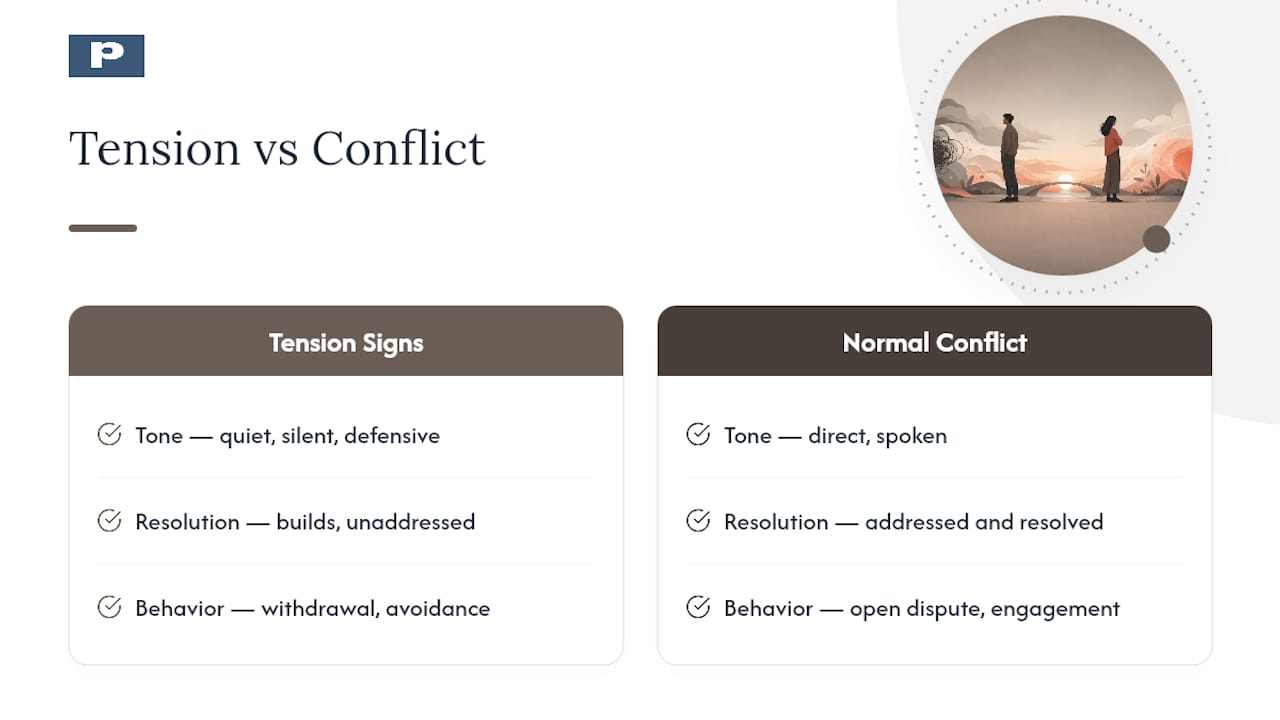
Are tension signs the same as normal relationship conflict? Not exactly. Normal conflict is direct and gets resolved. Tension signs are quieter: defensiveness, silence, and withdrawal that build without anyone naming what’s wrong.
How long should I wait before addressing tension signs? Don’t wait for a breakthrough moment. A small, low-pressure gesture within 48 hours tends to work better than letting the pattern sit for weeks.
Can daily habits really reverse weeks of distance? Yes, when they’re consistent. Gottman Institute research shows that connection erodes through missed small bids, so it also rebuilds through small, repeated ones.
When is a tension sign actually a red flag for something more serious? If you notice safety concerns, threats, or chronic disengagement that doesn’t shift despite real effort, that calls for professional help, not just a daily habit.
Sources
- The most toxic pattern in any relationship | Psychology Today
- Emotional connection in relationships | The Gottman Institute
- An attachment perspective on couple interaction: Helping couples signal needs clearly and respond appropriately | Journal of Marital and Family Therapy
- 4 subtle signs of unspoken tension in relationships | Verywell Mind
Recommended
Built for couples who care.
Pingher helps you send the right words at the right moment.
Get Pingher on Google Play