Stop Dry Texting in 7 Days for Busy Partners: Reply + Add + Ask

Stop Dry Texting in 7 Days for Busy Partners: Reply + Add + Ask
Stop dry texting by using one habit: reply to what your person actually said, add one specific detail or feeling, then ask an open question. Therapists call this pattern the fix for flat, generic replies, and it works because it gives the other person something to respond to. Short texts aren’t the problem. Texts with no hook are. Below you’ll find the exact checklist, scripts, and a seven-day plan to make it stick.
TL;DR:
- Using a reply, add a specific detail or feeling, and ask an open question can transform flat responses into engaging conversations.
- Small elements like emojis or tone markers significantly increase perceived responsiveness and emotional warmth in texts.
- Maintaining a consistent habit of replying with detail and openness over about a week develops healthier texting patterns and reduces dryness.
- When responses remain one-word or generic despite upgrades, directly asking about texting preferences helps determine if the issue is temporary or indicative of disinterest.
- Short, specific messages that include genuine detail outperform longer, filler-laden replies, emphasizing quality over quantity in digital communication.
Table of Contents
- Quick Checklist: Six Fast Fixes to Apply Now
- What Dry Texting Is and Why People Do It
- Core Method: Reply + Add + Ask and the Micro-Rules That Stick
- Swipeable Scripts and Message Templates to Stop Dry Texting
- Seven-Day Habit Reset and Sustainable Routines
- Channel and Tone Rules: When to Switch Off Text
- Troubleshooting: When Dryness Is a Red Flag
- Publisher Perspective: Evidence-Backed Tips and How Pingher Supports Them
- What the Research Actually Supports, and What Doesn’t
- Try Pingher to Build the Habit, Not Fix Everything
- Sources
- FAQ
Quick Checklist: Six Fast Fixes to Apply Now
You don’t need a personality transplant to fix dry texting. You need six small habits, applied consistently, starting with your next reply.
- Reply, Add, Ask: Answer what was said, tack on one detail or feeling, then ask something open-ended.
- Use a tone marker when the words alone could read flat: one emoji or a short phrase like “haha” softens a message that might otherwise land as cold. Emoji use raises perceived responsiveness, so this isn’t decoration. It’s signal.
- Have a warm-busy line ready: “Slammed today, thinking of you though, tell me more tonight?” beats silence or a bare “ok.”
- Ask open questions, not closed ones: swap “Did you have a good day?” for “What was the best part of your day?”
- Mirror, then lead: match their energy for one message, then add a question that moves the conversation somewhere new.
- Know when to stop typing and start asking: if two upgraded messages still get one-word answers, ask about their texting preferences instead of trying a third time.
Notice that none of this requires long paragraphs or constant texting. A three-word question with real curiosity behind it beats a five-sentence update with no question at all. The goal isn’t more words. It’s more openings for the other person to walk through.
Pro Tip: Keep a mental note of one thing your partner mentioned earlier in the day. Bringing it back up later, unprompted, does more for connection than any clever line you could write from scratch.
What Dry Texting Is and Why People Do It
Dry texting means replies so short or generic they leave the other person nowhere to go. “Lol yeah,” “k,” a single thumbs up emoji, “haha same.” None of these are wrong on their own. The problem is when they become the entire conversation, message after message, with no added detail and no question back.
Therapists interviewed on the subject describe dry texting as replies that provide no conversational foothold, and their fix lines up with the method in this guide: full sentences and specific follow ups instead of letting the other person guess your tone. A one word reply forces the reader to fill in blanks. Are they annoyed? Busy? Bored? Uncertain readers tend to assume the worst, which is exactly the misread you want to avoid.
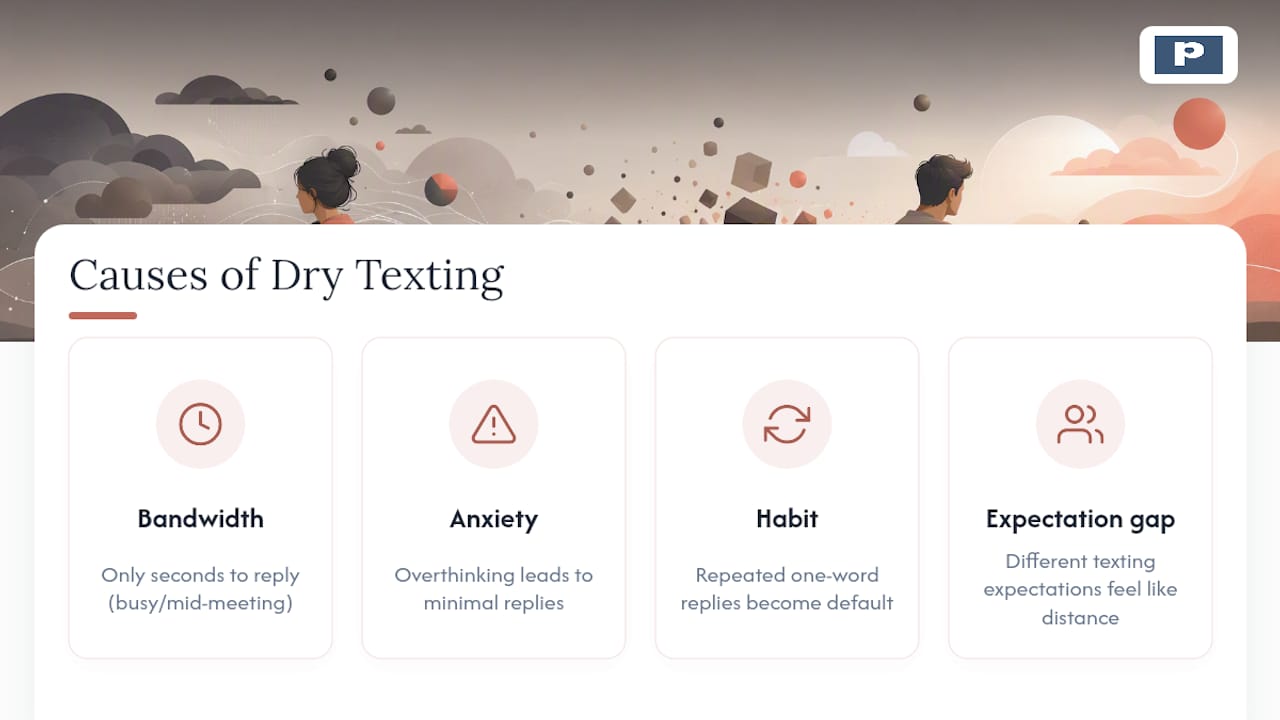
Four things usually cause it. Bandwidth is the biggest one. Someone mid-meeting or driving genuinely has ten seconds to type, not two minutes. Anxiety plays a role too. Some people go flat over text because they’re overthinking the “right” response and default to something safe and short. Habit matters more than people admit. If your last fifty replies were one word, the fifty-first will be too unless you interrupt the pattern on purpose. And mismatched expectations cause a lot of perceived dryness that isn’t really dryness at all. One partner assumes texting is for quick logistics. The other assumes it’s for staying emotionally connected all day. Neither is wrong, but the gap feels like distance.
Short messages aren’t automatically a problem. A one-line “on my way, can’t wait to see you” is warm and complete. It has clarity and affection built into six words. What signals disengagement isn’t brevity. It’s the absence of any detail, feeling, or question, repeated over time. Research on long distance and geographically close couples found that texting frequency and responsiveness predicted relationship satisfaction, but the benefit depended heavily on context. A couple who sees each other nightly doesn’t need the same texting rhythm as a couple three time zones apart. Dryness is relative to what your specific relationship needs, not a universal word count.
Core Method: Reply + Add + Ask and the Micro-Rules That Stick
The formula has three moves, and skipping any one of them is usually why a text still reads as dry even when it’s technically not one word.
Reply means actually answering the content of what was sent, not just acknowledging that a message arrived. If your partner texts “the meeting ran long, I’m exhausted,” a reply is “that sounds draining.” A non-reply is “haha ok.” Add means attaching one specific detail, feeling, or observation. This is the step almost everyone skips, and it’s the one that turns a flat message into a real one. Ask means ending with something open ended that invites a next message, rather than a closed question that can be answered in one word.
Here’s the formula against three flat replies:
- Flat: “Lol nice.” Upgraded: “That’s actually hilarious, I would’ve lost it too. What did everyone else do?”
- Flat: “Same tbh.” Upgraded: “Same here, today felt endless. What finally got you through it?”
- Flat: “K sounds good.” Upgraded: “Perfect, I’ll grab the tickets tonight. Window or aisle seat, as always?”
Notice the length stays modest. One to two sentences is the sweet spot. Longer than that and a reply starts to feel like a report instead of a conversation. Shorter and you’re back to dry. The “Add” step is doing the real work in every example above. It’s a small piece of personality or reaction that says “I actually read this and I’m thinking about it,” not “I saw a notification and tapped a response.”
A quiet but useful bit of evidence backs the tone marker piece of this. A 2025 experiment with 260 participants found that messages containing emojis were rated as more responsive than identical text-only messages, and that perceived responsiveness predicted greater closeness and satisfaction. One well-placed emoji or a warm phrase can carry tone that plain text drops. That doesn’t mean every message needs decoration. It means when a message could be misread as flat or curt, a small tone marker often fixes it faster than more words would.
Avoid the trap of turning “Ask” into an interrogation. Three questions in a row feels like a job interview, not a conversation. One genuine open question per exchange is enough. And avoid closed questions disguised as engagement. “Did you like the movie?” gets a yes or no. “What part of the movie stuck with you?” gets a real answer.
This same formula flexes across contexts. With a new match or early dating interest, “Add” often means a light observation with a hint of flirt: “You said you hate mornings, same, but I’d make an exception for good coffee with you.” With a friend, “Add” can be pure enthusiasm or a shared memory. With a long-term partner, “Add” often works best as a specific feeling: “That actually made me miss you a little.” Same three steps, different flavor.
Swipeable Scripts and Message Templates to Stop Dry Texting
Having a formula is one thing. Having it ready to use at 11 p.m. when you’re tired and the reply box is staring at you is another. These scripts are starting points, not scripts to copy word for word. Swap in your own details before you send.
- Logistics that still feel warm: “Running 10 minutes behind, sorry! Save me a seat and I owe you dessert.” It handles the practical update and adds a small personal touch instead of a bare “running late.”
- Early dating or crush territory: “Still thinking about that thing you said about your terrible karaoke voice. Prove it sometime?” This replies to a specific detail from earlier and asks for a next interaction without pressure.
- Long-term partner, daily maintenance: “Saw this and thought of you immediately [link or photo]. How’s your afternoon going?” The reply-add-ask structure works even when there’s nothing urgent to discuss.
- Warm-busy, genuinely swamped: “In back-to-back calls until 6, but I read this three times already. Tell me everything tonight?” This is the line to use instead of going silent or sending a flat “busy.” It sets a clear expectation and signals you still care.
- Voice note suggestion: “This is a five-voice-note kind of story, not a text kind of story. Got two minutes?” Useful when a topic has too much emotional weight or nuance for text and you want to switch channels without making it a big announcement.
- Reconnecting after a dry stretch: “Realized I’ve been giving you one-word replies all week, my bad. How was your actual day, the real version?” Naming the pattern lightly, with humor, often resets things faster than silently trying harder.
The one rule across all six: personalize before you send. A generic template sent word for word reads as generic, no matter how well written it is. Swap in the actual detail your person mentioned, the actual plan you’re making, the actual thing that made you laugh. The structure is a scaffold, not a script to be recited.
Seven-Day Habit Reset and Sustainable Routines
Dry texting is usually a habit, which means it responds to the same thing every habit responds to: small, repeated cues over about a week. Here’s a simple reset.
- Day 1: Reread every message before sending. Just that. Notice how many are one word or emoji-only.
- Day 2: Apply Reply + Add + Ask to every message sent for 24 hours, even quick logistics ones.
- Day 3: Set a five-minute daily “text window,” a specific time you check in properly instead of firing off fragments between tasks all day.
- Day 4: Send one warm-busy line instead of going quiet during a genuinely packed stretch.
- Day 5: Use one voice note instead of typing out something with real emotional nuance.
- Day 6: Notice reciprocity. Are replies getting longer or shorter than yours? That ratio tells you more than any single message.
- Day 7: Send one specific, detailed message of appreciation. Not “thanks for everything,” but something they actually did this week.
Research on habit change backs the structure here. An experiment testing simple “if-then” planning for gratitude found that making a brief, specific plan to express appreciation increased both grateful behaviors and time spent together. The plan doesn’t need to be elaborate. It needs to exist and repeat.
Scheduled reminders can scaffold this without adding mental overhead, as long as the wording stays personal. A pre-written message that gets sent on autopilot works only if it still sounds like you and references something real, not a generic template blasted out on a timer.
Pro Tip: When you write a gratitude or appreciation message, name the specific action, not the general trait. “Thanks for grabbing coffee before I even asked this morning” lands better than “thanks for being so thoughtful.” Specificity is what separates a message that feels sincere from one that reads like a form letter.
Channel and Tone Rules: When to Switch Off Text
Text is built for check-ins, logistics, and small doses of affection. It is a poor tool for high-stakes emotional conversations, and trying to force one through text usually makes things worse, not better.
Here’s the tell: if you’ve rewritten the same message three times, delete the draft and call instead. That editing loop is a signal your brain already knows text isn’t the right container for what you’re trying to say. A voice note splits the difference nicely when a call feels like too much but the topic still needs tone and nuance a text can’t carry. Try something low pressure like, “Can I send you a voice note instead of typing this out? It’s easier to explain out loud.”
Context changes the math here too. Long-distance couples often rely on texting for a bigger share of daily connection, and the research on this group found that frequent, responsive texting predicted higher relationship satisfaction, though the effect size depended on the couple’s specific situation. Couples who see each other most days don’t need that same texting volume, and trying to hit it can start to feel performative rather than genuine. Match the channel and frequency to your actual relationship, not to some standard you’ve absorbed from watching everyone else’s texting habits.
Troubleshooting: When Dryness Is a Red Flag
Try one or two sincere upgrades first. Apply Reply + Add + Ask, wait for a genuine reply, and see what happens. If the other person meets you with warmth and detail, you’ve solved it. If two upgraded attempts still get one-word answers back, stop escalating and start asking.
A direct, low-pressure check-in works better than a third attempt at a better message. Something like: “I’ve noticed our texting has felt a little flat lately, is that just a busy stretch or is texting not really your thing?” This isn’t confrontational. It’s a genuine question, and asking directly about texting preferences beats guessing at what silence means almost every time.
The answer you get tells you a lot. “Sorry, work has been brutal” points to temporary bandwidth issues, not disinterest. A vague deflection or continued one-word replies after you’ve named the pattern directly points somewhere else. Dryness caused by busyness resolves once things calm down. Dryness caused by low interest tends to persist no matter how many times you upgrade your side of the conversation.
If you’ve had the direct conversation and nothing changes, that’s information worth taking seriously. You’re allowed to protect your own energy rather than keep carrying a conversation solo.
Publisher Perspective: Evidence-Backed Tips and How Pingher Supports Them
The core claims in this guide rest on a small but consistent body of evidence. Perceived responsiveness, boosted by something as small as an emoji, tracks with closeness and satisfaction in the 2025 PLOS One study. Planned, specific gratitude habits increase relationship maintenance behavior in experimental work published in Nature. None of this is guesswork dressed up as advice.
Small, specific, well-timed messages matter more than long, occasional ones. Messaging, scheduling, and reminder features can support exactly the seven-day reset outlined above, without asking you to become a different kind of texter overnight. If you want to go deeper on any single piece of this, Pingher’s blog covers how messaging frequency affects intimacy, how to send affection between meetings, and how to send thoughtful messages on autopilot without losing sincerity.
What the Research Actually Supports, and What Doesn’t
The conventional advice on texting better usually amounts to “be more interesting” or “put in more effort,” which is vague enough to be useless. It doesn’t tell you what to actually type at 9 p.m. when you’re tired. The evidence points somewhere much narrower and more useful: the fix isn’t effort, it’s structure. Reply, add a detail, ask a question. That’s the whole mechanism, and it works because it removes the blank-page problem that causes dry replies in the first place.
Where I think most texting advice overcorrects is length. A lot of guides push people toward longer messages, assuming more words equal more effort equals more care. The research on emojis and responsiveness suggests otherwise. A short message with one specific, warm detail beats a long message padded with filler. Precision matters more than volume.
If you take one thing from this guide, take the seven-day reset over the scripts. Scripts fix a single message. A short, repeated habit fixes the pattern underneath it, which is the actual problem worth solving.
— Alan
Try Pingher to Build the Habit, Not Fix Everything
The seven-day reset works, but remembering to send a specific, warm check-in on day four of a busy week is its own kind of effort. Pingher is built for exactly that gap. It’s a one-tap messaging app that helps you write, schedule, and send personalized messages to your partner, with AI suggestions and reminders that keep the habit going without adding mental load to your day.
It is designed for people in long-term relationships who want to stay consistently thoughtful without treating it like a chore. Pingher won’t write your relationship for you, and it isn’t meant to replace real conversations or the channel-switching this guide covers. Try scheduling one week of small check-ins built around the Reply + Add + Ask formula and see what changes. Get started at Pingher and build the habit rather than white-knuckling it message by message.
Sources
- Why Therapists Are Begging People To Stop ‘Dry Texting’ — Parade
- Six tips for reading emotions in text messages — Greater Good
- Emoji use increases perceived responsiveness and relationship outcomes — PLOS One (2025)
- Texting, responsiveness, and relationship satisfaction in long-distance vs. geographically close couples (2021)
- If–then planning to express gratitude increases relationship maintenance behaviors — Nature (2022)
FAQ
Is a Dry Texter a Red Flag?
Not automatically. Someone who texts flat because they’re genuinely busy or texting-averse isn’t necessarily disinterested, but a pattern of dryness that persists even after a direct, honest conversation about it is worth taking seriously.
How Do You Fix a Dry Texter?
You can’t fix another person’s texting habits directly, but you can model the change by upgrading your own messages with Reply + Add + Ask, which often shifts the tone of the whole exchange. If that doesn’t help after a couple of tries, a calm, direct question about their texting preferences works better than continuing to guess.
Is Dry Texting Disrespectful?
It depends on intent and context. A single flat reply during a busy day isn’t disrespect, but consistently one-word replies with no acknowledgment or follow-up, especially after being asked to elaborate, can read as a lack of effort even when that’s not the intention.
Can You Tell if Someone Is Dry Texting on Purpose?
Look at the pattern rather than any single message. Someone who’s dry across the board, including with friends and in other parts of life, is probably just a low-effort texter by nature, while someone who’s warm elsewhere but flat only with you is signaling something worth asking about directly.
Recommended
Built for couples who care.
Pingher helps you send the right words at the right moment.
Get Pingher on Google Play