Small Everyday Gifts That Work: 2 Week Plan for Busy Men

Small Everyday Gifts That Work: 2 Week Plan for Busy Men
Small everyday gifts aren’t things you wrap. They’re micro-gestures, quick messages, and tiny shared moments that tell your partner she’s noticed and valued, right now, today. The payoff is real: The Gottman Institute points to “small things often” as a core habit of lasting couples, and a good message template inside an app like Pingher can make the habit almost automatic.
TL;DR:
- Small gestures should be specific, such as a heartfelt comment or a brief favor, and integrated into existing routines to foster consistency.
- Responses to bids for connection like small messages and eye contact significantly strengthen relationship quality when done frequently and sincerely.
- Avoid relying on one grand gesture to make up for long periods of silence; daily, modest acts are more impactful for long-term bonds.
- Utilizing apps like Pingher can help automate and remind you of small gestures, making them easier to practice regularly.
- Focus on frequency and authenticity of micro-gestures over size or complexity to build lasting emotional safety.
Table of Contents
- What Do “Small Everyday Gifts” Actually Look Like?
- How Do You Make a Small Gesture Actually Land?
- How Do You Turn Micro-Gestures Into a Habit, Not a Chore?
- What Should You Actually Text Her Today?
- Why Steady Micro-Gestures Beat Grand Gestures Long-Term
- How Pingher Makes Daily Gestures Effortless
- Research and Expert Resources Used in This Guide
- Sources
- FAQ
What Do “Small Everyday Gifts” Actually Look Like?
Forget gift wrap. These are one-line texts, two-minute rituals, and small favors you can pull off between meetings. Below is a working list, sorted by when your day naturally makes room for them.
Morning
- Send a wake-up text naming one specific thing: “Hope your 9am with Marcus goes smoothly, you’ve got this.”
- Build a six-second kiss into your goodbye routine. Gottman-trained therapists point to this exact ritual as a low-cost way to build emotional safety between partners.
- Have her coffee or tea ready before she asks. No message needed. It just shows up.
Midday
- Text something that names her effort, not just her existence: “Saw you prepped for that presentation all weekend. It’s going to land.”
- Drop off her favorite snack or coffee order without a reason attached.
- Send a 15-second voice note instead of a text. Voice carries tone that words on a screen lose.
Evening
- Give her two unplugged minutes when you walk in. Phone down, eyes up.
- Say one specific thing you appreciated about her day, out loud, before dinner gets in the way.
- Build a shared playlist you both add songs to. It becomes a running conversation neither of you has to schedule.
In person, in passing
- A hand squeeze while walking past her in the kitchen.
- Twenty seconds of full eye contact during a conversation, no phone in your peripheral vision.
- Handle the small favor she’d normally have to ask for.
Tiny shared experiences
- A 10-minute walk after dinner, no destination required.
- Fifteen minutes of a board game instead of two separate screens.
- Sitting down for coffee together instead of drinking it separately while scrolling.
Service gestures
- Pay a bill she usually handles, without being asked.
- Prep the laundry she was dreading.
- Take one task off her list and say nothing about it. Let her find out.
How Do You Make a Small Gesture Actually Land?
Volume isn’t the goal. Landing the gesture is. Gottman’s research keeps circling back to two mechanics: turning toward your partner’s “bids” for connection, and keeping roughly a 5:1 ratio of positive to negative interactions in the relationship. A bid is any small attempt she makes to connect, a comment, a sigh, a “look at this.” Turning toward it, instead of past it, is where most of the relationship-building actually happens.
The research: Couples who respond to daily thoughtful gestures with genuine gratitude report measurable gains in relationship quality over time, according to gratitude research from Algoe, Gable, and Maisel. The researchers describe these moments as “booster shots” for the relationship.
Specificity is the multiplier. “You’re great” evaporates the moment it’s said. “I admired how you handled that call with your mom” sticks, because it proves you were paying attention, not just performing affection. Practitioner insight from Gottman confirms that specific acknowledgment consistently outperforms generic compliments.
Surprise matters too. Psychology Today’s coverage of microgesture research notes that unexpected small gestures carry more emotional weight than predictable ones, simply because the brain registers the unexpected more intensely.
A few rules to keep you out of trouble:
- Don’t use gestures as currency. A coffee run isn’t a favor to be repaid.
- Don’t let vague praise stand in for specific praise. It costs the same effort to be precise.
- Don’t wait for a “big enough” moment. Small and frequent beats rare and impressive.
How Do You Turn Micro-Gestures Into a Habit, Not a Chore?
The trick is anchoring, not willpower. Tie each gesture to something you already do. If you make coffee, you send the one-line appreciation text. If you’re locking the front door, that’s your cue for the six-second kiss. This is basic implementation-intention thinking: pair the new behavior to an existing routine so it stops requiring a decision.
Try this two-week starter plan:
- Pick three gestures from the list above. No more than three.
- Attach each one to a real anchor in your day: coffee, commute, bedtime.
- Set reminders through your calendar or an app like Pingher so the first two weeks don’t rely on memory alone.
- Every Sunday, spend two minutes reviewing what landed and what fell flat.
Watch out for “binge-connection,” where one grand weekend gesture tries to make up for two silent weeks. Gottman’s research is direct on this point: occasional big moves don’t substitute for daily engagement. Consistency is what her nervous system actually registers over time.
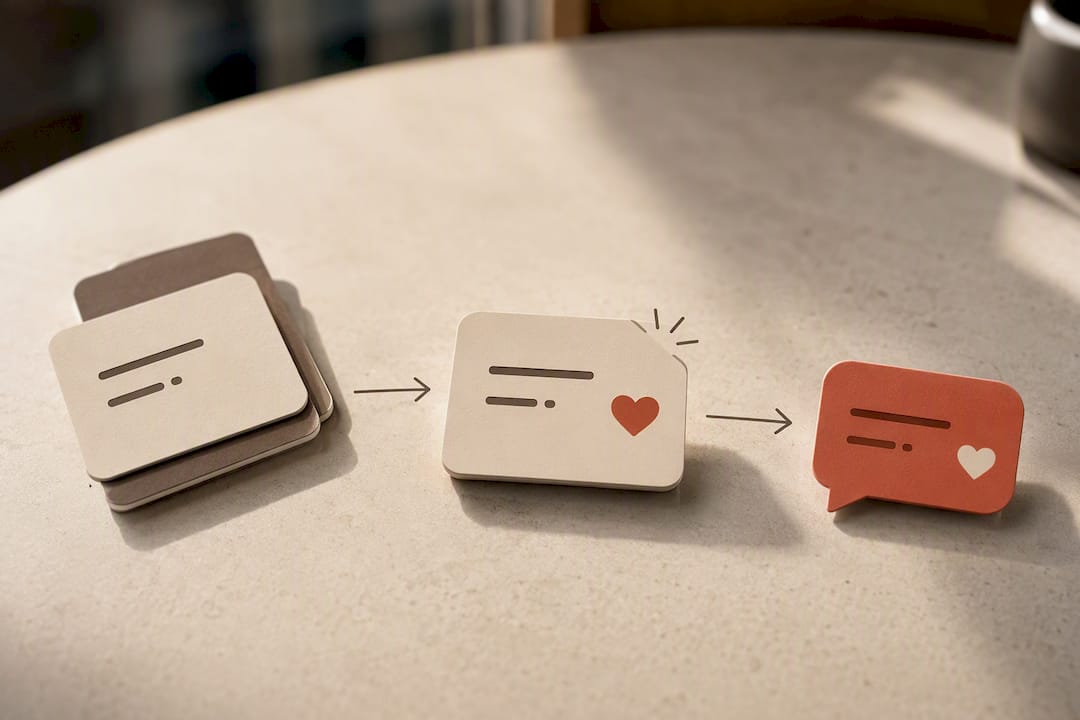
Pro Tip: Keep two or three default phrases ready that you can personalize in ten seconds. A template beats a blank text box every single time you’re rushed.
What Should You Actually Text Her Today?
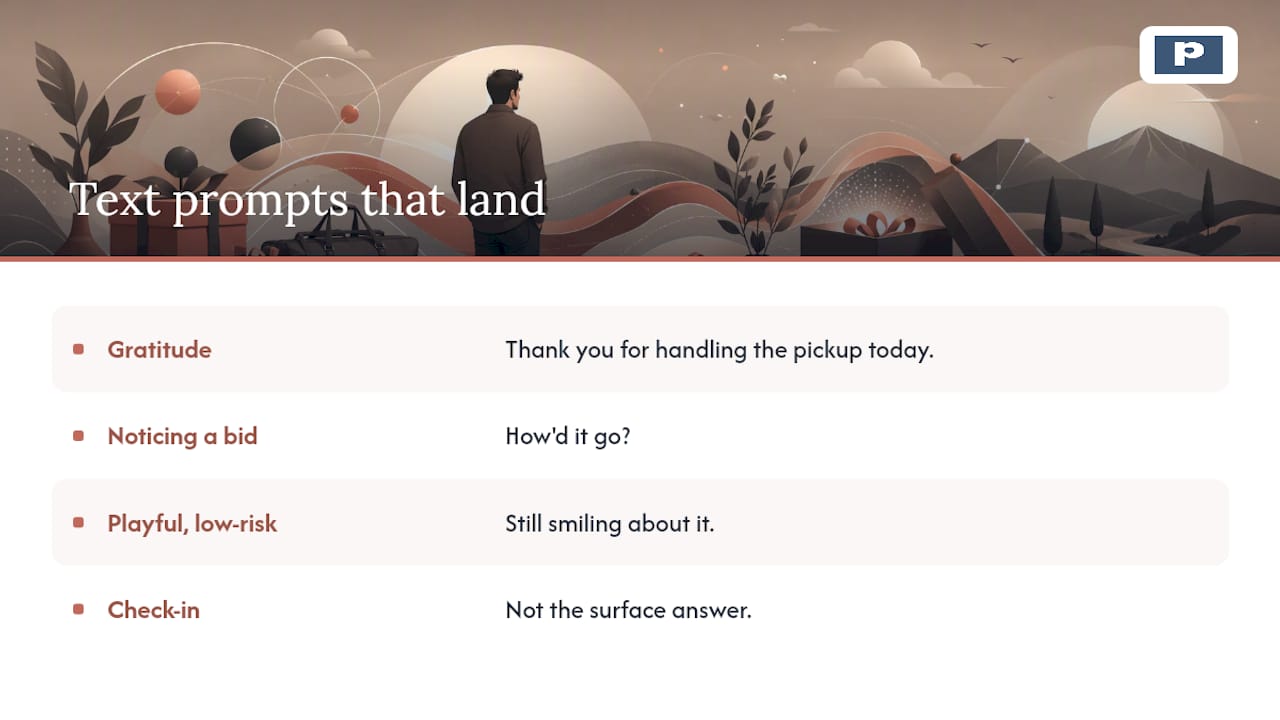
Use these as starting points, then swap in her name, her situation, her specific effort.
Gratitude: “Thank you for handling the pickup today. I noticed, and I don’t say it enough.”
Noticing a bid: “You mentioned that meeting was stressing you out. How’d it go? I’ve been thinking about it.”
Playful, low-risk: “Just remembered that thing you said this morning. Still smiling about it.”
Check-in: “No agenda, just wondering how you’re actually doing today. Not the surface answer.”
Each one names something specific. That’s the difference between a message that lands and one that gets a quick thumbs-up reaction and nothing more.
Why Steady Micro-Gestures Beat Grand Gestures Long-Term
Presence beats performance, almost every time. Couples chasing the next big trip or expensive dinner often miss what’s sitting right in front of them: a partner who mostly just wants to feel noticed on an ordinary Tuesday. The couples who seem to weather hard years well tend to be the ones with small, boring rituals nobody outside the relationship ever sees.
None of this replaces the bigger moments or the repair work that follows a real conflict. Small gestures are necessary, not sufficient. But they’re the floor everything else stands on.
— Alan
How Pingher Makes Daily Gestures Effortless
Pingher exists for exactly this problem: the gap between wanting to show up daily and actually remembering to do it. Instead of staring at a blank text box at 11pm, you get curated message templates, one-tap sending, and habit reminders that nudge you before the moment passes, not after.
The app is built for users who want the effortless-gesture habit without turning it into another task on a to-do list. It features a calm, ad-free, and privacy-first design, avoiding gamified guilt trips and shaming streaks. Beyond messages, Pingher also curates weekend getaways, takes the guesswork out of dinner plans, and surfaces gifts she’ll actually want when an occasion calls for more than a text.
If you’ve read this far and thought “I’ll remember to do this,” you probably won’t, not for two straight weeks. Set one reminder tonight. Download Pingher and pick your first three anchors before you close this tab.
Research and Expert Resources Used in This Guide
- The Gottman Institute: small gestures and turning toward bids
- Algoe, Gable, Maisel: everyday gratitude research
- Psychology Today: the microgesture effect
- Meaningful gifts for long distance couples — GeoKeeps Journal
Sources
- 5 Ways to Make Small Gestures Count in Your Marriage — The Gottman Institute
- It’s the little things: Everyday gratitude as a booster shot for romantic relationships — Algoe, Gable, Maisel (Greater Good)
- The powerful microgesture that strengthens partnerships — Psychology Today
FAQ
What counts as a small everyday gift?
A small everyday gift is a micro-gesture, a specific text, a brief unplugged check-in, a small favor handled without being asked, rather than a physical present. The goal is consistency and specificity, not cost or size.
How often should I do these gestures?
Daily is the target, even if it’s just one gesture a day. Gottman’s research suggests roughly five positive interactions for every negative one keeps a relationship stable over time.
What’s the biggest mistake men make with small gestures?
Relying on one grand gesture to cover for weeks of silence, often called “binge-connection.” Small, frequent, and specific beats rare and impressive almost every time.
Does Pingher cost anything?
Pingher offers a free tier alongside its Pingher+ subscription; current pricing details are available on the Pingher website.
Can a text message really replace a physical gift?
For daily connection, yes, a specific and well-timed message often does more relational work than an object. Gratitude research shows ordinary thoughtful actions, acknowledged consistently, predict real gains in relationship quality.
Recommended
Built for couples who care.
Pingher helps you send the right words at the right moment.
Get Pingher on Google Play