Active Listening in Love: How to Deepen Intimacy

Active Listening in Love: How to Deepen Intimacy
Active listening is the single most underused skill in romantic relationships. When you genuinely hear your partner, not just wait for your turn to speak, you create emotional safety, reduce misunderstandings, and open the door to real closeness. According to HelpGuide, active listening increases emotional safety and supports problem-solving when used with intention.
- Listening with full attention builds trust faster than grand gestures
- Reflecting back what your partner says defuses conflict before it escalates
- Responding with empathy, rather than advice, deepens emotional intimacy over time
The sections below give you the behaviors, exercises, and scripts to make this a repeatable skill, not a one-time effort.
Key Takeaways
Active listening is the most direct path to emotional intimacy in a romantic relationship, and it’s built from five repeatable behaviors, not personality traits.
| Point | Details |
|---|---|
| Listening vs. hearing | Active listening requires attention, reflection, and empathic response, not just registering words. |
| Five core behaviors | Focused attention, open body language, curious questions, reflective paraphrase, and empathy without fixing. |
| Research-backed outcomes | Active-constructive responses to a partner’s good news are strongly linked to relationship satisfaction. |
| Kama Muta effect | High-quality listening can move both partners emotionally, increasing closeness for the listener too. |
| Pingher for habit support | Use Pingher’s reminders and one-tap messages to maintain daily listening and appreciation habits. |
Table of Contents
- What is active listening in a romantic relationship?
- The five core active-listening behaviors in love
- How active listening strengthens intimacy, trust, and conflict outcomes
- Exercises and scripts couples can use today
- Common listening mistakes and how to avoid them
- What the research on Kama Muta reveals about listening
- What I’ve learned from actually trying this
- Pingher helps you keep the listening habit going
- Sources
What is active listening in a romantic relationship?
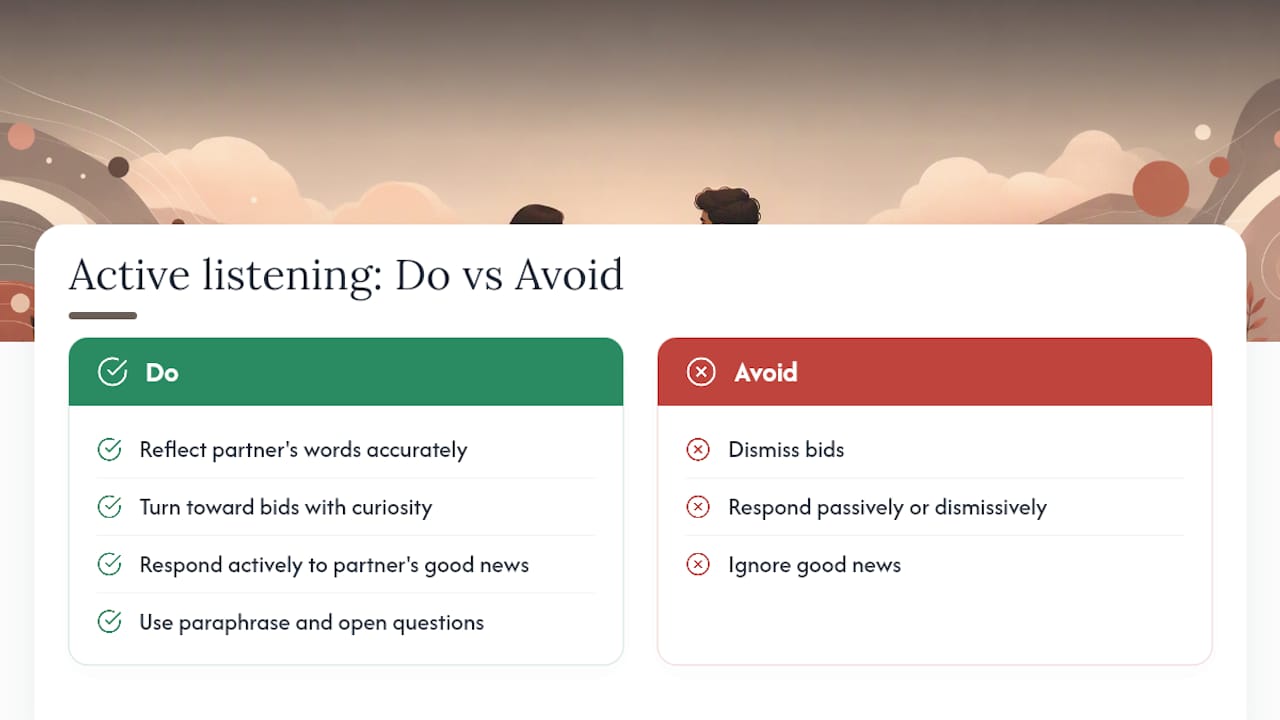
Hearing is passive. Your ears register the words, but your mind is elsewhere. Active listening is the opposite: you give your full attention, reflect what you heard, and respond in a way that makes your partner feel understood. In a romantic context, that means resisting the urge to fix, defend, or redirect, and staying with your partner’s experience long enough for them to feel it landed.
The difference shows up fast in real conversation:
Fixing response: “You’re stressed about work? Just set better boundaries.” Listening response: “It sounds like you’re carrying a lot right now. What’s weighing on you most?”
The second response doesn’t solve anything. That’s the point. Feeling genuinely heard reduces defensiveness and lowers the body’s threat response, which is what makes a real conversation possible in the first place.
Nonverbal signals matter just as much as words. Clinical communication research confirms that eye contact, body posture, and deliberate silence shape how empathic a listener is perceived to be, often more than what they actually say.
When to use active listening:
| Situation | What it looks like |
|---|---|
| Daily check-in | Ask one open question; reflect the answer before responding |
| Conflict cooling | Pause advice; paraphrase your partner’s position first |
| Sharing good news | Respond with curiosity and enthusiasm, not a quick pivot to your own news |
| Grief or venting | Stay present; resist the urge to offer solutions |
The five core active-listening behaviors in love
These five behaviors form the practical backbone of how to listen actively with a partner. Each one is learnable, and each one has an immediate effect on how safe your partner feels talking to you.
-
Focused attention. Put the phone face-down. Turn toward your partner. Even a 5-minute conversation with zero distractions signals that they matter. Try saying: “Give me one second to put this down so I can actually hear you.”
-
Open body language. Uncrossed arms, relaxed shoulders, eye contact held without staring. Your body communicates before you say a word. Try saying: nothing, just turn toward them and nod slowly as they speak.
-
Curious follow-up questions. Instead of jumping to conclusions, ask what you don’t know. Studies across thousands of conversations suggest follow-up questions increase how likable and competent a listener is perceived to be. Try asking: “What did that feel like for you?”
-
Reflective paraphrase. Repeat back the core of what you heard in your own words. This isn’t mimicking; it’s confirmation. Try saying: “So what I’m hearing is that you felt left out when I didn’t mention it to you. Is that right?”
-
Empathic response without fixing. Acknowledge the emotion before you reach for a solution. Try saying: “That sounds really hard. I can see why you’d feel that way.”
Pro Tip: During a heated moment, sequence these behaviors in order: attention first, then body language, then one question, then paraphrase. Clinicians recommend this sequence because it slows the conversation down before either person says something they’ll regret.
How active listening strengthens intimacy, trust, and conflict outcomes
The mechanism isn’t mysterious. When your partner speaks and you reflect their words back accurately, their nervous system registers: I’m safe here. That reduction in perceived threat is what Psychology Today describes as the foundation of emotional connection, not grand romantic gestures, but the daily experience of being understood.
Gottman Institute guidance shows that small interaction patterns, specifically how couples respond to each other’s bids for connection, predict long-term relationship health more reliably than how couples handle major crises. Turning toward a bid (“I had the worst day”) with curiosity rather than dismissal deposits into what Gottman calls the emotional bank account.
The research on capitalization, how partners respond to good news, is equally striking. A study of 139 young adults found that active-constructive responses to a partner’s positive news were most strongly associated with relationship satisfaction. Passive or dismissive responses predicted poorer outcomes, even when the news itself was minor. The study’s sample was drawn from Malaysian dating adults, so cultural context applies, but the directional finding aligns with broader practitioner consensus.
Utah State University Extension research links paraphrase and open questions specifically to trust-building, noting that partners who feel consistently heard are more willing to be vulnerable, which compounds over time into deeper intimacy.
Exercises and scripts couples can use today
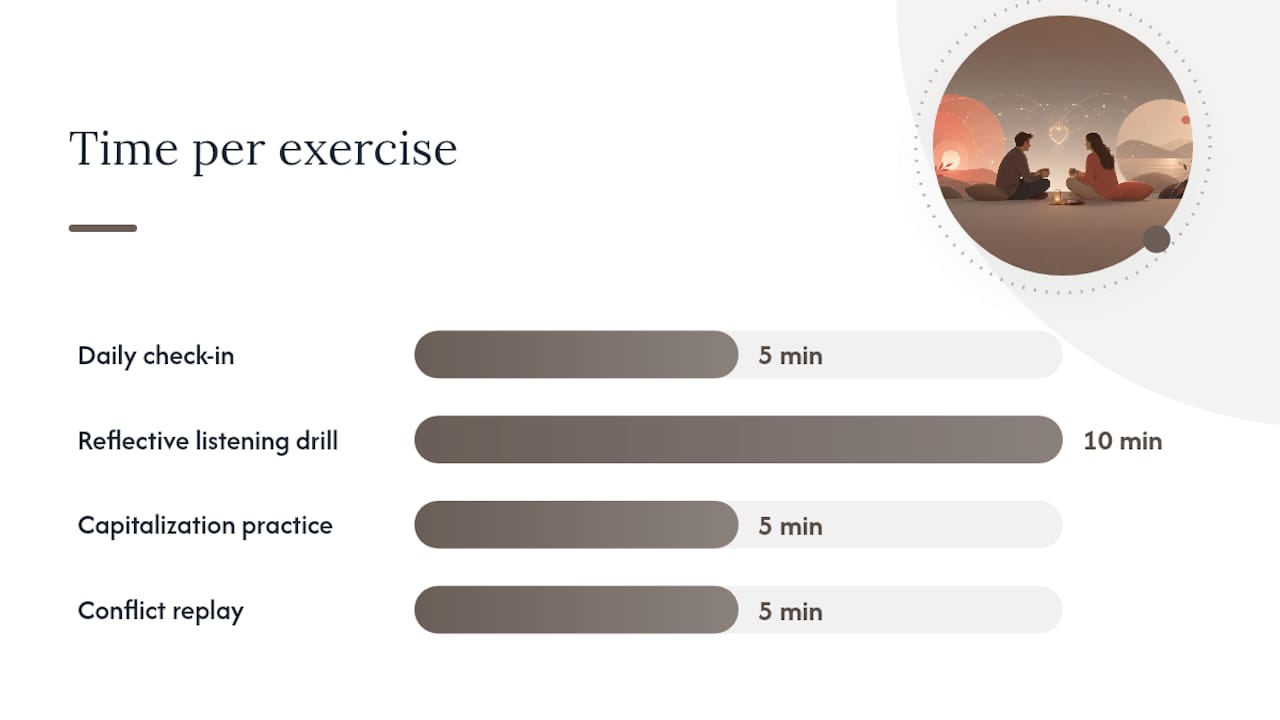
These four exercises are time-boxed, repeatable, and require no special setting. Pick one to try this week.
| Exercise | Time | Format |
|---|---|---|
| Daily check-in | 5 minutes | One question, one reflection, swap roles |
| Reflective listening drill | 10 minutes | Speaker talks 3 min; listener reflects; swap |
| Capitalization practice | 5 minutes | Share good news; partner responds with curiosity |
| Conflict replay | 5 minutes | Revisit a past disagreement using only paraphrase |
1. The 5-minute daily check-in
One partner asks: “What’s one thing on your mind today?” The listener reflects back what they heard before sharing anything of their own. Swap roles. Keep it to five minutes so it stays sustainable.
2. The 10-minute reflective listening drill
Speaker talks for three minutes on any topic, no interruptions. Listener then paraphrases: “What I heard you say is…” Speaker confirms or corrects. Swap. This drill builds the paraphrase muscle faster than any other exercise.
3. Capitalization practice
When your partner shares good news, resist the urge to pivot to your own story. Instead: “Tell me more about that. How did it feel?” This is the active-constructive response the research above links to satisfaction.
4. The conflict replay
Choose a past argument that ended badly. Replay it with one rule: before either person responds, they must paraphrase what the other just said. It feels slow at first. That’s the point.
Pro Tip: Log each session with a quick note: date, exercise, one thing you noticed. Even a phone note works. Tracking creates accountability and shows you the pattern of improvement over weeks.
For couples navigating different cultural backgrounds or language styles, a multilingual relationship communication checklist can help adapt these exercises to fit how each partner naturally expresses and receives connection.
Common listening mistakes and how to avoid them
Most listening failures aren’t malicious. They’re habits.
- Interrupting: You finish their sentence because you think you know where it’s going. You’re probably wrong, and even when you’re right, the interruption signals that your version matters more than theirs.
- Multitasking: Half-listening while scrolling isn’t listening. Your partner can tell.
- Premature advice: Jumping to solutions before the person feels heard closes the conversation down. Wait until they ask.
- Rehearsing your rebuttal: If you’re composing your response while they’re still talking, you’ve stopped listening. The Cleveland Clinic recommends brief self-checks, a slow breath, naming the feeling internally, to interrupt this pattern before it takes over.
- Empathy fatigue: Sustained emotional attunement without boundaries drains you. If you’re running on empty, you can’t listen well. Short daily check-ins are more sustainable than marathon emotional processing sessions.
Workarounds that actually help:
- Use “I need a minute” instead of shutting down. It’s honest and buys you the regulation time you need.
- If a conversation is escalating, say: “I want to hear this. Can we take five minutes and come back?”
- When empathy fatigue is real, name it: “I care about what you’re going through. I’m also a little depleted right now. Can we set a time tomorrow?”
If one or both partners feel consistently unheard despite genuine effort, a licensed couples therapist can provide structured support that goes beyond what self-guided practice can reach.
Pro Tip: Emotional regulation before a hard conversation is not optional. Clinicians recommend a 6-step self-check: pause, breathe, name the emotion, decide if you’re regulated enough to listen, then engage. Skipping this step is where most listening breakdowns start.
What the research on Kama Muta reveals about listening
Most people think of listening as a courtesy. The research suggests it’s something closer to a biological trigger.
Psychology Today reports that high-quality listening can produce Kama Muta, a Sanskrit-derived term for the feeling of being moved or touched by love, and that this response increases communal closeness for both the speaker and the listener. The evidence comes from multiple small studies and lab work, so it’s directional rather than definitive, but the implication is significant: when you listen well, you don’t just help your partner feel good. You feel it too.
The practical implication is straightforward. Prioritize reflective listening when your partner shares something that matters to them, whether it’s good news, a fear, or a small daily frustration. The emotional return isn’t one-sided.
For couples from different cultural backgrounds, adapting how you express active listening matters. Cross-cultural relationship communication guidance notes that capitalization and accommodation behaviors can look different across cultures, and that awareness of those differences prevents misreading a partner’s response style as indifference.
What I’ve learned from actually trying this
The hardest part of active listening isn’t the technique. It’s the pause before you respond. That two-second gap where you could jump in with a solution or a story of your own, and you choose not to. That gap is where the skill lives.
A two-week trial is enough to notice a shift. Pick one exercise from the list above, the daily check-in is the lowest barrier, and commit to it every evening for 14 days. Tell your partner what you’re trying. That transparency alone tends to soften how both people show up.
Pair it with a short reminder, a phone alarm, a sticky note, anything that interrupts the default of coming home and immediately talking about logistics. The reminder isn’t the practice. It’s just the thing that gets you to the practice.
Pingher helps you keep the listening habit going
Knowing what to do and remembering to do it are two different problems. Pingher solves the second one.
Pingher is a mobile app built for couples who want to maintain daily emotional connection without it becoming another item on a to-do list. After a listening session, you can use Pingher’s one-tap messaging to send a short follow-up note: “I’ve been thinking about what you shared earlier. I’m glad you told me.” The app’s AI-assisted templates and reminders make it easy to stay consistent, even on days when life gets in the way. You can also use it to schedule a daily check-in prompt so neither of you forgets.
For couples who want to sustain communication habits that last, Pingher’s Pingher+ subscription adds scheduling, personalized templates, and date tracking. Download Pingher and use it as the accountability layer your listening practice needs.
Sources
- Active Listening Tips for Improved Communication — HelpGuide
- Why Feeling Heard Can Make or Break a Relationship — Psychology Today
- Active-constructive responses and relationship satisfaction — PMC
- Active listening — Cleveland Clinic
Recommended
Built for couples who care.
Pingher helps you send the right words at the right moment.
Get Pingher on Google Play